Paris: Late-Game Execution Haunts Gamecocks in Texas Loss
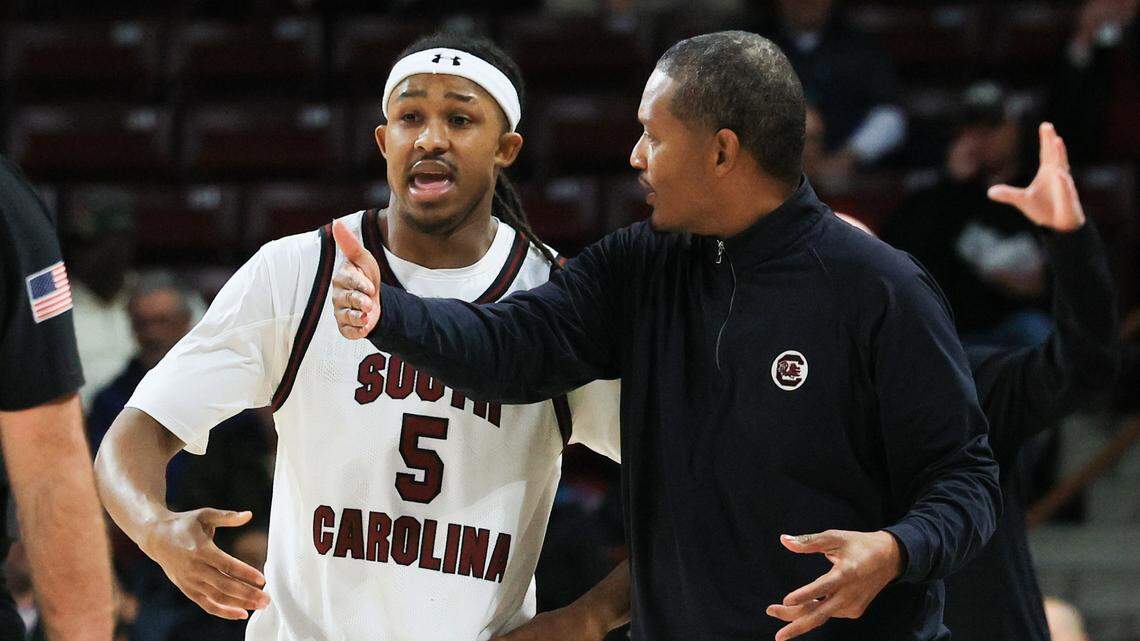
South Carolina men’s basketball coach Lamont Paris didn’t sugarcoat Tuesday night’s 84-75 defeat to Texas—his team did enough to win but failed when it mattered most.
Crunch-Time Struggles Continue
Paris laid out his team’s two-step formula for victory, acknowledging they only completed half of it.
“We did a lot of right things that allowed us to be in a position to win the game,” Paris said. “Those were the two things we wanted. One, our first responsibility was to do enough right things that when it got to game-winning time, you were right there to win the game. Then once those circumstances had worked out that way, then you have to make some game-winning decisions and or plays.”
The second part remains a work in progress. South Carolina is now 1-5 in games decided by five points or fewer this season, and while Tuesday’s final margin exceeded that threshold, it was a one-possession contest with under three minutes remaining.
“The decisions are the ones that are really important in that stretch, and we’re still getting better at those decisions,” Paris admitted. “So those are the times where we really got to dig in and make better decisions and make a couple of plays. But we did some good things. It stings to be in that position and then in the last two and a half, three minutes, not be in a position to win the game.”
How a Two-Point Game Became Six
Paris pinpointed the exact sequence where South Carolina’s chances evaporated.
“We had a couple of decisions that weren’t great. They made a couple of plays. We got beaten one-on-one. I think it was a two-point game if I’m not mistaken, right around three minutes or whatever it was,” he explained. “And then in two back-to-back plays, we give up a one-on-one attack for a shot at the rim. And then we give up a backdoor dunk. And two turns to six quickly, and six at that point, it doesn’t look as appealing to young people as two does.”
Texas capitalized on those defensive breakdowns while making clutch shots down the stretch.
“[Jordan] Pope hits a baseline jumper. Even the very last shot that I think [Tramon] Mark maybe hit to pull up when we were right at the point where it was we could foul and try to start that game or get one more stop and then move it forward from there, and the clock was at 10,” Paris said. “So, we just decided just to play it without fouling, and then he hits one at the buzzer at the shot clock.”
Johnson’s Development, Swain’s Poise
Meechie Johnson’s aggressive attacking produced results, continuing a trend Paris has emphasized.
“Meechie has had a good year. He’s been getting better at his one-on-one attacking. So he’s been doing that a lot more, I’d say, in the last few games, especially getting to the rim and finishing strong. That’s been a point of emphasis for him to try to improve,” Paris said. “The way they were guarding allowed him to get it a little bit of a head of steam… I thought Meechie did a good job of getting his body into defenders. He was patient around the basket, made a couple of really strong finishes. So he’s growing as a player. It’s amazing to say he’s been in college for, I don’t know, double figures years, I think. But he’s still growing as a player.”
Paris, who previously faced Texas guard Dailyn Swain when he played at Xavier, offered perspective on the transfer’s maturation.
“We played him when he was at Xavier, and so I have a different perspective in his growth, really more than anything. And he’s grown so much as a player from the time that we played them before to just the things that he’s doing now,” Paris said. “He played with real poise. He was never rushed. Got into some tough spots and made tough finishes… he had a big bucket where he drove left, pivoted back to the right, and then made an off-balance shot at the end of the game, which was a big play for him and for them.”
Switching Defenses Create Isolation Opportunities
Johnson’s one-on-one success stems partly from SEC defensive trends, Paris explained.
“There’s not a lot of guys that double necessarily, but there are a lot of guys that switch. I mean, honestly, that’s been a big part of why he’s done more one-on-one, because a lot of teams in our league switch pretty much everything. Sean [Miller] doesn’t do that,” Paris noted. “We’ve had a few guys playing a lot more one-on-one just because we’ve played some teams here recently that do a lot of switching. And so then coming off of screens is not quite as effective… it seems like the games all end up in at the end in the final five minutes; it all ends up being ball screens or one-on-one.”
Paint Dominance, Strong Finishes
South Carolina’s 46 paint points represented genuine progress, particularly in how those points were scored.
“I thought we did a good job of getting into the paint. It’s been a point of emphasis for us recently. And more importantly, if you look back to when I answered the question about Meechie, I was really excited about strong finishes because we’ve been getting into the paint some, and then some of the finishes just haven’t been strong,” Paris said. “In this league, you have to make strong finishes, or you don’t—one, you can’t get to the free throw line or anything like that. But I was happy that we got in there and we made some strong moves and some strong finishes.”
The challenge now is combining interior production with perimeter efficiency while—most critically—executing in crunch time. Until South Carolina solves that late-game puzzle, moral victories will continue translating into actual losses.
About The Author