
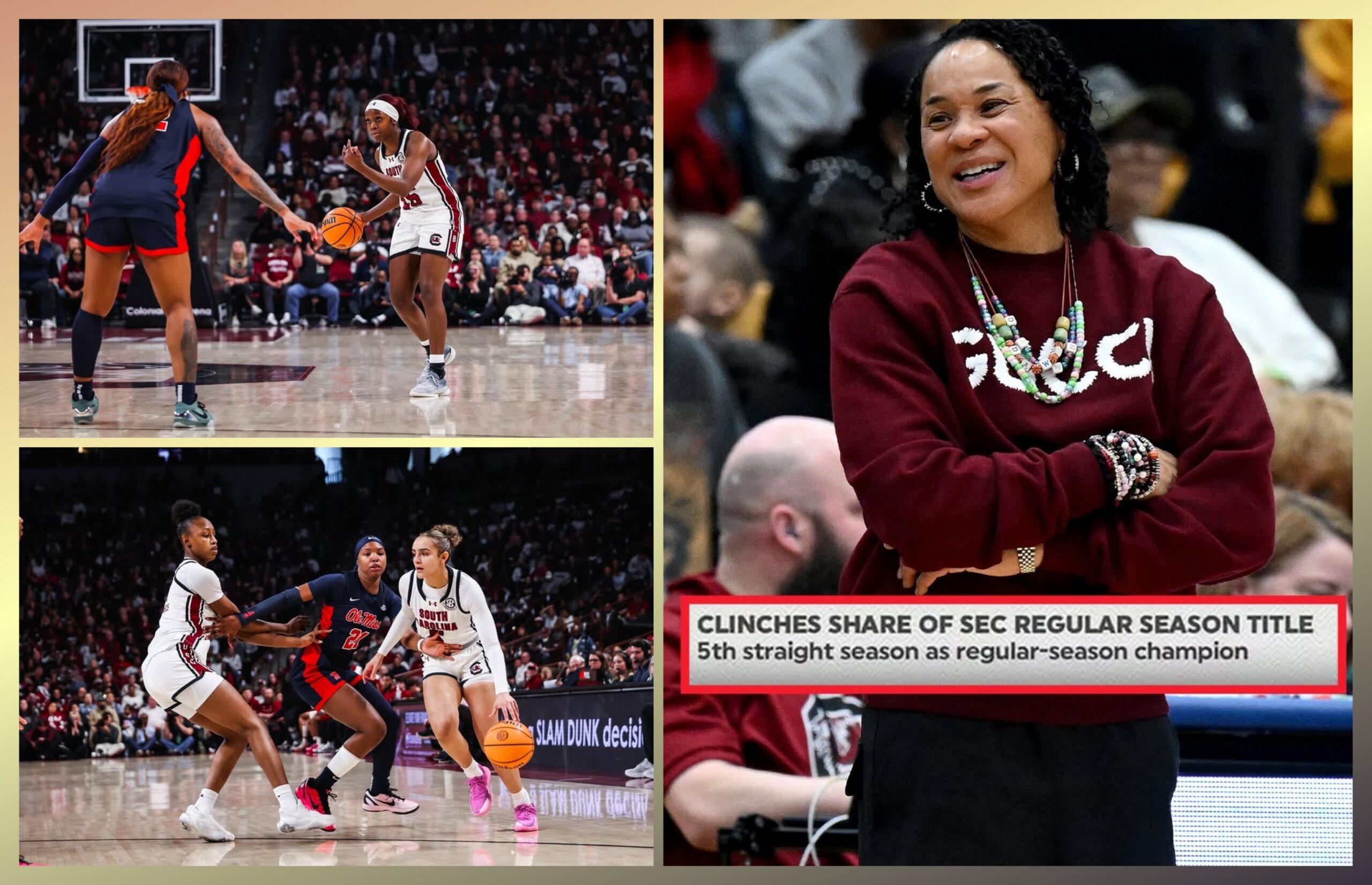
Burning Questions, Peaking Gamecocks, and the Magic of Raven Johnson: South Carolina’s Final Regular Season Stretch Unpacked
As South Carolina enters the final stretch of the regular season, two questions are dominating the conversation around the most dominant program in women’s college basketball — and the answers, when they come, will tell us everything we need to know about how seriously to take this Gamecock team as a national championship contender.
Burning Question No. 1: How Will South Carolina Play at Kentucky With Nothing on the Line?
This is the question that matters most in the immediate term, and it is a more revealing test than it might initially appear.
Barring a seismic upset at Missouri on Thursday, South Carolina will clinch the outright SEC regular-season championship and arrive at Lexington with nothing mathematically at stake. No seeding implications. No title race pressure. No scoreboard watching. Just a road game against a Kentucky team that has been, by most accounts, one of the hottest teams in the entire conference over the last several weeks.
That context is what makes the Kentucky game so analytically fascinating. Elite programs are often defined not by how they play in high-stakes moments — where adrenaline, preparation, and competitive instinct carry the load — but by how they perform when the external motivation has been removed. When the trophy is already locked up and the only thing left to play for is pride, process, and the habits that championship runs are built upon, who shows up?
For South Carolina in particular, this question carries extra weight. Since Teonni Key returned from injury, Kentucky has been playing at a level that demands respect from any opponent. A hostile road environment, a motivated opponent with everything to gain, and a Gamecock team that has already secured what it came for — that is the precise combination of circumstances that separates programs that are performing like champions from programs that have genuinely become champions in their deepest competitive identity.
Dawn Staley has spoken repeatedly about playing to standard, about staying in character, about not taking the foot off the gas simply because the mathematical destination has been reached. The Kentucky game is where that philosophy gets its most meaningful test of the season. If South Carolina goes to Lexington and competes with full intensity, full defensive effort, and the kind of professional focus that has defined its best performances all year, it tells you that the standard is genuinely internal — that it does not need a scoreboard or a title race to keep showing up. If the Gamecocks sleepwalk through it, it tells you something different — something that March Madness opponents will be very interested to know.
The safe expectation is that Staley’s program passes this test. The history of this program under her leadership strongly suggests they will. But the question is worth asking, and the answer will be worth watching.
Burning Question No. 2: Are the Gamecocks Peaking at the Right Time?
This question was raised last week. The evidence that it is being raised again this week — and that the answer still appears to be yes — is itself analytically significant.
Peaking in college basketball is not a destination. It is a trajectory. A team does not simply arrive at peak form and stay there indefinitely. It climbs toward it, sustains it briefly, and either breaks through at the tournament or begins to plateau before the moment of maximum consequence arrives. The fact that South Carolina’s performance level has been trending upward over consecutive weeks — that the question of whether they are peaking keeps yielding the same affirmative answer — suggests a team that is building toward something rather than coasting on what it has already achieved.
The timing, however, introduces urgency that cannot be ignored. As the analysis notes plainly and correctly: in about three weeks, it’s now or never. The SEC Tournament begins imminently, and March Madness follows almost immediately thereafter. There is no more runway for gradual development. Whatever this South Carolina team is going to become in 2026, it is becoming it right now — in these final regular-season games, in these practice sessions, in these film room conversations, and in the competitive habits being reinforced or abandoned in real time.
The Kentucky game, as noted above, will go a long way toward answering this question definitively. A South Carolina team that plays with full intensity against a motivated road opponent — with the title already clinched — is a team that is peaking at exactly the right moment, for exactly the right reasons. That is the team that makes a deep tournament run. That is the team that March fears.
One Favorite Play: The Shirts, the Story, and Raven Johnson’s Vanishing Pass
Before we arrive at the actual favorite play, the honorable mention earns its moment — and it is a genuinely wonderful story about what happens when a program captures the imagination of its fanbase so completely that creativity takes over.
The homemade “Who Can Guard Tessa?” shirts that populated Colonial Life Arena on Sunday represent something that no marketing department can manufacture and no official merchandise can replicate. The phrase, born from Kim Mulkey’s now-viral question, became a rallying cry so organic and so immediate that fans were arriving at the game wearing versions they had made themselves — each one slightly different, each one carrying the fingerprints of the person who created it.
One fan, when asked where she got her shirt, explained that she told her manicurist she wanted a shirt with that phrase — and he called her the next day to say he had made it for her. That story is, in miniature, everything that great sports moments produce: spontaneous creativity, community connection, and the kind of personal investment in a team’s story that turns casual fans into lifelong ones. No mass-produced shirt, regardless of how well-designed, can carry that origin story. The charm is inseparable from the context.
And then there is the actual favorite play: Raven Johnson’s assist to Alicia Tournebize.
The description of this pass is worth reading twice, because it captures something specific about what makes Johnson’s playmaking so genuinely exceptional:
“Johnson threw the pass so far in front of Tournebize that the ball disappeared. It didn’t reappear until Tournebize was finishing the layup. Great pass, long arms, soft hands.”
Read that again. The ball disappeared. It was thrown so perfectly, so precisely calibrated to where Tournebize was going to be rather than where she was, that the human eye tracking the play at normal speed simply lost it — and then it reappeared, already at its destination, already in Tournebize’s hands, already completing the play that Johnson had visualized before anyone else in the building had processed it.
This is what elite passing looks like at its highest expression. It is not the flashy no-look pass that draws gasps from the crowd. It is the pass so perfectly timed and so precisely weighted that it becomes almost invisible — a ball that travels faster than the defensive reaction, lands softer than the moment of contact would suggest, and results in the easiest layup the recipient has taken all game.
Johnson’s length is a physical asset, but the more important element in this play is the anticipatory intelligence — the ability to see where a play is going before it gets there and deliver the ball to a location in space rather than to a person in a specific position. That is not coachable in the traditional sense. It is the product of a basketball mind operating at a genuinely elite level, refined by years of competitive experience and the daily standard of playing alongside and against South Carolina’s best.
Dawn Staley has said repeatedly that Raven Johnson does not get the credit she deserves. Plays like this one — disappearing passes that reappear as layups — are precisely why she keeps saying it. The box score will show an assist. It will not show the geometry, the timing, the vision, or the soft hands that made Tournebize’s finish look effortless. That is the part only the people in the building truly see.
The Bigger Picture: A Program Preparing for Its Moment
Taken together, these burning questions and this favorite play tell a coherent and compelling story about where South Carolina stands as the regular season draws to its close.
The Gamecocks are a team that has already accomplished everything the regular season could ask of them. They are a team whose individual players — from Raven Johnson threading invisible passes to Madina Okot hitting threes that make four-time MVPs rise to their feet — are performing at the highest levels of their careers. And they are a team that, in about three weeks, will have to answer the only question that truly remains: not whether they can win the SEC, not whether they can beat Ole Miss or Kentucky or any single opponent on any single night, but whether they can sustain this level, carry it into a tournament setting, and deliver when the stakes are at their absolute maximum.
Three weeks. It’s now or never.
And from everything this season has shown, the Gamecocks appear to be exactly where they need to be — heading in exactly the right direction, at exactly the right time.
About The Author