Teammates and Fans reacts to the Best Three points Threats in South Carolina —Who is it going to be?
The Revolution Nobody Saw Coming: How South Carolina’s Bigs Are Quietly Changing the Entire Conversation in Women’s Basketball
Sunday’s 85-48 demolition of Ole Miss quietly, emphatically, and permanently complicated that answer that says Tessa Johnson is the three-point threat in South Carolina.
What If It’s Madina Okot?
The question sounds almost absurd when you first encounter it. Okot is a 6-foot-2 senior transfer forward — a post player, a rebounder, an interior presence. She is the kind of player whose value, in the traditional understanding of basketball roles, lives entirely in the paint. Catch and finish. Screen and seal. Defend the rim. Box out. Do the physical work that guards cannot do and that wins or loses games in the margins.
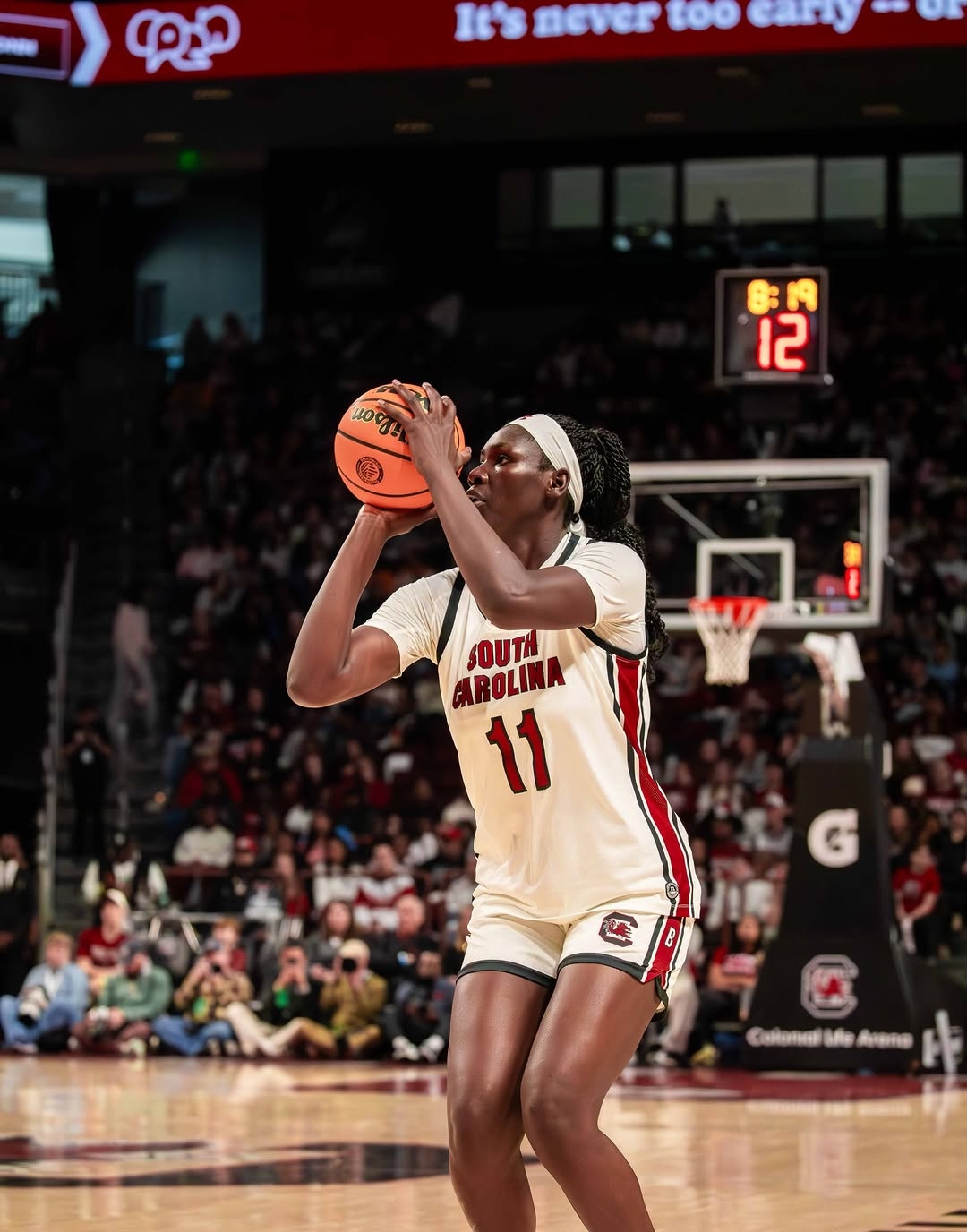
And yet. On Sunday against Ole Miss, Okot went 3-of-3 from three-point range, finishing with 17 points and nine rebounds in just 21 minutes. She has now made seven of her nine three-point attempts in SEC play alone, including each of her last five consecutive attempts. The efficiency of those numbers — 77.8% from three in conference play — is not a hot streak. It is a pattern. And patterns demand explanation.
The explanation, when it comes from the people closest to the situation, is both illuminating and slightly terrifying for the rest of the country.
“She Started Looking Like Steph Curry”
Ole Miss head coach Yolett McPhee-McCuin has seen enough basketball to recognize when something has changed. She coached against Okot at Mississippi State last season. She knows what that player looked like before she arrived in Columbia. And she watched, from the opposing bench, as Okot stepped back and drained three after three with a purity of form that made the Ole Miss defensive game plan fundamentally unsolvable.
“When I saw Madina start making threes, I was like, sht, it’s over for us,”* McPhee-McCuin said. “It’s one thing to have to battle with her around the basket, but she started looking like Steph Curry.”
The Steph Curry comparison is not flattery and it is not hyperbole. It is a tactical assessment delivered by a veteran head coach who is trying to explain, in the most vivid terms available to her, why her defense had no answer. Steph Curry’s revolution in basketball was not simply about shooting ability — it was about the spatial disruption his shooting created. When a player of his size can hit threes at an elite rate, defenses cannot sag into the paint to help. They cannot double-team the post. They cannot load up against the drive. Every defensive adjustment that would be standard against a non-shooting big becomes a catastrophic risk against a big who can punish it from distance.
That is precisely what McPhee-McCuin is describing when she says it was “over.” She is not conceding defeat emotionally. She is acknowledging, in real time, that the defensive mathematics of the game had become unsolvable. You cannot guard Okot in the post with single coverage because she is too physical and too skilled. And you cannot sag off her on the perimeter because she will drain the three. You are, as a defensive coordinator, simply out of answers.
“You Can Stand Up and Sit Back Down Before It Goes In”
The appreciation for Okot’s shooting form is not limited to opposing coaches. Inside the South Carolina locker room, her teammates have developed their own vocabulary for describing what makes her jumper so special.
Ta’Niya Latson specifically noted the arc on Okot’s three-point attempt — calling her jump shot simply “pretty.” But it was the secondhand Raven Johnson quote that captured it most memorably.
“Raven always says when Madina shoots, you can stand up and sit back down before it goes in,” Latson said.
Raven Johnson, the most basketball-intelligent player on this roster by most accounts — the player Dawn Staley says the entire defense starts and ends with — has watched Okot shoot enough to develop a theory of her trajectory. The ball leaves Okot’s hands on such a high arc, with such a consistent release, that it hangs in the air long enough for an observer to complete a full physical action — standing, registering the shot, and sitting back down — before the ball arrives at the rim.
That is not an observation about a player getting lucky with her form. That is a recognition that Okot’s release mechanics have reached a level of consistency and repeatability that generates supreme confidence. High-arc three-point shooters, when their mechanics are sound, are among the most reliable shooters in basketball because the ball is less susceptible to wind, rim interference, and defensive contests. The geometry of a high-arc shot gives it a larger effective target area at the rim. Raven Johnson, in her characteristically matter-of-fact way, has identified this — and her locker room is now operating with the full confidence of players who know what that shot looks like when it goes up.
The Coaching Decision That Started It All
What makes Okot’s three-point evolution particularly compelling is that it did not happen accidentally. It was a deliberate coaching decision, executed gradually and with patience, that transformed a big who wanted to shoot threes into a big who could be trusted to shoot them in the most important games of the season.
Dawn Staley’s honesty about her own early skepticism is revealing. When Okot arrived at South Carolina, Staley saw the shooting ability but categorized it the way most coaches would — as an interesting peripheral skill for an interior player, not as a primary tactical weapon.
“Now she’s popping back off of screening,” Staley said. “Today, we were a little bit more intentional about setting plays up for her to take them.”
The evolution described in that single sentence covers an enormous amount of ground. There is a significant difference between a post player who occasionally drifts to the perimeter and catches an open three, and a post player for whom the coaching staff is deliberately designing plays to create three-point opportunities. The first is opportunistic. The second is tactical. The fact that South Carolina has moved Okot into the second category — running sets specifically to get her looks from the perimeter — tells you everything about how much the coaching staff’s confidence in her shooting has grown over the course of the season.
The deliberate play design also serves a second function that is easy to overlook. When defenses see that South Carolina is actively scheming to get Okot three-point looks, they have to account for it in their preparation. That changes the entire pre-game scouting conversation from “Okot might step out for a three occasionally” to “we have to have a specific defensive answer for Okot on the perimeter or they will run plays to get her open.” That is the difference between a tendency and a threat, and it is a line South Carolina has clearly crossed.
Tournebize: The Other Half of a Historic Frontcourt Shooting Revolution
Okot is not the only reason this story is so significant. Alicia Tournebize, the midseason addition who joined South Carolina when her European club season concluded, is shooting an almost incomprehensible 66% from three-point range in her 11 games with the Gamecocks — leading the entire team in three-point percentage by a significant margin.
Sixty-six percent. From three. For a forward.
To put that number in context: the WNBA’s single-season three-point percentage record is in the low-to-mid 50s. Elite college three-point specialists who shoot 40% from deep are considered exceptional. Tournebize, in 11 games as a Gamecock, is shooting at a rate that would be historically remarkable for a guard, let alone a forward who operates comfortably on the perimeter.
The combination of Okot and Tournebize presents opposing coaches with something that has never really existed at this program in quite this form: two bigs who can stretch the floor simultaneously, with verified, game-tested efficiency. That does not just change individual defensive assignments. It changes the entire structural logic of defending South Carolina. You cannot collapse into the paint against this frontcourt. You cannot double-team without leaving a perimeter threat open. You cannot even make the traditional adjustment of switching guards onto bigs at the three-point line, because the bigs in question can actually make you pay for that decision.
The Daily Work Behind the Dramatic Results
None of this happened overnight, and Staley’s program does not leave development to chance. Every day after practice, Okot, Tournebize, and the other post players run three-point shooting drills — going around the horn with associate head coach Lisa Boyer feeding them shot after shot. The repetition is deliberate, the environment is pressure-free, and the intent is clear: build comfort, build confidence, build muscle memory, until the three-point shot from a forward position becomes as natural as a post move.
Staley’s philosophy on this is precise.
“The post rotation, they’re getting a lot more reps. There’s not one post player sitting out, they’re getting reps every other possession in practice,” Staley said. “They want to do well for each other.”
That last sentence — they want to do well for each other — is the one that deserves the most attention, because it explains why the shooting development has accelerated so effectively. When players are invested in each other’s success rather than competing for individual recognition, the daily shooting drills become collaborative rather than performative. Okot and Tournebize are not shooting after practice because they are told to. They are shooting because they know that every make they hit in practice is another data point that their teammates, their coaches, and ultimately their opponents have to account for. The development is collective. The buy-in is genuine.
What It Means for the Driving Guard: Latson’s Perspective
For a guard like Ta’Niya Latson — a player whose offensive game is built around getting downhill and attacking the rim — having bigs who can step out and shoot threes is not just a tactical convenience. It is a fundamental expansion of what her own game can look like.
Latson articulated this with a clarity and directness that cuts straight to the tactical heart of the matter.
“I mean, I need to get to the rim so they can go out there and go shoot some threes,” she said. “And they just have pretty shots. I mean, we believe in them. They shoot them a lot in practice.”
The interdependence Latson is describing here is the essence of modern basketball spacing. When Okot and Tournebize pull their defenders out to the three-point line, the lane opens up. The help defense that would normally converge on a driving guard is now occupied — or at minimum, conflicted — by the threat of leaving a legitimate three-point shooter unattended. Latson’s drives become easier. Her finishing angles improve. Her decision-making at the rim simplifies. And if she does draw help and kick it out, the player receiving the pass is one of the most efficient three-point shooters on the floor.
That is not an accident. That is basketball architecture — and South Carolina is building it in real time, with bigs who can shoot, a driving guard who creates for them, and a coaching staff that has had the vision to develop the pieces and the boldness to actually run plays designed around the combination.
The National Championship Implications
As March approaches and the bracket conversation intensifies, the emergence of Okot and Tournebize as genuine three-point threats fundamentally changes the calculus of scouting South Carolina. Teams preparing to face the Gamecocks can no longer build their defensive game plan around loading the paint and daring the bigs to shoot. The bigs are shooting. And they are making it.
McPhee-McCuin, watching her team get dismantled on Sunday, provided the clearest possible articulation of what this means for future opponents: when Okot starts making threes, it is over. Not because Okot alone is unbeatable. But because the combination of an interior force who can also shoot threes, alongside a shooting-specialist big in Tournebize, alongside a driving guard in Latson, alongside Tessa Johnson still out there as the best-known three-point threat on the roster — that combination has no clean defensive answer.
And that is the most dangerous kind of basketball team there is.
Source: on3
About The Author