
“The 2026 Bracket Is Set: Who Stands Between Dawn Staley and Another SEC Title?”
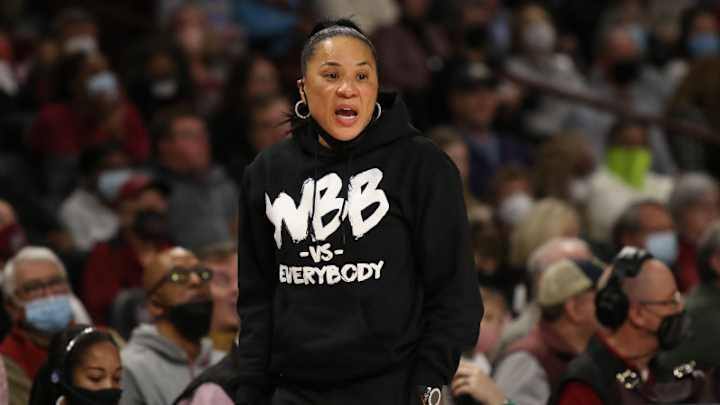
Some programs win conference championships. A select few own them. And then there is Dawn Staley’s South Carolina Gamecocks — a program that has elevated SEC dominance into something that transcends sport and enters the realm of institutional identity.
With their 65-60 survival win over Kentucky on March 1 to close out the regular season, South Carolina officially clinched the 2025-26 SEC regular-season championship — their latest chapter in a reign over women’s college basketball that shows absolutely no signs of ending. The Gamecocks enter the SEC Tournament in Greenville’s Bon Secours Wellness Arena not merely as the No. 1 seed, but as a program chasing layers of history that would cement this era as one of the greatest in the sport’s existence.
The Numbers Behind the Dynasty
Let the record speak first. South Carolina finished the regular season at 15-1 in conference play — a mark of dominance in the deepest women’s basketball conference ever assembled. In a year where Vanderbilt, Texas, and LSU all posted double-digit conference win totals, the Gamecocks still separated themselves from the field by two full games. The one blemish on their conference record is not an indictment — it is a reminder that even the greatest teams play in a league that demands perfection every single night.
At 29-2 overall, South Carolina arrives in Greenville as a battle-tested, championship-caliber team. Two losses in thirty-one games against the most brutally competitive schedule in women’s basketball is not a vulnerability — it is a credential.
For Dawn Staley, this marks her 10th SEC regular-season title — a number so staggering that it demands repetition. Ten. In a conference that has featured elite programs, elite coaches, and elite players throughout her tenure, Staley has won the regular season title in ten of her seasons at the helm. That is not a hot streak. That is a philosophy, a culture, and a standard made permanent.
The Double Bye Advantage — and What It Means Strategically
As the tournament’s No. 1 seed, South Carolina enters with a double bye, missing the first two days of competition entirely. Their earliest possible appearance is noon ET on Friday, March 6 in the quarterfinals — a gift of rest, preparation, and scouting that only a top seed can afford.
This advantage is more significant than it may appear on the surface. The SEC Tournament is a physical and emotional gauntlet that compresses multiple high-intensity games into a narrow window. For a team like South Carolina — one that leans heavily on Madina Okot’s interior dominance and depends on guard-driven execution — the ability to watch potential opponents exhaust themselves across two rounds before stepping on the floor is an enormous strategic benefit.
The Gamecocks will face the winner of a path that runs through No. 16 Arkansas, No. 9 Kentucky, and No. 8 Georgia. South Carolina has already handled all three of these teams decisively this season — beating Kentucky 65-60 on March 1, dismantling Georgia 65-43 on January 11, and routing Arkansas 93-58 on January 8. Familiarity breeds preparation, and no team in Greenville knows its potential quarterfinal opponent better than South Carolina does.
The Full Bracket Picture: A Deep Field With Real Danger
While South Carolina’s path carries the most favorable seeding, the broader tournament bracket presents a genuinely compelling narrative at every tier.
On the bottom half of the bracket, No. 2 Vanderbilt and No. 3 Texas — both 13-3 in conference play — loom as the most credible threats to a Gamecocks-dominated final. Vanderbilt’s rise this season has been one of the SEC’s defining storylines, and Texas’s blend of size and perimeter shooting makes them dangerous in a short-series format. A potential South Carolina-Vanderbilt or South Carolina-Texas final would be the kind of marquee collision that elevates the entire tournament’s national profile.
In the first round, the most compelling opening-day matchup is No. 16 Arkansas against No. 9 Kentucky — a game loaded with stakes for the Wildcats, who need a strong tournament showing to bolster their NCAA seeding case. As Staley herself noted after the regular-season finale, the SEC’s depth this year makes it genuinely difficult to assess how the committee will value conference records, and Kentucky’s tournament performance will go a long way toward making that argument for them.
No. 5 Oklahoma, riding a five-game winning streak and ranked No. 12 nationally in the latest Top 16 reveal, represents one of the most dangerous middle-bracket teams capable of causing an upset. Their second-round matchup against the winner of the Mississippi State-Florida game could produce a result that reshapes the quarterfinal landscape significantly.
Raven Johnson and the Quiet Record Nobody Is Talking About Enough
In the shadow of Staley’s milestone, it is worth pausing to recognize what starting point guard Raven Johnson has achieved. With this regular-season title, Johnson has now won five SEC regular-season championships as a Gamecock — a personal collection of hardware that reflects not just individual talent but a commitment to staying, building, and winning within a program across multiple years.
In an era defined by the transfer portal and the pursuit of immediate impact elsewhere, Johnson’s loyalty to South Carolina and its results — five titles — stands as one of the sport’s quiet but profound stories. She has been present for nearly half of Staley’s ten regular-season championships. That is a legacy that will outlast statistics.
Chasing a Fourth Consecutive Tournament Title — and a 10th Overall
If the regular-season championship is Staley’s statement of dominance, the SEC Tournament title is where her legacy gets punctuated. She enters Greenville with nine tournament championships, seeking her 10th — and more urgently, seeking her fourth in a row.
Three consecutive SEC Tournament titles is itself a remarkable achievement in a conference this competitive. Four straight would move the conversation from “dynasty” to something approaching permanent structural advantage — the idea that South Carolina doesn’t just win the SEC, it owns it in ways that competitors cannot yet dismantle.
The pressure of that pursuit, however, cuts both ways. Greenville is South Carolina’s home turf in a very real sense — the Bon Secours Wellness Arena is close enough to Columbia to function as a de facto home game for the Gamecocks. The crowd will be loud, the expectation will be overwhelming, and every opponent that walks onto that floor against South Carolina will be playing with house money and nothing to lose.
That dynamic — the weight of expectation versus the freedom of the underdog — is the central tension of every tournament the Gamecocks enter. Managing it, channeling it, and ultimately rising above it is the test that March always brings to programs that have made winning routine.
The Road to the Championship
The path to Sunday’s 3 p.m. ET championship game runs through a bracket that respects no seedings once the ball tips. Here is how the tournament could unfold for South Carolina:
Quarterfinals, Friday March 6 (Noon ET): South Carolina vs. the survivor of Arkansas-Kentucky-Georgia. Based on current form, a rematch with Kentucky — who will enter desperate for tournament momentum — is the most likely scenario and one that presents the most familiar challenge given Sunday’s regular-season finish.
Semifinals, Saturday March 7 (4:30 p.m. ET): A potential matchup with LSU, who sits as the No. 4 seed and brings a roster talented enough to compete with anyone. An LSU-South Carolina semifinal would be the most nationally watched game of the weekend and would carry enormous NCAA Tournament seeding implications for both programs.
Championship, Sunday March 8 (3 p.m. ET): The ultimate prize — a 10th tournament title, a fourth consecutive crown, and the program statement that would echo all the way to Phoenix and the Final Four.
The Bigger Picture: A Tournament That Matters Beyond Greenville
For South Carolina, what happens in Greenville is not just about trophies. NCAA Tournament seeding, national narrative, and program momentum are all on the line. A dominant tournament run — especially one where Okot continues her dominant interior play, Johnson orchestrates with composure, and the shooting struggles that plagued the Kentucky regular-season finale are corrected — would send a message to every other No. 1 seed that the Gamecocks are arriving in Fort Worth in full form.
A stumble, however, would fuel a different conversation — one about whether this team’s fourth-quarter fragility is a correctable habit or a deeper structural problem.
Dawn Staley has been here before. Ten times, in fact. And ten times, she has found a way to leave the SEC regular season on top.
Now, in Greenville, she goes hunting for her 10th tournament title too.
The Gamecocks are ready. The bracket is set. And history — as it always seems to be for this program — is well within reach.
About The Author