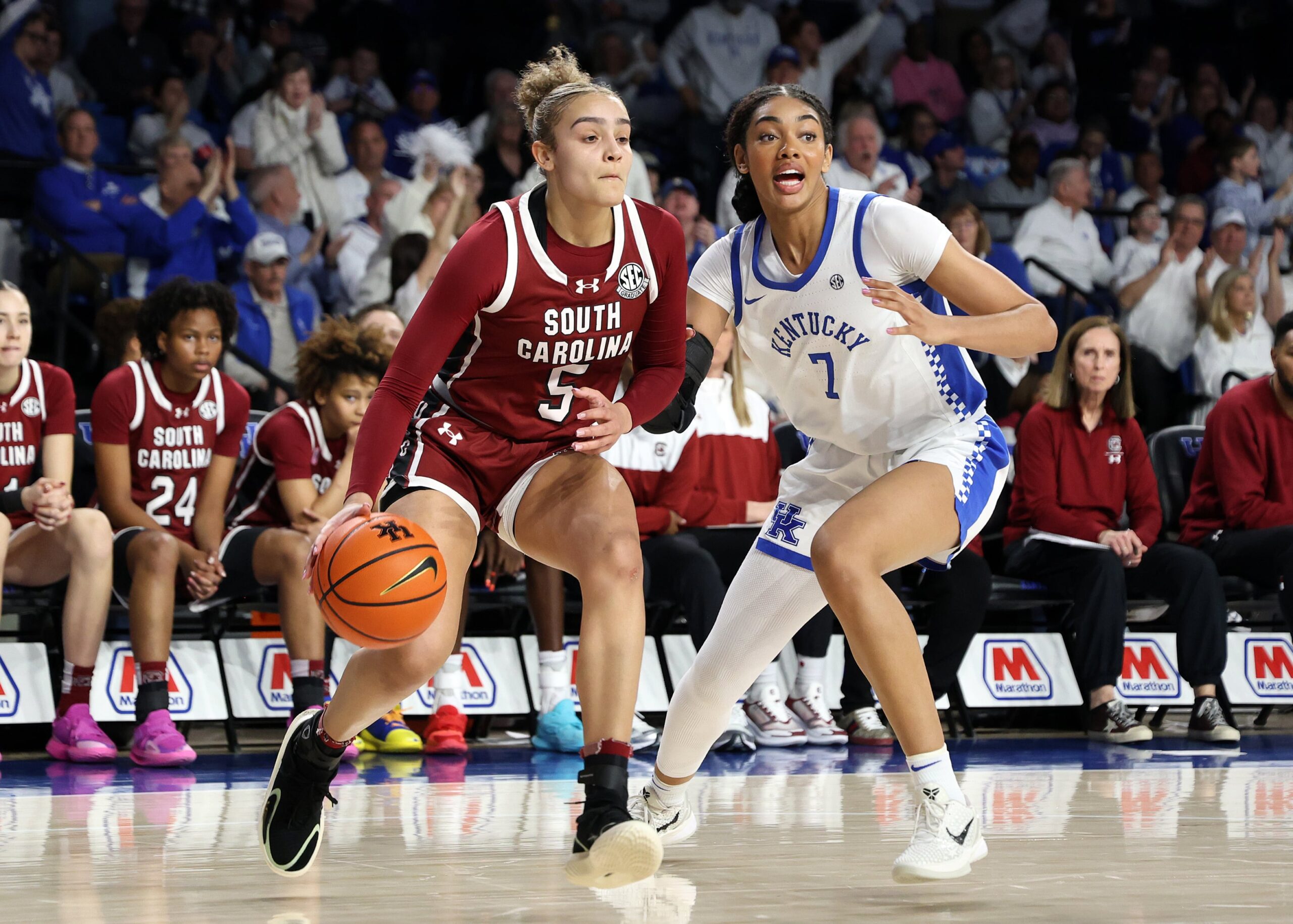
The Gamecocks got the win, but the manner in which they got it raised questions that will need answers before Friday’s SEC Tournament opener.
A Game Nobody Will Frame on the Wall
Let’s be direct: this was not a pretty basketball game. Neither team shot efficiently, both sides were struggling from the foul line — finishing below 50% — and long stretches of the contest produced the kind of basketball that tests the patience of even the most loyal fan bases.
Dawn Staley pointed to fatigue as the primary culprit, and there is merit to that explanation. Madina Okot was visibly running on fumes in the fourth quarter, and the number of shots that clanged off the front of the rim suggested legs that had logged too many minutes without proper rest. Coming off two emotionally charged home games, and with the regular-season standings already settled, the physical and mental drain on this roster was real.
But fatigue alone doesn’t fully explain the Gamecocks’ performance. South Carolina simply didn’t look locked in — and that distinction matters. There is a difference between a team that is tired and a team that is disengaged, and on Sunday, South Carolina showed traces of both. It is worth noting, however, that this is not unprecedented. The Gamecocks have a documented history of sleepwalking through their final regular-season game, only to recalibrate and refocus when the postseason begins.
After winning their previous three games by an average of more than 32 points, Sunday’s narrow escape may actually serve a useful psychological purpose — a reminder that talent alone does not guarantee outcomes, and that complacency is a luxury no team can afford when March arrives. The hope is that the discomfort of nearly losing to Kentucky re-sharpens a team that had been coasting on autopilot.
Tessa Johnson’s Rollercoaster Afternoon
No individual narrative from Sunday’s game was more complicated — or more consequential for what lies ahead — than Tessa Johnson’s.
On paper, her stat line was a mess: 5-of-15 from the field, 2-of-10 from three-point range, and three turnovers. Those are the numbers of a player who was off, and by most measures, Johnson was.
Yet this was also a game in which Johnson finished as South Carolina’s second-leading scorer. She was responsible for seven critical points during the Gamecocks’ defining 17-4 third-quarter run — the surge that gave South Carolina the separation it needed. When Kentucky mounted an 8-0 run in the fourth quarter and threatened to pull the game back, it was Johnson who answered with a strong reverse layup to stop the bleeding. And it was Johnson who, in the final minutes, caught three consecutive inbounds passes and found Madina Okot for the bucket that effectively sealed the game.
That is not the stat line of a player who quit on her team. That is the stat line of a competitor who kept competing even when the shots weren’t falling.
Still, the trend line around her shooting is concerning. In her last three games, Johnson is just 4-of-21 from three-point range — a prolonged slump that predates the upper-body contusion that kept her out against Missouri. While she did not miss a day of practice due to that injury, the timing of its arrival and the continuation of the shooting slump have blurred the line between physical limitation and genuine form loss.
The psychological dimension is also worth examining. In the second half on Sunday, Johnson passed up multiple open looks that she would typically take without hesitation. When a shooter of Johnson’s caliber starts second-guessing herself, it is usually more of a mental hurdle than a mechanical one — and those can be harder to clear than a sore shoulder.
The stakes here are significant. South Carolina is a measurably different team when Johnson is shooting well. She stretches defenses, creates driving lanes for others, and forces opponents to make impossible rotational decisions. Without that threat, the Gamecocks become more predictable. The tournament ceiling of this team rises substantially when “Tournament Tessa” shows up — and right now, her return is the most important subplot entering the SEC Tournament.