Dawn Staley Defied the NCAA to Sign Autographs — And She’d Do It Again, Here is Why.
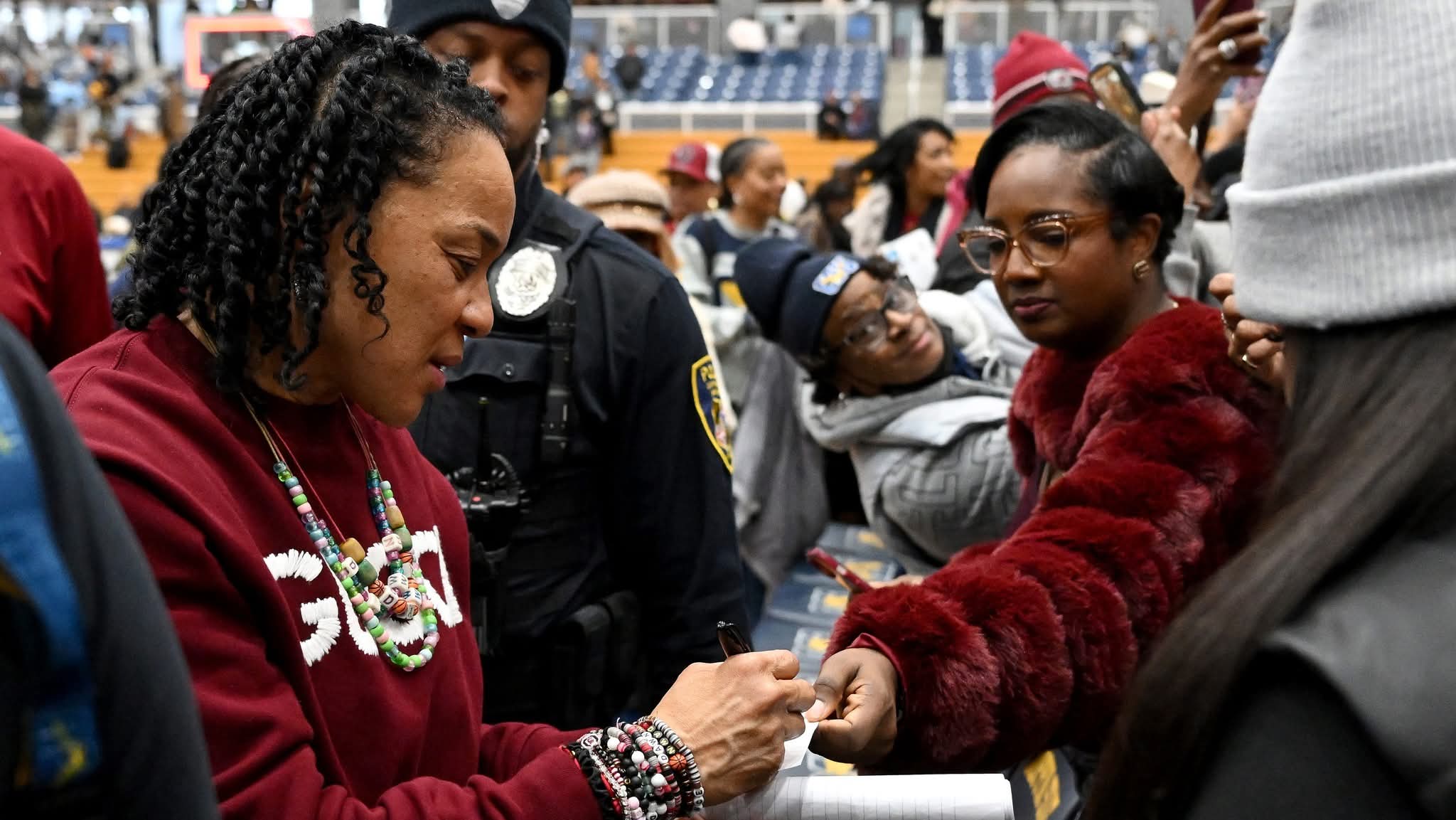
SACRAMENTO — Dawn Staley beat Oklahoma on Saturday afternoon, watched her team advance to the Elite Eight, and then walked back out onto the floor during halftime of the next game to sign autographs for fans. The NCAA tried to stop her. She kept going anyway.
The story, which Staley revealed unprompted during her pre-Elite Eight press conference Sunday, is both entirely on-brand for one of the sport’s most beloved figures — and a revealing window into the tension between institutional control and the kind of genuine fan connection that has helped women’s basketball reach new heights.
What Happened at Golden 1 Center
After South Carolina’s 94-68 dismantling of Oklahoma, Staley did what she says she has done for years in similar settings — found an open area in the arena while her assistant coaches scouted the next opponent, and began signing autographs and taking selfies with fans during the TCU-Virginia halftime break. Arena workers joined South Carolina’s staff in organizing the line, which stretched deep into the lower-bowl stairwell and grew even larger over the following ten minutes.
Then an official intervened.
“They started helping to organize it, and then some gentleman came over and he’s like, ‘Stop, we’re not doing this,'” Staley said Sunday. “I was like, ‘Well, why?’ And he said, ‘Because the NCAA people told us to stop it.'”
Staley’s response was characteristically composed and characteristically defiant. She said “Excuse me,” reached around the official, and kept signing.
“I’m going to keep going, because this is the way you grow the game,” she said.
The Fire Hazard Argument
The NCAA’s stated concern eventually shifted to safety — specifically, a potential fire hazard created by the line of fans crowding the stairwell. Staley pushed back on that framing directly, noting that this is not a new practice for her program.
“They did say something about a fire hazard,” Staley acknowledged. “But we’ve done this before. We do this at the SEC Tournament. We have our staff members keeping everything organized in a way that is safe for the fans to come get autographs and then exit out — like, real organized.”
The distinction matters. This wasn’t a spontaneous, chaotic crowd gathering — it was a structured, staffed autograph line that South Carolina’s program has executed successfully at multiple events. The NCAA’s intervention wasn’t about safety logistics. It was about control.
An NCAA spokesperson did not respond to a request for comment.
Why It Was Especially Meaningful Saturday
The timing and location added layers of significance to the moment. Staley is a Virginia legend — she played her college basketball in Charlottesville — and UVA fans had traveled to Sacramento in significant numbers for the TCU-Virginia game. Many of those fans were in line waiting for Staley specifically, making the NCAA’s attempt to shut down the session even more tone-deaf given the context.
Videos posted by CBS Sports’ Isabel Gonzalez captured just how large the demand was — a line snaking through the stairwell that only grew longer as the halftime clock ticked down. Staley signed for the majority of the 15-minute break.
The Bigger Point Staley Was Making
What’s most notable about this story is how Staley chose to tell it. She raised the NCAA’s intervention unprompted — not as a complaint, but as an illustration of a broader philosophy she was articulating about giving back to the sport.
“Our game has grown,” Staley said. “People want more access to us. I think it’s only right for us to give back to the game. You didn’t ask me for all of that, but I enjoy giving back.”
Earlier in the week, Staley had praised South Carolina fans — who the program calls FAMs — for the financial and personal commitment required to travel cross-country for tournament games, noting the elevated cost of tickets and travel. The autograph session was a direct, tangible response to that sacrifice. Fans who spent thousands of dollars to be in Sacramento deserved more than a wave from across the arena.
The NCAA’s instinct, apparently, was to stop that. Staley’s instinct was to keep going.
Given that women’s basketball is in the middle of a cultural moment — record attendance, surging TV ratings, a generation of stars who have transcended the sport — one of those instincts looks a lot more like leadership than the other.
About The Author