
How TCU Built Its Way Back to the Elite Eight — Starting With a 33-Point Loss
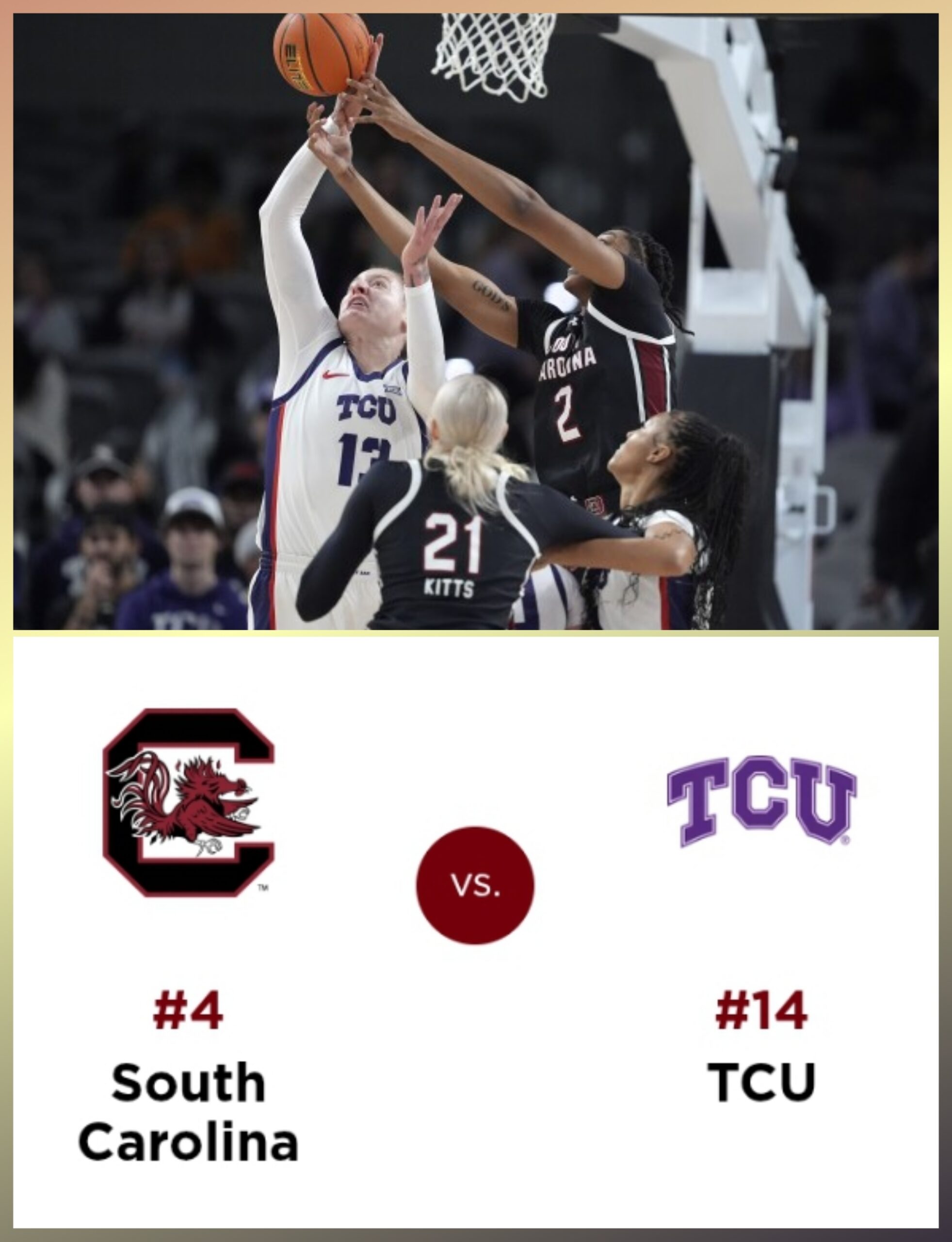
There is a particular kind of institutional honesty required to look at a blowout defeat and extract not just lessons, but a blueprint. That’s precisely what TCU head coach Mark Campbell did after South Carolina dismantled his Horned Frogs 85-52 on December 8, 2024. Rather than chalking the loss up to circumstance, Campbell identified a structural vulnerability — size — and spent the offseason systematically addressing it.
The result is a TCU roster that looks fundamentally different from the one that was overwhelmed in that December meeting. And on Monday night at Golden 1 Center in Sacramento, Campbell will find out if the rebuild was enough.
The Blueprint: Building a Bigger Team
The 33-point margin of that December loss was damaging, but for Campbell, it was clarifying. His diagnosis was precise:
“One thing that I thought we’d try and close that gap in, one of the areas, was size. And, so, I think we did a great job going out and building a roster where we are a little bigger and stronger this year.”
That self-assessment led to an aggressive use of the transfer portal. TCU added Clara Silva (6-foot-7) from Kentucky and Kennedy Basham (6-foot-7) from Arizona State to immediately bolster the frontcourt. For good measure, Campbell also signed Sarah Portlock (6-foot-8) and Emily Hunter (6-foot-7) in his 2025 recruiting class, signaling that this isn’t just a one-year fix — it’s a deliberate program identity shift.
The results are measurable. TCU is now the only program in the country with four players standing 6-foot-7 or taller, and the team leads the nation in average height at 6 feet, 2½ inches. That kind of roster construction doesn’t happen by accident. It reflects a head coach who understood exactly where his program needed to grow and moved decisively to get there.
Clara Silva: The Transfer Portal’s Most Important Return
Of TCU’s new additions, Silva has had the most immediate and sustained impact. She has started all 37 games this season, averaging 9.2 points, 7.5 rebounds, and 1.8 blocks per game — a blocks figure that ranked second in the Big 12 and speaks to her impact as a deterrent in the paint, not just a presence.
Her production isn’t spectacular in the box score sense, but it’s the kind of steady, foundational contribution that championship-caliber teams are built around. She cleans glass, protects the rim, and holds her position — three qualities that become essential when facing a South Carolina frontcourt that includes Madina Okot (6-foot-6) and Alicia Tournebize (6-foot-7).
Okot in particular arrives off a dominant Sweet 16 performance — nine points and 14 rebounds — against Oklahoma, demonstrating she is capable of single-handedly winning the battle of the boards. Silva will be the primary answer to that challenge.
Kennedy Basham: The X-Factor
While Silva provides the reliable foundation, Campbell has identified Kennedy Basham as a potential difference-maker in this specific matchup. Basham’s regular-season numbers — 2.8 points, 3.6 rebounds, and 1.6 blocks in just 12.1 minutes per game — are modest by surface-level standards. But her shot-blocking rate relative to her minutes suggests an impact player who hasn’t yet been asked to carry a full load.
Campbell made clear that Monday night changes that calculus entirely:
“Their post players are some of the best posts in college basketball… Kennedy Basham is going to have to have a huge role against these guys. We’re going to feed both Silva and Basham, in order to compete and hold our own inside against them.”
That is a significant statement. Campbell is essentially telegraphing that a player who has averaged under three points per game will be a featured offensive weapon in the highest-stakes game of the season. It’s a calculated gamble — one that only makes sense if you believe, as Campbell clearly does, that matching South Carolina’s size in the post is more valuable than rotating in a more polished offensive option. Against a team that allows opponents to score at will inside, Campbell may be right.
The Rebounding Imperative
Perhaps the clearest tactical priority Campbell has identified for Monday is rebounding — and the stakes, as he framed them, couldn’t be higher:
“Rebounding against South Carolina, you have to be able to battle them on the boards. If they punk you and can get offensive rebounds and shoot layups, you have no shot. So one of the huge areas is being great on the glass.”
The data backs up his urgency. South Carolina ranks 10th nationally in rebounds per game, a reflection of both their size advantage and their offensive aggression. Historically, teams that allow the Gamecocks second-chance opportunities don’t just lose the rebounding battle — they lose the game, often by wide margins.
TCU’s response has been to win the conference rebounding title outright. Leading the Big 12 in rebounding is one thing; replicating that against the nation’s elite is another. But the infrastructure is now in place — Silva, Basham, and a roster of players averaging over 6-foot-2 — to at least make it a contest on the glass.
The Bigger Picture: Joyce Edwards and the Paint Battle
Beyond the post matchup, TCU’s frontcourt will also need to manage Joyce Edwards, South Carolina’s leading scorer at 19.9 points per game and one of the most difficult interior scoring threats in college basketball. Edwards operates in the paint with efficiency and physicality, and limiting her will require exactly the kind of size and help-side presence that TCU has spent the offseason acquiring.
Campbell’s plan appears to involve using Silva and Basham not just as offensive contributors, but as defenders capable of making Edwards work for everything she gets. Whether two transfers, however talented, can slow down the most productive forward in the tournament remains the central unanswered question heading into Monday night.
A Program Defined by Adaptability
What makes TCU’s run to back-to-back Elite Eights genuinely impressive isn’t just the winning — it’s the how. Campbell has demonstrated a willingness to evaluate his own roster honestly, identify deficiencies without ego, and use every available tool — particularly the transfer portal — to address them.
No. 3 seed TCU (32-5) against No. 1 seed South Carolina (34-3) is, on paper, a significant mismatch in pedigree. But this is not the same TCU that walked into December and got blown out by 33. The Horned Frogs have been rebuilt, literally from the ground up, with exactly this rematch in mind.
Whether that’s enough to finally beat the Gamecocks — and punch TCU’s first-ever Final Four ticket — is the question Monday night will answer.
About The Author