
Depth vs. Dependence: The Structural Divide That Will Define Monday’s Elite Eight
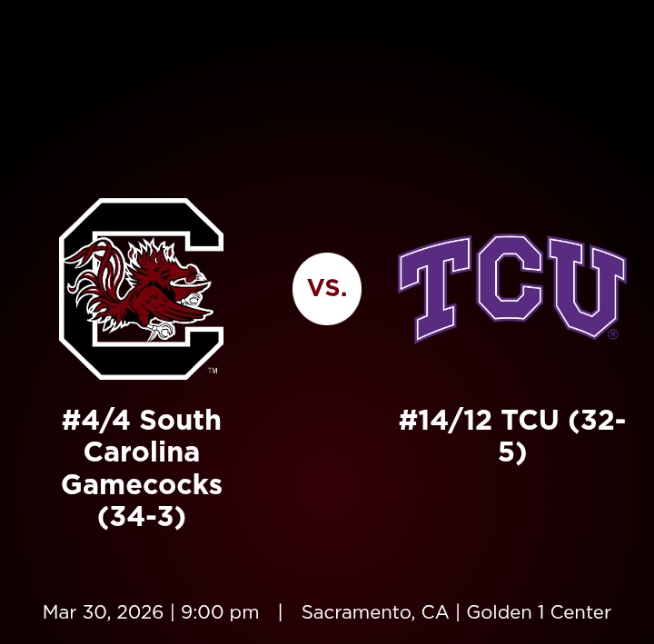
Saturday’s Sweet 16 results at Golden 1 Center didn’t just send South Carolina and TCU to the Elite Eight — they exposed, in vivid detail, the fundamental structural difference between these two programs. The scores were similar. The stories behind them were not.
Two Teams, Two Completely Different Realities
South Carolina deployed all 10 available players against Oklahoma. Eight logged at least 10 minutes. Six scored at least eight points. Only Joyce Edwards played more than 30 minutes, and reserve Agot Makeer outplayed three starters in terms of floor time. The Gamecocks won with the kind of balanced, distributed excellence that makes them genuinely difficult to game plan against — because there is no single thread an opponent can pull to unravel them.
TCU’s win over Duke told an entirely different story.
The Horned Frogs played just seven players. Their two reserves combined for fewer than 10 minutes of court time. Two starters played the full 40 minutes, and a third rested for exactly eight seconds. Two players — Donovan Hunter and Veronica Sheffey — didn’t score at all. Kennedy Basham managed two points.
Then there were Olivia Miles and Marta Suarez.
Miles finished with 28 points and eight assists. Suarez put up 33 points and three assists. Together, they scored or assisted on all 79 of TCU’s points — a statistical fact that strains credulity but is simply true. They took 39 of TCU’s 60 shots, all 12 free throws, and grabbed 20 of the team’s 38 rebounds. In a game TCU won.
That is not a sustainable model against South Carolina. And everyone in both locker rooms knows it.
South Carolina’s Depth Is a Weapon in Itself
Saturday didn’t just showcase South Carolina’s talent — it demonstrated how the Gamecocks can win in multiple configurations. Edwards, the team’s leading scorer at 19.9 points per game, was held to a season-low eight points. Rather than representing a failure, that number actually illustrates how thoroughly defenses have to commit to stopping her — and how punishing those commitments become.
The double- and triple-teams that Oklahoma threw at Edwards created open space for South Carolina’s guards, and they made Oklahoma pay. Ta’Niya Latson erupted for 28 points — her second-highest single-game total as a Gamecock — snapping a stretch that had seen her stay under 20 points since February 8. That kind of offensive flexibility, where the team’s leading scorer can be neutralized and the team still wins convincingly, is the hallmark of genuine championship depth.
South Carolina now has six players averaging 10 or more points in the NCAA Tournament — the five starters plus Makeer. That figure isn’t an accident. It reflects a roster built to sustain pressure across 40 minutes regardless of which individual matchups an opponent tries to exploit.
The season-long context matters here too. All five Gamecock starters averaged double-figure scoring during the regular season. Bench contributions were inconsistent, but that inconsistency was largely injury-driven — when Makeer and Maddy McDaniel were healthy and available consistently, they performed. The tournament has given them that stability, and it’s showing.
TCU’s Structural Vulnerability
TCU’s situation is more precarious than their Elite Eight appearance suggests. Three players averaged double-figure scoring during the season, and two more averaged at least eight. But the bench has averaged just 13.5 points per game — a figure inflated by Maddie Scherr’s contributions before she was lost to injury on February 8. Remove Scherr’s 5.3 points per game from that calculation, and the depth picture becomes even thinner.
The NCAA Tournament bracket is, by design, forgiving to teams with short rotations. With only three days between games, heavy minutes loads are survivable. But the Elite Eight is where that structure gets tested most severely — because South Carolina is precisely the kind of opponent built to exploit it.
Edwards laid out the strategy directly:
“That’s definitely a thought process. Attacking their better players to get them either tired and make them work on defense or get them in foul trouble. If they have to sit, TCU’s going to have to go deeper and deeper and deeper in their bench, which is something that they don’t want to do.”
That is not a theoretical concern — it is a concrete tactical plan, and South Carolina has the roster to execute it. If Miles or Suarez picks up two fouls in the first half, TCU faces an impossible choice: play them conservatively and sacrifice offensive production, or keep them on the floor and risk fouling out entirely. Either outcome benefits the Gamecocks.
Campbell’s Honest Appraisal
To his credit, TCU’s head coach isn’t pretending the challenge isn’t enormous. Campbell offered one of the most candid assessments of an opponent you’ll hear from a coach before a game of this magnitude:
“They have tremendous post players. Joyce, as a forward, can punish you inside and is great out. Playing iso ball at 15, 17 feet. Then their three guards, that guard trio is as good as anybody in college basketball. They’re all old veterans. There’s not a lot of weaknesses when you look at their group and their team. (Staley) has done just a tremendous job of blending it all together, and they share the basketball. They have five players on any given night that can really, really hurt you. So, we’ve got our hands full defensively of guarding them and slowing them down.”
“There’s not a lot of weaknesses” is a remarkable thing to say about your next opponent — but it’s also accurate, and Campbell clearly understands the reality his team is walking into. His acknowledgment that South Carolina can hurt you with five different players on any given night is precisely the problem TCU’s thin rotation must solve.
The Core Question Monday Night Must Answer
Saturday turned season-long trends into high-definition snapshots. South Carolina’s depth is real, tested, and expanding at the right moment. TCU’s dependence on Miles and Suarez isn’t a flaw in their identity — it’s simply the reality of their roster construction.
The question isn’t whether Miles and Suarez are good enough to beat South Carolina. Saturday proved they are capable of carrying a team to extraordinary heights. The question is whether they can do it for 40 minutes against a program that will specifically, systematically, and relentlessly try to wear them down — while rotating in fresh defenders every few minutes from a bench that goes six deep with double-digit tournament scorers.
For TCU to advance, Miles and Suarez will likely need to produce another combined masterpiece while staying out of foul trouble. For South Carolina, the task is simpler in structure if not execution: use their depth as a weapon, force TCU into the discomfort of going shorter and shorter into a bench that simply doesn’t have the answers the starters do.
One team is built for a war of attrition. The other is built to win a battle. Monday night will reveal which design wins out.
About The Author