
Where The Lineage of The Point Guard Legacy Started: What It Means to Run Dawn Staley’s Team
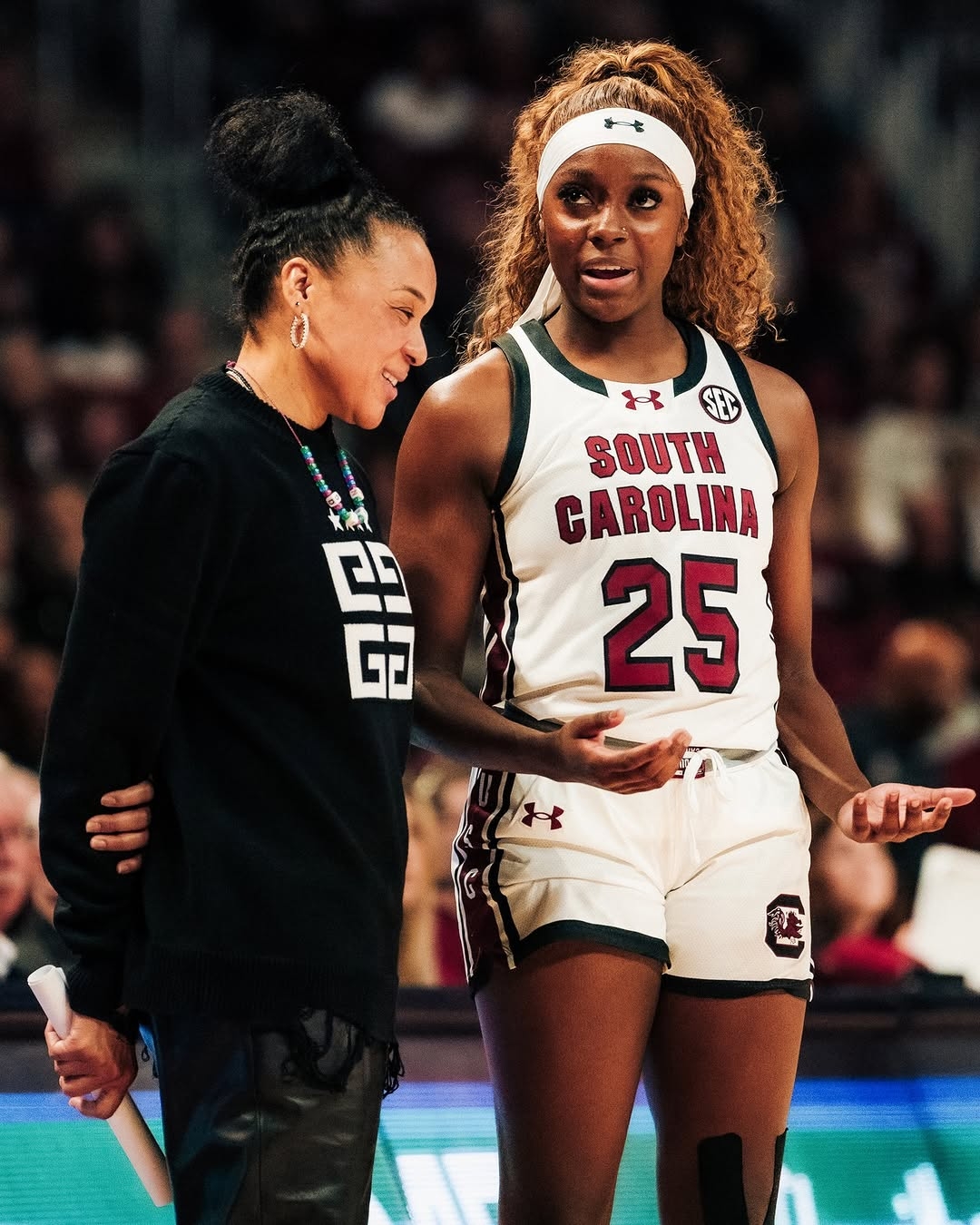
COLUMBIA, S.C. — Raven Johnson’s career at South Carolina will not be defined by her statistics. The numbers tell part of the story — the assists, the steals, the defensive assignments on the opponent’s best player — but they do not capture what she has actually meant to this program, or what it cost her to become the player she is.
To understand Johnson’s legacy, you have to understand what it means to be a point guard under Dawn Staley. And that story did not begin with Johnson. It began in 2008, and it has been passed from player to player ever since.
What Staley Demands at the Point
Staley played the position at the highest level. She has a Player of the Year award named after her. And that background makes her simultaneously the most qualified and most demanding coach a point guard could play for.
Her philosophy begins with accountability — not the comfortable kind.
“It’s a position in which, if everything goes right, they get all the praise. If everything goes wrong, it’s their fault. And you have to condition them to believe that,” Staley said. “They’re always understanding their responsibility on the floor. And sometimes they can handle it very early in their career.”
The preparation she demands is rooted in simulation. Staley believes the worst thing that can happen to a point guard is encountering a high-pressure situation for the first time in a real game.
“We’re trying to familiarize them with situations that, when they arise, they’ve already been through it. That’s my job as a coach,” she said.
But preparation alone is not enough. What separates the great ones, in Staley’s framework, is the ability to remain composed when everything around them is moving fast and loud. Calm through the storm. It is a phrase that runs through this program like a thread.
Crucially, Staley does not manufacture that composure through protection. She cultivates it through exposure.
“It’s almost like parenting,” Staley said. “Like if you hover over them all the time and they can’t work through problems, they’re going to have issues. You’ve got to let them work through problems because they’re working through the things you’ve instilled in them. That’s the same thing with point guard play for us.”
Where the Lineage Begins
La’Keshia Sutton arrived in Columbia in 2008 as one of Staley’s first recruits — one of the foundational stones of everything that has been built since. She remembers the significance of that moment clearly.
“It’s a privilege to be one of the first recruits for Coach Staley. Just, being one of her first point guards, one of the first people to score 1,000 points, to be an all-SEC performer,” Sutton said.
What Sutton took from her time in Columbia extended well beyond basketball. She went on to an international professional career and became one of the few women ever to play for the Harlem Globetrotters. Today she coaches high school basketball in New Jersey and mentors players like Notre Dame’s Hannah Hidalgo. The lessons Staley taught her are still operating in the world, filtered through every player Sutton has touched since.

The most enduring of those lessons was about vision — seeing the game before it happens.
“What I learned from Coach Staley is to see the game before certain things happen. That’s why I love watching Raven play,” Sutton said. “She doesn’t even need to look over at coach to know exactly what the team needs in certain moments.”
That is not instinct. That is years of conditioning, of being put in difficult situations in practice until the right read becomes automatic. Sutton also credits Staley for something less commonly discussed in elite coaching circles — the freedom to fail.
“She allows us to be who we are,” Sutton said. “In doing so, we’re going to make mistakes, but she allows us to think the game for ourselves before she tries to overcorrect or prevent us from making mistakes.”
Johnson’s Road to Leadership
Raven Johnson did not arrive at South Carolina as a finished product. She arrived as a freshman who needed to be broken down and rebuilt — and the person who did most of the breaking was Destanni Henderson.
“Henny? Oh my gosh, she used to beat me up,” Johnson said. “It was hard guarding her. I had to guard her as a freshman, and I remember, I was like, ‘I don’t think I belong here.'”
That feeling — the doubt, the physical and mental challenge of going against someone better than you every single day in practice — is precisely the point. The veterans at South Carolina do not protect the freshmen from the difficulty. They are the difficulty. And it is that crucible that prepares the next generation for what the games will demand.
Johnson’s path became significantly harder when she tore her ACL during her freshman season in 2021. The injury threatened not just her year but potentially her entire trajectory. What carried her through, she says, was the people around her.
“When I got back on the court, you had Zia Cooke, people like that, make sure I was good. Kierra Fletcher, when she was here, she made sure I was good,” Johnson said. “That matters. People before you just dropping off the torch to other people. I think Mouse is going to be ready when it’s her turn.”
The torch reference is deliberate. Johnson understands that her role now is not simply to play well — it is to prepare someone else to play well after she is gone.
The Next Carrier of the Torch
That someone is Maddy McDaniel, a sophomore who is absorbing everything Johnson models while trying to stay present in the moment rather than rushing toward what comes next.
McDaniel rejects the idea that playing for Staley as a point guard carries unusual pressure.
“It’s not more difficult, it’s just stepping into bigger shoes, a bigger role,” McDaniel said. “You’re the coach on the floor, and she’s just such a high caliber of a coach, and she was such a high caliber of a player, so it comes to the point guard, she definitely expects a lot out of us.”
The most important lesson Johnson has passed to her so far is the one Staley has been teaching since 2008.
“She just taught me a lot about being calm, getting through the storm,” McDaniel said. “It’s a lot being a one guard, especially a one guard here, and being another extension of coach.”
McDaniel is not looking past the present moment, though. With South Carolina still in the NCAA Tournament and a national championship within reach, the future can wait.
“We’re in a good position right now where we have a good amount of games in front of us,” McDaniel said. “I can’t think too far into the future.”
What the Legacy Actually Is
The point guard lineage at South Carolina is not a list of statistics or a collection of award citations. It is a set of values — competitiveness, composure, accountability, vision — that Staley instilled in Sutton, that Sutton carried into the world, that Henderson passed to Johnson through the brutality of daily practice, and that Johnson is now transferring to McDaniel through her example.
When Johnson’s career ends, whenever that final buzzer sounds, she will not just be leaving a program. She will be joining a lineage. And somewhere down the line, when McDaniel is the veteran grinding against the next frightened freshman who wonders if she belongs, the thread will continue.
That is what it means to be a Dawn Staley point guard. And that is what Raven Johnson’s legacy actually is.
About The Author