Dawn Staley’s Postgame Masterclass: The Geno and Dawn HEATED MOMENT, and How South Carolina Dismantled UConn’s Perfect Season
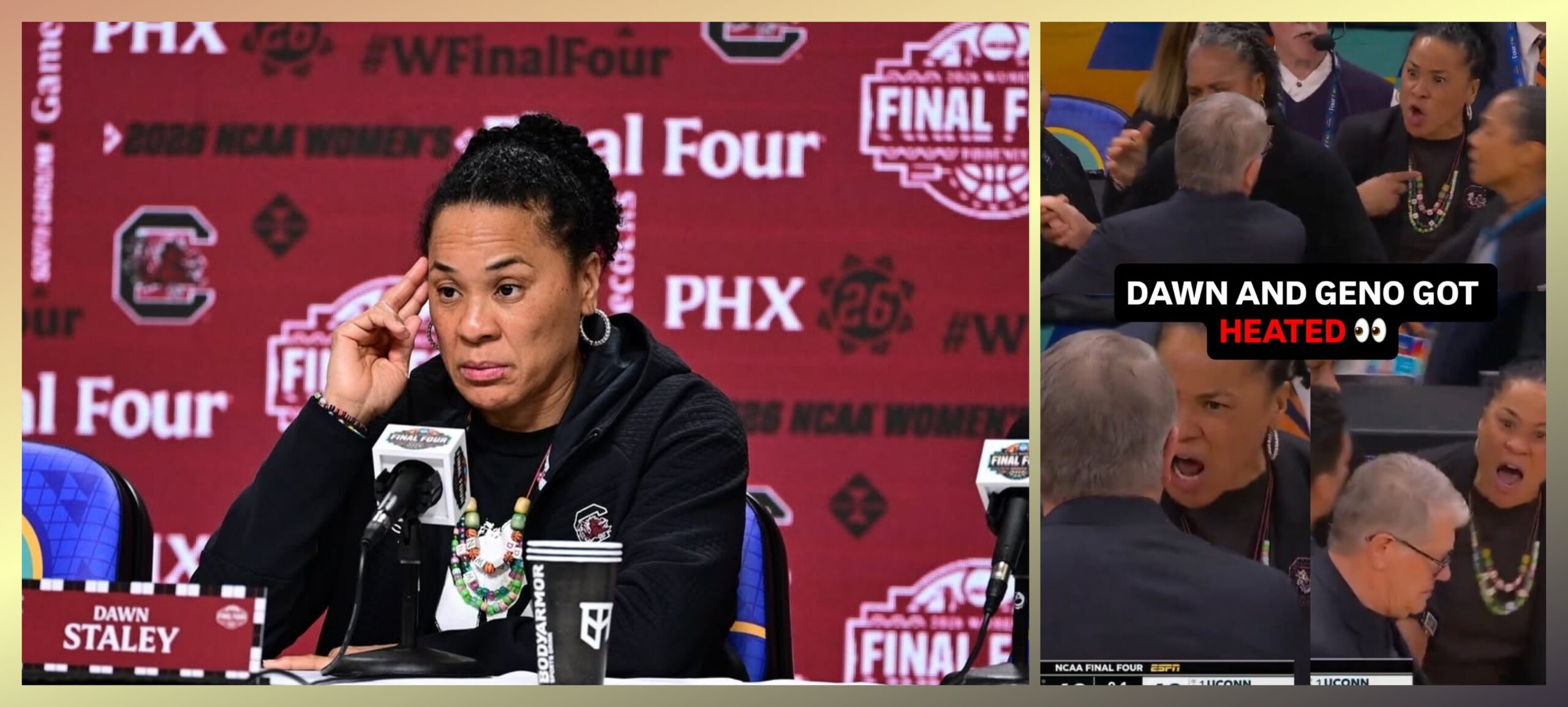
PHOENIX — Dawn Staley sat down at the postgame podium having just ended UConn’s perfect season, advanced to a third consecutive national championship game, and navigated one of the most emotionally loaded rematches in women’s college basketball history. What followed was one of the most revealing press conference performances of her career — candid, analytical, and occasionally haunted by a game that happened three years ago.
The Auriemma Exchange: Letting It Go
The first question addressed the moment everyone had seen — Auriemma approaching Staley near the final buzzer. Staley’s response was immediate and deliberate.
“You can ask Geno the question. He’s the one that initiated the conversation. I don’t want what happened there to dampen what we were able to accomplish today.”
She returned to the same posture when asked directly about Auriemma’s fourth-quarter criticism of her sideline communication with officials.
“I think that’s a Geno question.”
Two answers. Both complete sentences. Both redirections. Staley was not going to let a sideline dispute become the story of South Carolina’s victory, and she executed that boundary with the same discipline her team showed defensively in the fourth quarter.
The Game Plan That Won It
Staley’s tactical explanation of how South Carolina solved UConn was as clear-eyed as anything she has said all season. Last year’s losses — both the regular season blowout and the championship game — had taught her something specific: when you allow UConn to play freely, to catch and shoot, to assist their way through a game, they are unbeatable.
“Our whole objective was to get them to shoot as inefficiently as possible, make them put the ball on the floor. Don’t give them as many catch-and-shoot opportunities.”
The numbers validated the approach. UConn finished with 15 assists on 19 field goals — a ratio that tells you they were still finding each other, but doing so at a dramatically reduced rate compared to their season average. South Carolina held them to 48 points. The Huskies did not score in the final four to five minutes of the game.
“I didn’t really realize they didn’t score a point in the last four or five minutes. I was just really concentrating on coaching our team up and just trying to score more points because they can generate points in a short period of time.”
When assistants suggested switching to a different defensive scheme after South Carolina built its lead, Staley refused.
“No, this is what is working. Let’s continue to do what’s working. We just created a lot of disruption.”
That decision — to stay disciplined rather than clever — is the kind of in-game coaching that separates good coaches from great ones.
The Halftime Jolt
South Carolina trailed at halftime and came out of the locker room as a different team. Staley explained what she said — and why she said it the way she did.
“You really don’t get these opportunities very often. You don’t. So you’ve got to meet the moment. Like, if we lost this game, I know our players would have been mad at themselves because they’re very capable. Play to your capabilities.”
She described the necessity of getting under her players’ skin to reset their competitive identity — not to criticize them, but to jolt them back to who they actually are.
“You’ve got to get under their skin a little bit because you’ve got to jolt ’em out of the state that they’re in to get them back to who they are.”
And once she delivered the message, she pivoted to information.
“Hold a team like UConn to 26 points, you’re doing some really great things. I just thought our offense — we were just not making the right decisions. We had to put ourselves in positions where we got to play a little bit faster.”
The adjustment was structural: South Carolina had been walking the ball up and playing half-court basketball. The second half directive was to push pace, stay in transition, and force UConn to defend rather than dictate.
Ta’Niya Latson’s Moment
Latson led South Carolina in scoring on Friday night, and Staley framed her performance within the full arc of the sacrifice the transfer made this season.
“I think Ta’Niya just made huge individual sacrifices. Wasn’t an All-American this year. I want her, if she’s not going to get the individual awards, I want her to be part of a national championship team.”
Staley said she saw the readiness in Latson’s eyes before the game even began.
“You see players, they just have a different look. When they have it, it gives you confidence to know that they’re ready. I didn’t have any question marks about whether Ta’Niya was ready to meet the moment. Didn’t have any of that with Raven. Joyce, none of that.”
Raven Johnson: Fearless on Any Matchup
One of the game’s tactical curiosities was Staley deploying 5-foot-9 Raven Johnson against the much taller Sarah Strong in the first half. Staley explained the decision without apology.
“Raven thrives on any matchup. Sarah Strong is not the tallest player that she guarded. We were put in the position where she guarded Kentucky’s big, Clara Strack. We know she’s fearless when it comes to who she’s guarding. She takes really great pride in not letting people score on her. When you have a guard like that that has elite defensive skills, you let ’em be great.”
Johnson also sat for an extended stretch in the fourth quarter — a decision that raised eyebrows given her role as South Carolina’s floor general. Staley’s explanation revealed something important about this team’s culture.
“One, I thought Mouse, Maddy McDaniel, did a really great job. Sometimes when you’re coaching a game, you’re looking for a unit that can play well together. The more time that we could have given Raven on the bench, the fresher she was going to be when she returned.”
“Once you have a strong enough culture, when you can sit your All-American point guard for an extended period of time in the fourth quarter, and they really understand it is about winning — Raven’s the best at really understanding. She only wants to win.”
Being Locked In — What It Actually Means
Staley was asked to define the concept her players kept returning to in their own postgame comments. Her answer was specific and instructive.
“Being locked in is really understanding what the game plan is, really understanding personnel on our opponents, and executing it. Like, you can know and not execute it.”
She described letting Raven Johnson decide whether the team needed an additional film session the night before the game. Johnson said yes. They watched more film.
“You could see the players really lock into what needed to get done. Probably after game 20 in the regular season, some of ’em are half paying attention because it’s just routine. But when you get to this level, you want to see a little bit more. You want to see all the players locked in and all the players asking questions about whatever the game plan is. That’s being locked in.”
The Ghost of 2023
Perhaps the most unexpected moment of the press conference was Staley’s admission that she is still haunted by the 2023 Final Four — a loss that did not end in a championship game defeat but in a semifinal that she has never fully processed.
“I’m haunted by 2023. That particular Final Four, because of the players that we had and the season that we were having. It got upended. I never got a chance to coach the Freshies anymore.”
She won the championship the following year with a different group, but the 2023 team stays with her.
“For me, if we ever get the opportunity to be in that position again, which we were today, we’re going to lay it on the line. Figure out ways in which to win the game.”
What Drives Her
When asked how much of this run reflects her players versus her own coaching and culture-building, Staley’s answer stripped away the tactical language and went somewhere more foundational.
“I love basketball. Like, it’s my passion. It is the very thing I don’t cheat on. I’ve been that way growing up in the projects in Philly. Basketball wasn’t one of them that came in and out of my life. I coach really from the love of what basketball can do for you, can do for your families, do for creating young people who will go out in the world and lessons and success stories that make you valuable to whatever situation you’re going to be in.”
“My cup runneth over when it comes to just what basketball has meant to me.”
South Carolina plays for a national championship on Sunday. Dawn Staley will stand on that sideline having outcoached Geno Auriemma, having solved a 38-0 team in the biggest game of the season, and having done it while still carrying the weight of a loss from three years ago that most people have already forgotten.
She has not forgotten. And that, perhaps more than anything else, is why she wins.
About The Author