Geno Auriemma’s Postgame: Grievances, His Version of the Handshake and the Perspective of 25 Final Fours
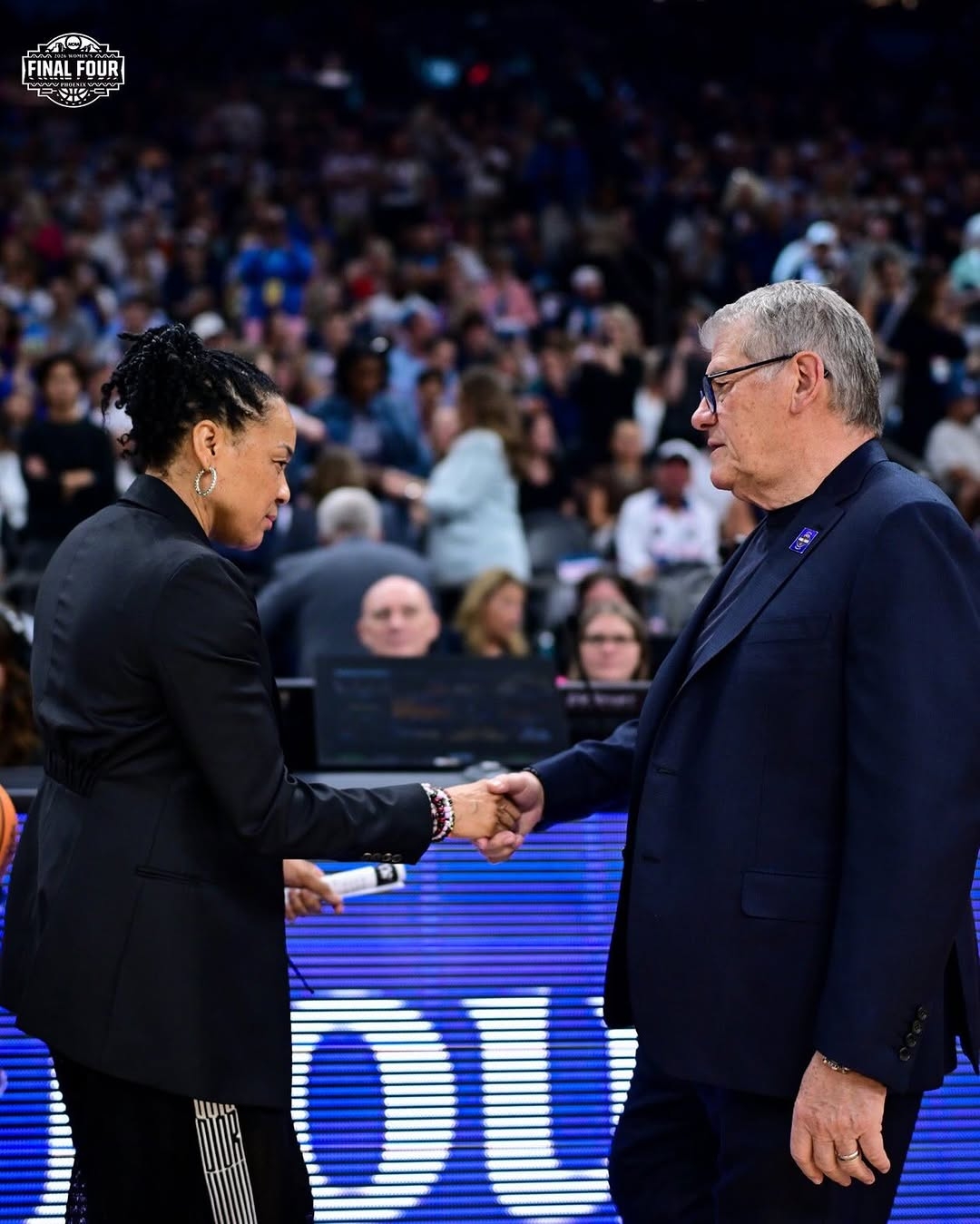
PHOENIX — Geno Auriemma sat down at the postgame podium having just watched his undefeated season end at 38-1. He was composed, occasionally sharp, sometimes genuinely reflective — and completely unwilling to walk back anything he had said or done during the game.
What followed was one of the more revealing press conferences of his career.
The Handshake Incident: His Version
Auriemma addressed the postgame confrontation with Dawn Staley directly, but carefully.
“I just said what I had to say. Nothing. Nothing.”
When pressed on what specifically he said, he declined again — but not without adding a layer.
“Why would I say it? I said what I said. And obviously, she didn’t like it. I just told the truth.”
What he was willing to elaborate on was the pregame handshake protocol that he believes Staley did not follow. His account was specific: coaches are announced and expected to meet at halfcourt before the game. He says he waited.
“The protocol is before the game, you meet at halfcourt. Anybody see that before? Two coaches meet at halfcourt, and they shake hands. They announce it on the loudspeaker. I waited there for like three minutes. So it is what it is.”
Staley had said she shook every member of his staff’s hand before the game. Auriemma’s account suggests the issue was the formal halfcourt meeting specifically — a distinction that matters to him after 41 years of coaching and 25 Final Fours.
No Regrets on the Holly Rowe Interview
Auriemma was asked whether he regretted his fourth-quarter sideline comments about Staley’s communication with officials. His answer was unequivocal.
“I don’t have any regrets about what I said to Holly Rowe. Why would I? I’ve been coaching a long time. I’ve never had a kid have to change their jersey because somebody ripped it, and the official said, ‘I didn’t see it.’ There are a lot of things that happened in that game. Unless you’re on that sideline, you have no idea what’s happening on this sideline.”
When reporters pushed him on the jersey incident — noting that video appeared to show Sarah Strong ripping it herself — Auriemma offered a careful clarification.
“She didn’t make a mistake. She said it was a mistake. She didn’t say she ripped her own jersey.”
And then, cutting to his actual point: “I’m saying there wasn’t a single foul called on them in the third quarter. I have a kid who is one of the best players in the country, has the ball a lot, trying to get something done. You mean to tell me there was never a time when she got fouled? Find that hard to believe.”
The grievance was not really about the jersey. It was about what he perceived as a systemic officiating imbalance that he felt empowered to call out publicly. He also addressed the double standard question directly.
“I just want to make sure there’s not a double standard. I’m of the opinion that if I ever talk to an official like that, I would get tossed. So I just want to make sure there’s not a double standard, that some people are allowed to talk to officials like that and other people are not.”
On the Game Itself: Credit Where It’s Due
When Auriemma moved away from the officiating narrative and addressed the basketball, he was generous and analytically honest.
“We held them to 62 points. You hold a team to 62 points, you think you’re going to win that game. We just didn’t make the plays that we needed to make on the offensive end. All the credit to them for how they played and how hard they played and the shots they made when they had to make ’em.”
He identified the turning point with precision — the start of the third quarter, when empty UConn possessions became South Carolina transition opportunities.
“I think there was maybe three or four straight times where we came out with empty possessions. They turned it over, and that led to some easy buckets for them.”
And on the broader question of whether South Carolina simply outcoached and outplayed them, he was direct: “The game wasn’t played the way we want to play it. It was played the way South Carolina wanted to play it. I think they did a great job of doing that.”
The Undefeated Narrative: Always Uncomfortable
Auriemma pushed back firmly on the idea that UConn’s unbeaten record going into the game represented some kind of destiny.
“I was never comfortable with that narrative. There’s too many good teams left to play. There’s too many big moments left to play in. The four teams that are playing here today, I don’t know that you would be surprised if any of them won.”
When asked whether going through more adversity during the season might have better prepared his team, he rejected the premise cleanly.
“You’ve got to run the race you’re racing. It’s not our fault we beat all those teams in November and December by 30. I can’t tell them, ‘Let’s make the game close.’ We just weren’t good enough tonight. It has nothing to do with going through adversity or no adversity.”
Sarah Strong and What Comes Next
Strong finished with 12 rebounds but struggled offensively — a departure from the player who had dominated virtually every game this season. Auriemma acknowledged the South Carolina game plan’s impact on her, particularly the early assignment of Raven Johnson as her primary defender.
“The more pressure, the more defensive pressure you try to put on the other team’s best player, you’re hoping that there’s a level of frustration a little bit, and it starts to affect the way they play. Maybe if she was a senior, maybe she would have gone, ‘Oh, yeah, I’ve been to a lot of Final Fours where this happens.’ This is the first time that it’s happened to her.”
But Auriemma expressed zero concern about Strong’s long-term trajectory.
“I don’t think Sarah Strong needs me to put any fire or motivation or anything into her. We’ll be back here next year. She’ll make sure of that.”
What Keeps Him Going: The Perspective of 41 Years
The most revealing stretch of the press conference came when Auriemma was asked what motivates him to keep coaching at 25 Final Fours in.
“Well, after tonight I don’t know that I want to continue coaching,” he said, drawing laughter before turning serious.
He shared something unexpected — that until last year’s championship, he had actually lost more Final Four games than he had won.
“There’s no stigma, there’s no stain in losing because you have to be in this. If you’re going to be in this enough times, you’re going to lose enough times.”
He described the failure mode he has always tried to avoid — coaches who stop putting themselves in high-stakes positions because they cannot handle the losses.
“If you walk away when you’re losing, you’re never going to get another opportunity to win again.”
And then, the line that cut deepest: “At Connecticut, after we won in 2016, we went nine years without winning again. So there was this feeling out there that it’s over for Connecticut. Meanwhile, we kept going to the Final Four. For nine years, we kept going to the Final Four, but we kept losing.”
He closed with something that sounded like both a coaching philosophy and a personal creed.
“99.9% of all the kids playing college basketball this year are going to go home without winning a national championship. Somebody out there Sunday night is going to win one. Everybody else — they’re not losers.”
Geno Auriemma left Phoenix with grievances about officiating, a specific complaint about a pregame handshake, and 41 years of perspective that prevents him from treating a Final Four loss as anything other than motivation to come back.
UConn will be back. He made sure of that before he left the podium.
About The Author