The Sleeping Giant Is Waking Up: Why Alicia Tournebize’s Best Dunks Are Still Ahead of Her
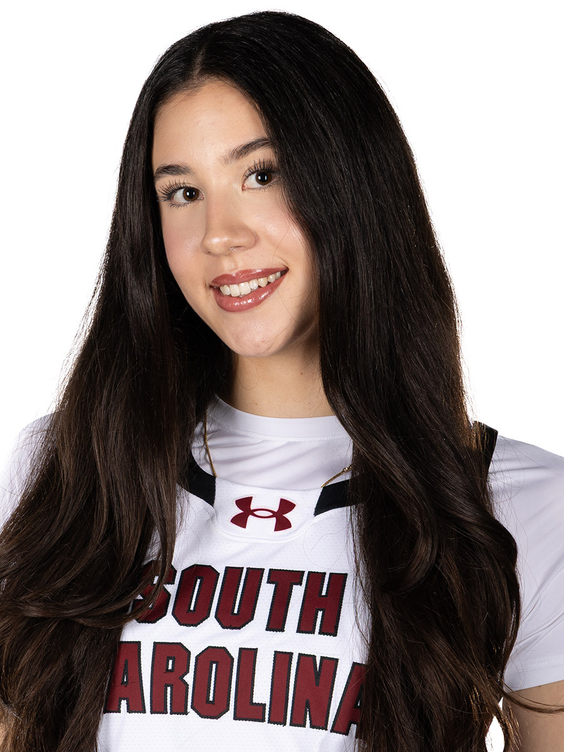
There is a moment that tells you everything you need to know about Alicia Tournebize’s raw, untapped potential. During South Carolina’s open practice session at the Final Four, ESPN sideline reporter Holly Rowe was mid-sentence, conducting a live interview with Dawn Staley at midcourt, when the entire crowd suddenly erupted. Rowe, visibly caught off guard, paused and looked around trying to understand what had stolen the room’s attention. The answer was simple. Alicia Tournebize had just thrown down a thunderous dunk — and nobody in that building could look away.
A few minutes later, as South Carolina’s practice window was nearly up, assistant coach Khadijah Sessions wasn’t ready to let the moment pass. She emphatically urged Tournebize to do it again. Somewhat reluctantly — almost casually, as if it were the most natural thing in the world — Tournebize obliged. The crowd erupted a second time.
And here’s the most stunning part of all of that: she was still just getting started.
The Raw Material Is Already There
What makes Tournebize’s dunking story so compelling isn’t just the act itself — it’s the context surrounding it. Those two Final Four practice dunks didn’t come after months of refinement in a South Carolina practice facility. They came from a 6-foot-7 teenager who had joined the Gamecocks mid-season in January, fresh off limited playing time in professional basketball in France, still adjusting to a new country, a new system, and one of the most physically demanding conferences in all of women’s college basketball.
She dunked anyway. Twice. While an ESPN reporter was on live television.
Now consider what happens when that same player has a full offseason — her very first as a Gamecock — to train under Dawn Staley’s staff, build her strength, absorb the culture, and fully settle into the rhythm of the program. The dunks at the Final Four weren’t a ceiling. They were a preview.
Dawn Staley has made her assessment of Tournebize’s upside abundantly clear, and when Staley speaks about a player’s ceiling, the women’s basketball world listens.
“Ali’s going to be a pro,” Staley told The State in February. “So her coming in a semester earlier means she’s gonna be a pro quicker. She could be a pro next year if she really wanted to be a pro. I don’t know how long we’ll have her. I hope we have her for another three years, but her talent is high level. I know she’s learning and growing, and I know she’ll learn and grow and get stronger here.”
That is not boilerplate coach-speak. That is a program architect identifying generational talent and putting the entire sport on notice.
The Wemby Comparison and What It Really Means
The coaching staff hasn’t been shy about drawing a striking comparison when describing Tournebize’s physical profile. Associate head coach and offensive coordinator Fred Binetti offered a reference point that frames Tournebize’s potential in terms that transcend women’s college basketball entirely.
“Obviously, when you’re that tall and you have such long limbs, I kind of look at her as someone like a Wemby — she’s got really good body control and movement but needs to gain a little bit of mass,” Binetti said.
Invoking Victor Wembanyama — the 7-foot-4 generational NBA talent celebrated precisely for combining extraordinary size with elite athleticism and body control — is not a comparison coaches make lightly. It speaks directly to what makes Tournebize so rare. Her size alone is imposing. But size without coordination is just height. What separates Tournebize is that at 6-foot-7, she moves with a fluidity and spatial awareness that players half her size often lack. Her dunks aren’t forced or awkward. They are natural extensions of how she plays.
Associate head coach Lisa Boyer was quick to add crucial context to the strength question — Tournebize is not weak. The distinction matters enormously. The kind of strength the staff is looking to develop isn’t about fixing a deficiency from scratch. It’s about fortifying a foundation that is already sound, building the physical durability to absorb the grind of SEC basketball night after night across a full season. That is a very different — and far more solvable — challenge.
One full offseason in South Carolina’s strength and conditioning program will go a long way toward answering that question.
A First Offseason That Changes Everything
There is an aspect of Tournebize’s development that hasn’t received nearly enough attention: this upcoming offseason will be the first time she has experienced a full South Carolina summer. When she arrived in January, the season was already in motion. There was no time for gradual acclimation, no extended preseason to find her footing. She was thrown directly into one of the hardest competitive environments in women’s college basketball — and she still managed to flash potential that, by the coaching staff’s own admission, is through the roof.
Now, for the first time, she gets to be a Gamecock from day one. She gets the full summer workouts, the full training camp, the complete installation of everything Dawn Staley’s program demands. She gets to internalize the culture, build chemistry with her teammates, and — critically — push her body in ways that weren’t possible mid-season.
When a player of Tournebize’s physical gifts gets that kind of runway, the growth can be dramatic. If she was throwing down dunks during open practice having barely settled in, the imagination runs wild thinking about what she is capable of producing once she is fully comfortable, fully conditioned, and fully unleashed.
Three Dunkers, One Roster, and the Competition That Breeds Excellence
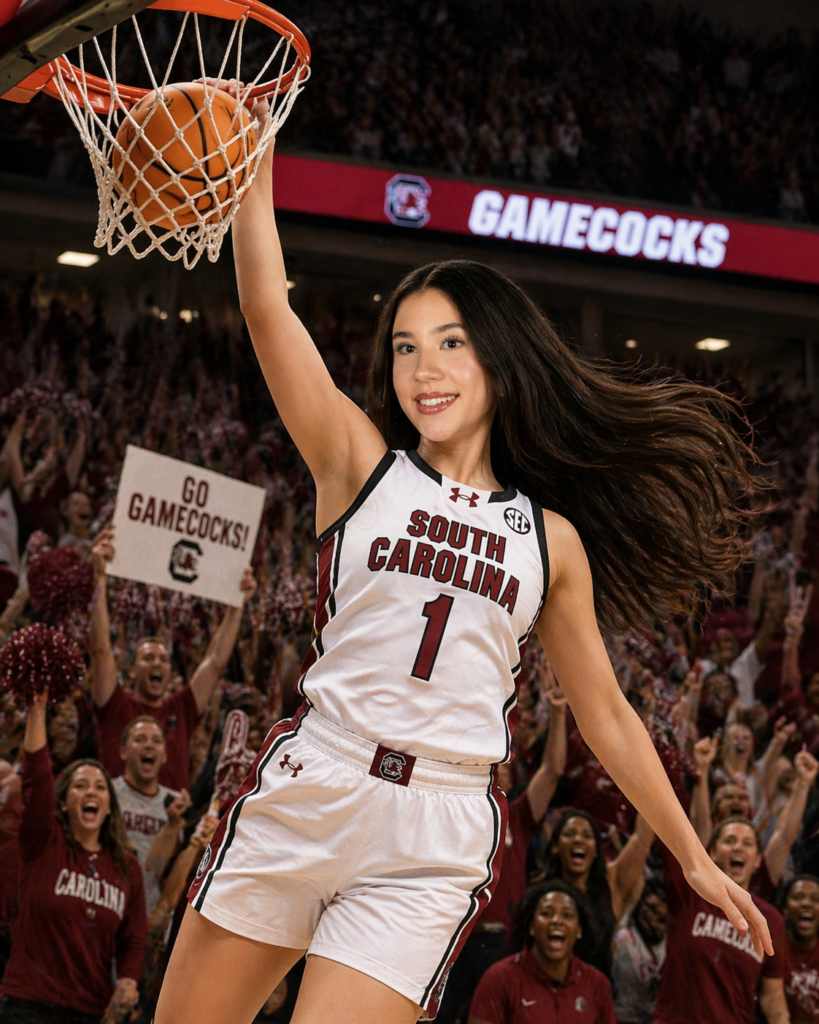
Perhaps the most fascinating dimension of Tournebize’s upcoming development is the environment she will be developing in. She will not be the only player on Dawn Staley’s roster capable of throwing down a dunk. She will be one of three.
Ashlyn Watkins — who has dunked three times in her career and won the McDonald’s All-American dunk contest in 2022 — is one of only nine women in history to ever dunk in an NCAA game. She is a walking benchmark for what explosive athleticism at 6-foot-3 looks like at the college level. Incoming five-star forward Oliviyah Edwards, the No. 3 recruit in the Class of 2026, dunked repeatedly during the McDonald’s All-American Game dunk contest, going viral with one-handed and two-handed slams that had players and fans alike losing their minds.
Now place Tournebize inside that environment. Place her alongside two women who understand what it means to throw down in front of a crowd, who have each developed their dunking ability with intention and purpose. The conversations alone — the shared knowledge of footwork, timing, approach angles, and body positioning — could accelerate her development in ways that individual training simply cannot replicate.
And if there is a competitive spirit between these three? Good. Competition among teammates in a healthy program environment doesn’t fracture chemistry. It raises the collective standard. If Watkins challenges Tournebize to meet her in the gym. If Edwards’ explosive viral moment lights something in Tournebize’s competitive fire. If the three of them push each other to be better, stronger, and more dynamic every single day — then South Carolina doesn’t just have three players who can dunk. It has three players who are actively trying to out-dunk each other in service of a common goal: winning another national championship.
When there is genuine internal competition, there is growth. And when that growth is happening at the most physically gifted positions on one of the nation’s elite programs, everyone benefits.
The Crowd Is Already Waiting
Gamecock fans have already seen the trailer. They were there — or they watched online — when Tournebize interrupted Holly Rowe’s interview with the sound of the crowd erupting around her. They saw Coach Sessions pleading with her to do it one more time. They saw her do it with the nonchalance of someone who has no idea just how extraordinary she is.
Next season, in the full lights of Colonial Life Arena, with a packed house of FAMS who have been waiting all offseason to see what she becomes — the expectation is no longer curiosity. It is anticipation. The kind that builds when you’ve watched something extraordinary happen in a practice setting and you know, intuitively, that the real stage is going to bring out something even greater.
Dawn Staley doesn’t just recruit talent. She architects transformation. She took a 6-foot-7 teenager from France, midway through a college basketball season, in the most demanding women’s conference in the country — and still couldn’t keep her from dunking at the Final Four.
Give her an entire offseason. Give her Watkins and Edwards to compete with. Give her a full South Carolina summer in the weight room and on the practice floor.
The open practice dunks that interrupted Holly Rowe’s interview? Those were just the warm-up. The real show is coming — and rivals should probably start preparing now.
About The Author