The Size Argument: Dawn Staley’s Frontcourt Is Unlike Anything in America

The Real SC: When Two Basketball Empires Collide, Only One Can Claim the Crown
There is a debate that has been simmering in women’s college basketball circles for years now, one that lives at the intersection of brand identity, program prestige, and pure basketball excellence. Who is the Real SC? When South Carolina and USC share a court — two programs that wear those two letters with pride and conviction — the question stops being rhetorical. It becomes a game. And in November 2026, when these two loaded rosters meet, it becomes one of the most anticipated early-season matchups women’s college basketball has seen in years.
Both programs enter 2026-27 with rosters that are, by any objective measure, terrifying. Both have talent from top to bottom. Both have size, skill, and star power. But side by side, these two rosters tell very different stories about how a program is built, how a program is maintained, and ultimately, who is built to rule the sport at its highest level.
Let’s get into it.
Start with the most visually striking difference between these two rosters and it becomes immediately apparent why South Carolina’s program occupies a category of its own.
The Gamecocks’ 2026-27 roster fields eight players at 6’2 or taller. Eight. Not a starting five with some depth — eight legitimate contributors who cannot be undersized at any position on the floor. The tallest player on the USC roster is 6’6 Pania Davis. She would not even be the tallest player on South Carolina’s bench. Alicia Tournebize stands at 6’7, Adhel Tac at 6’5, Oliviyah Edwards at 6’4 — and all three of those players are capable of dunking a basketball in a game.
That is not a size advantage. That is a structural imbalance that opposing coaches have to account for in their entire defensive scheme before a single play is drawn up.
USC’s frontcourt isn’t a weakness by any normal standard. Vivian Iwuchukwu and Dayana Mendes at 6’3, Sara Okeke and Sitaya Fagan at 6’4, and Pania Davis at 6’6 form a formidable big rotation. Against most programs in the country, that group would be dominant. Against South Carolina’s interior? The Trojans will be tested in ways they rarely face in the Big Ten. The Gamecocks don’t just have size — they have size that can move, create, and finish above the rim. The Wembanyama comparison coaches have drawn for Tournebize isn’t just flattery. It’s a scouting problem.
Gamecocks 2026-2027 Roster (B/R)
5’9 Maddy McDaniel | 6’0 Jordan Lee | 6’0 Tessa Johnson | 6’0 Jerzy Robinson | 6’1 Agot Makeer | 6’1 Ayla McDowell | 6’2 Chloe Kitts | 6’2 Kaeli Wynn | 6’3 Kelsi Andrews | 6’3 Joyce Edwards | 6’3 Ashlyn Watkins | 6’4 Oliviyah Edwards | 6’5 Adhel Tac | 6’7 Alicia Tournebize
Trojans 2026-2027 Roster (B/R)
5’8 Ryann Bennett | 5’9 Brooklyn Shamblin | 5’11 Riann Forestier | 6’1 Saniyah Hall | 6’1 Kennedy Smith | 6’1 Jazzy Davidson | 6’2 JuJu Watkins | 6’2 Laura Williams | 6’3 Vivian Iwuchukwu | 6’3 Dayana Mendes | 6’4 Sara Okeke | 6’4 Sitaya Fagan | 6’6 Pania Davis
Advantage: South Carolina — and it isn’t particularly close.
The Star Power Question: JuJu vs. Everyone in Garnet
If South Carolina wins the size battle decisively, USC answers with the single most electric name in women’s college basketball not named Caitlin Clark or Paige Bueckers: JuJu Watkins.
At 6’2, Watkins isn’t just a star — she is the kind of generational talent that reorients how entire games are played. She draws defensive attention before she touches the ball. She commands double teams. She creates for teammates. She takes over fourth quarters. Every arena she plays in is locked in on her from tip-off. She is, in the simplest terms, a problem that no team in the country has fully solved.
But here’s where the South Carolina comparison gets interesting. The Gamecocks don’t have one player that functions as JuJu Watkins. They have something different — and in many ways, something harder to stop. They have a collective.
Joyce Edwards, the Gamecocks’ reigning single-season scoring record holder at 19.5 points and 6.7 rebounds per game, is an All-American talent in her own right. Tessa Johnson, who led the SEC in three-point shooting, is a genuine threat from range who forces defenses to extend. Agot Makeer is the kind of long, explosive wing defender who makes opposing scorers miserable on one end and can explode on the other. Ashlyn Watkins — no relation to JuJu — is one of only nine women in history to dunk in an NCAA game.
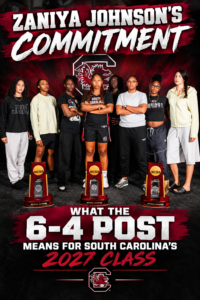
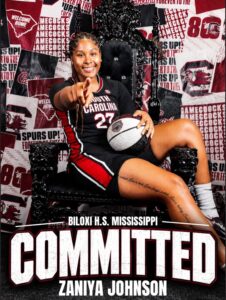
And then Oliviyah Edwards, before she’s played a single college minute, arrives as a viral phenomenon and top-2 national recruit who dunked in the McDonald’s All-American Game dunk contest with a nonchalance that made seasoned scouts stop and stare.
JuJu Watkins is the most individually dominant player in this matchup. But no defensive scheme can simultaneously account for Joyce Edwards, Tessa Johnson, Agot Makeer, Oliviyah Edwards, and Ashlyn Watkins. The Gamecocks have weapons everywhere. That depth of collective star power is what makes South Carolina uniquely difficult to prepare for — a truth Ole Miss head coach Yolett McPhee-McCuin communicated perfectly in 2024 when she said: “You cannot prepare for one, two, three, four, or five players for South Carolina. You gotta prepare for the whole group.”
Advantage: USC for individual star power. South Carolina for collective firepower. Slight edge: South Carolina.
Guard Play: Speed, Skill, and the Backcourt Battle
This is where USC makes its most compelling case. With JuJu Watkins as the fulcrum and Kennedy Smith, Jazzy Davidson, Brooklyn Shamblin, and Ryann Bennett surrounding her in the backcourt, the Trojans can push pace, create in isolation, and generate offense in a variety of ways. Their guards are experienced, skilled, and operating in a system designed to maximize their initiative.
South Carolina’s backcourt has undergone a meaningful transformation heading into 2026-27. Jordan Lee — who averaged 13.2 points, 2.5 assists, and shot 48.2% on two-pointers in her sophomore season at Texas — brings proven SEC-level scoring to a team that already has Tessa Johnson and the incoming Jerzy Robinson, the No. 5 recruit in the entire 2026 class. Maddy McDaniel holds down the point guard role with steady, reliable decision-making.
What South Carolina’s guards have that USC’s don’t is something that cannot be replicated in a recruiting portal visit or a transfer window: experience in the highest-pressure moments women’s college basketball produces. Tessa Johnson has played in national championship games. Joyce Edwards has carried offensive loads when the lights were brightest. Lee arrived battle-tested from the SEC grind. These aren’t players who will be introduced to the moment in November — they’ve already lived in it.
Advantage: Edge to USC in individual guard explosiveness. Edge to South Carolina in guard experience and system fit.
The Incoming Class Factor: Freshmen Who Change Everything
Both programs are welcoming significant incoming talent, but South Carolina’s incoming class operates at a level that borders on unfair.
Oliviyah Edwards, the No. 2 recruit in the country, is already one of the most talked-about players in the sport before stepping onto a college court. Kelsi Andrews at No. 30 brings frontcourt length and versatility. Kaeli Wynn at No. 17 adds depth and athleticism. Jerzy Robinson at No. 5 gives the backcourt another elite option from Day 1. Taken together, South Carolina’s incoming class is being assembled the way a general manager builds a championship team — position by position, with purpose, with no obvious weaknesses filled by afterthoughts.
USC’s incoming additions are meaningful and well-targeted, but they don’t arrive with the same collective national profile. When your program’s biggest incoming name is the No. 2 recruit in the country who can dunk and already has viral national recognition, the recruiting battle isn’t particularly competitive.
Advantage: South Carolina, significantly.
The Championship Pedigree Factor
There is one variable in this comparison that no roster graphic, recruiting ranking, or statistical analysis can fully capture: what it means to be Dawn Staley’s South Carolina Gamecocks.
South Carolina has appeared in three consecutive NCAA Championship games. They have built a culture that converts elite recruiting rankings into national titles — not just tournament appearances, not just conference championships, but banners. The pressure in Columbia isn’t to compete for a championship. It’s to win one, every single year.
That expectation, and the organizational infrastructure Staley has built around it, is the invisible factor that separates the Gamecocks from every other program in women’s college basketball. USC is building something real and exciting under their coaching staff. The growth has been genuine. The roster is legitimately elite. But building toward a championship and operating as the standard of championship basketball are two different realities.
When these two teams meet in November, one program will bring championship rings to the court. The other will bring the hunger to eventually earn them.
The Verdict: Who Is the Real SC?
Both programs will field rosters that could beat almost anyone on a given night. USC’s backcourt depth and the singular brilliance of JuJu Watkins make them a legitimate threat to anyone in the country. This is not a team to dismiss, and their early-season matchup with South Carolina will be genuinely competitive, genuinely electric, and genuinely worth every piece of hype it is already receiving.
But when the dust settles and the rosters are laid side by side — the size, the depth, the incoming talent, the championship pedigree, the collective firepower that makes scheming against them an exercise in futility — one conclusion is unavoidable.
South Carolina doesn’t just have more talent. They have more of everything. More height. More proven scorers. More elite recruits. More championship experience. And in Alicia Tournebize, Ashlyn Watkins, and Oliviyah Edwards, they have something no other women’s college basketball program on earth can claim: three players on the same roster who can throw the ball through the hoop.
In November, when these two programs meet and the question of the Real SC gets answered on the floor, the smart money says the answer comes back the same way it always has.
There is only one South Carolina.
And she wears Garnet and Black.
About The Author