Geno Auriemma Finally Admitted He Felt “Dumb” For What Happened With Dawn Staley At The Final Four — But His Defense Of Himself Reveals Exactly Why The Moment Still Stings
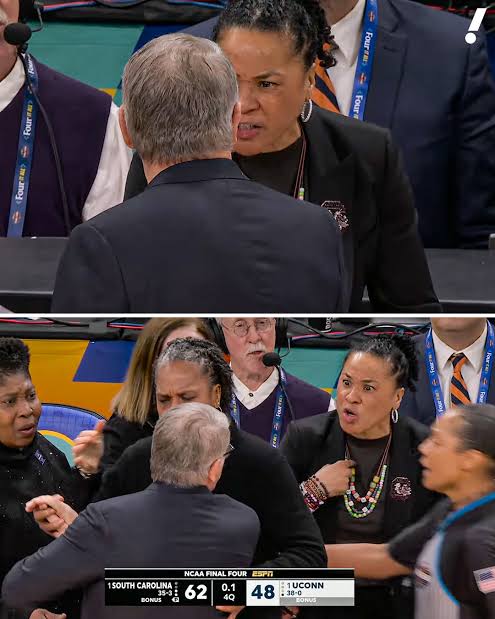
Six weeks is apparently what it takes for Geno Auriemma to process a public embarrassment of his own creation. The UConn head coach returned to the podium Monday for his first news conference since the Final Four in Phoenix — where his heated sideline confrontation with Dawn Staley in the closing seconds of South Carolina’s 62-48 victory turned a basketball game into a national conversation — and he arrived with words that sounded like contrition but carried the unmistakable subtext of a man who still believes history will vindicate him.
“When I walked into the locker room afterward with the coaches, you are just shaking your head, thinking five more seconds, you couldn’t keep it in for five more seconds,” Auriemma said. “You just feel dumb for the way that it played out. We are all human and we all do dumb (stuff).”
The acknowledgment is genuine enough on its surface. Auriemma is not denying the moment happened, not reframing what the nation watched with its own eyes. He felt dumb. He said so publicly. The word itself carries a specific and meaningful weight — not that what he did was wrong in principle, as he would articulate in the sentences that followed, but that the timing was indefensible and the execution was self-defeating. Five more seconds of composure and it never becomes the story. He couldn’t find those five seconds. He knows it.
But the self-criticism ends precisely where it becomes most analytically interesting — because what Auriemma built around that admission reveals that the contrition is significantly narrower than it appeared.
The Confrontation: What Actually Happened
The facts require no embellishment. In the closing seconds of a South Carolina Final Four victory that was never truly in doubt — a 62-48 outcome that represented a dominant, comprehensive Gamecock performance — Auriemma left his bench, approached Dawn Staley, and appeared to chastise her while coaches from both programs had to intervene to separate them. When the game concluded, he walked directly to the locker room without returning to shake hands with anyone from South Carolina. He later issued a written apology.
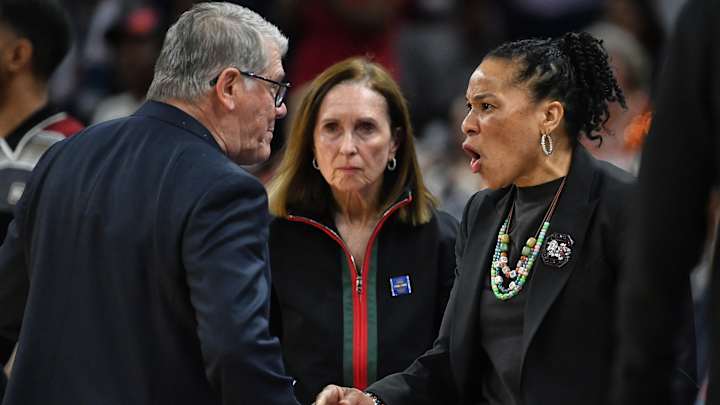
Auriemma’s stated explanation — that the exchange concerned the absence of a traditional pregame handshake between the coaches — did not satisfy the national audience that watched it unfold, and it does not fully satisfy the analytical framework either. A pregame protocol disagreement does not require a public confrontation in the final seconds of a nationally televised game that your team is losing by fourteen points. The choice of moment, the choice of venue, and the choice to abandon the postgame handshake entirely are not incidental details — they are the story.
The Defense That Undermines the Apology
Here is where Auriemma’s remarks become analytically revealing in ways that complicate the straightforward contrition narrative his opening quotes suggested.
“I didn’t see a lot of it, but that is to be expected,” he said of the backlash. “I think maybe some of it was warranted and some of it was people have been lying in the weeds waiting for that moment.”
That sentence — “lying in the weeds waiting for that moment” — is not the language of a man who has fully accepted accountability for creating the conditions that made the moment possible. It is the language of a man who believes the reaction to his behavior was partially manufactured, partially opportunistic, and partially driven by critics who were looking for an excuse to come for him specifically.
“Unfortunately, that is the world that we live in today and it usually is one-sided,” he continued. “The people who understood what it was all about in a different light, they are not going to go on the air and say it. They are not going to write about it because now they are going against a major internet or media frenzy.”
The argument embedded in those sentences is both familiar and problematic. The suggestion that silent supporters — people who privately understood his perspective — were intimidated into silence by media frenzy implies that the public reaction was disproportionate, manufactured, or politically motivated rather than a genuine and organic response to watching a Hall of Fame coach berate a peer in the final seconds of a game his team was losing. That framing does significant analytical work in the service of Auriemma’s self-image.
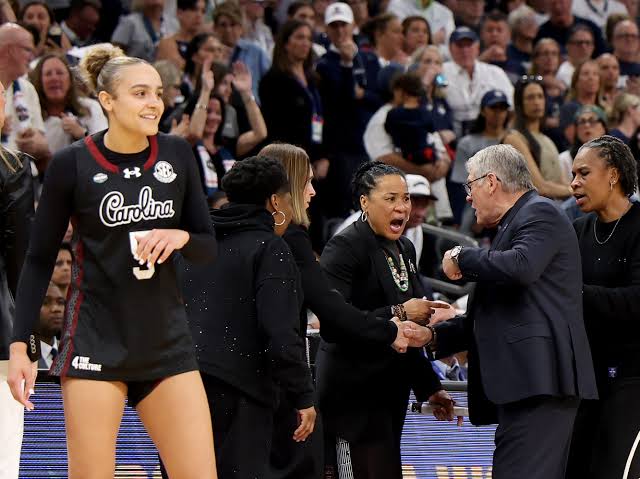
“I brought the criticism on myself. I didn’t bring the (stuff) that came after it on myself.”
Parsed carefully, that sentence is not an apology. It is a distinction — between the criticism he accepts responsibility for generating and the specific nature and volume of the reaction he believes was unfair. He owns the spark. He disputes the fire.
The 1998 Comparison: A Telling Historical Reference
Auriemma reached for a historical parallel that deserves its own analytical scrutiny. He compared the backlash to the reaction that followed his 1998 decision to arrange for injured Nykesha Sales to make a basket so she could set the program’s career scoring record — a controversial moment that generated significant criticism at the time.
“Immediately, it was the worst thing to ever happen to the game of basketball and to sports in general,” he said. “These things that happen, you take them all with a grain of salt, understand them. I did what I did, I apologized for it and I moved on.”
The comparison is instructive, but not in the way Auriemma intends it. The 1998 Sales moment involved a genuinely debatable act of coaching generosity toward an injured player — a move that had a defensible human motivation even if its competitive ethics were questioned. What happened in Phoenix involved walking across a basketball court to confront a peer in the final seconds of a nationally televised loss, in front of thousands of fans and a broadcast audience, in a manner that required physical separation by other coaching staff. The analytical equivalence between these two situations is not self-evident.
What the comparison does reveal is a pattern: Auriemma processes criticism of his most controversial moments as temporary media storms that will eventually pass, after which history will reassess his intentions fairly. Whether that reassessment comes for the Phoenix confrontation remains genuinely uncertain.
UConn’s Forward Look: The Basketball Still Gets Played
To Auriemma’s credit, he arrived at the podium with a forward-looking basketball agenda that deserved its own examination — and the picture he painted of the 2026-27 Huskies is simultaneously ambitious and analytically honest about the challenges ahead.
Despite losing two starters, including No. 1 overall WNBA pick Azzi Fudd, UConn finished 38-1 and figures to remain among the sport’s elite programs. Auriemma opted against adding transfers, choosing instead to develop from within — a philosophical decision that reflects both his historical preference for player development and his confidence in the returning core.
“People have to get better,” he said. “You want your players to get better and improve from one year to the next. Blanca (Quinonez) going from playing 17 minutes a night to playing 27-30 minutes a night, I think changes the dynamic of the team. Sarah (Strong) probably getting more touches, probably playing 30 minutes per game.”
The internal development projection is sound analytically. Strong — the reigning national player of the year — is recovering from leg inflammation that limited her practice availability during the postseason, and she has declined USA Basketball commitments this offseason to prioritize full recovery. A healthy, fully loaded Sarah Strong operating at 30 minutes per game in an offense that can now funnel more touches her way is a genuinely formidable foundation.
“The new kids that are coming in are going to give us a little bit of a different look than we had. We have really good guards on our team but none of them are exactly what Jovana (Popovic) is; our big kids are going to get better. Olivia (Vukosa) is a little different than what we have right now. We will look a little different, but the core of the team is back,” Auriemma said.
The return of Morgan Cheli — who showed genuine promise in limited freshman minutes before an ankle injury erased her sophomore season — adds a wildcard element that could meaningfully expand UConn’s rotational options if her recovery holds.
The Bigger Picture: What Monday’s Press Conference Actually Told Us
Strip away the basketball projections and what Auriemma’s Monday press conference actually revealed is a man operating with a carefully constructed internal narrative about the Phoenix confrontation — one where he acknowledges the tactical error of the moment’s timing while quietly maintaining that the underlying grievance was legitimate and the resulting criticism was partially unjust.
That is a very different posture from the one his opening words suggested. “You just feel dumb for the way that it played out” sounds like full accountability. “People have been lying in the weeds waiting for that moment” sounds like something considerably more defensive. Both sentences came from the same press conference, within minutes of each other.
Dawn Staley won that game 62-48. She won the public conversation that followed. And six weeks later, the most storied coach in women’s college basketball history stood at a podium and said he felt “dumb” — while simultaneously suggesting that much of what came next wasn’t something he brought on himself.
South Carolina plays again next November. So does UConn. The rematch, when it comes, will carry the weight of everything that happened in Phoenix — and everything that was said, and not fully said, on Monday. 🐓
About The Author