Dawn Staley’s Masterclass in Recruiting: Assembled a Roster dunkers, PG, Guards, Sharp Shooter — And She’s Not Even Done Yet
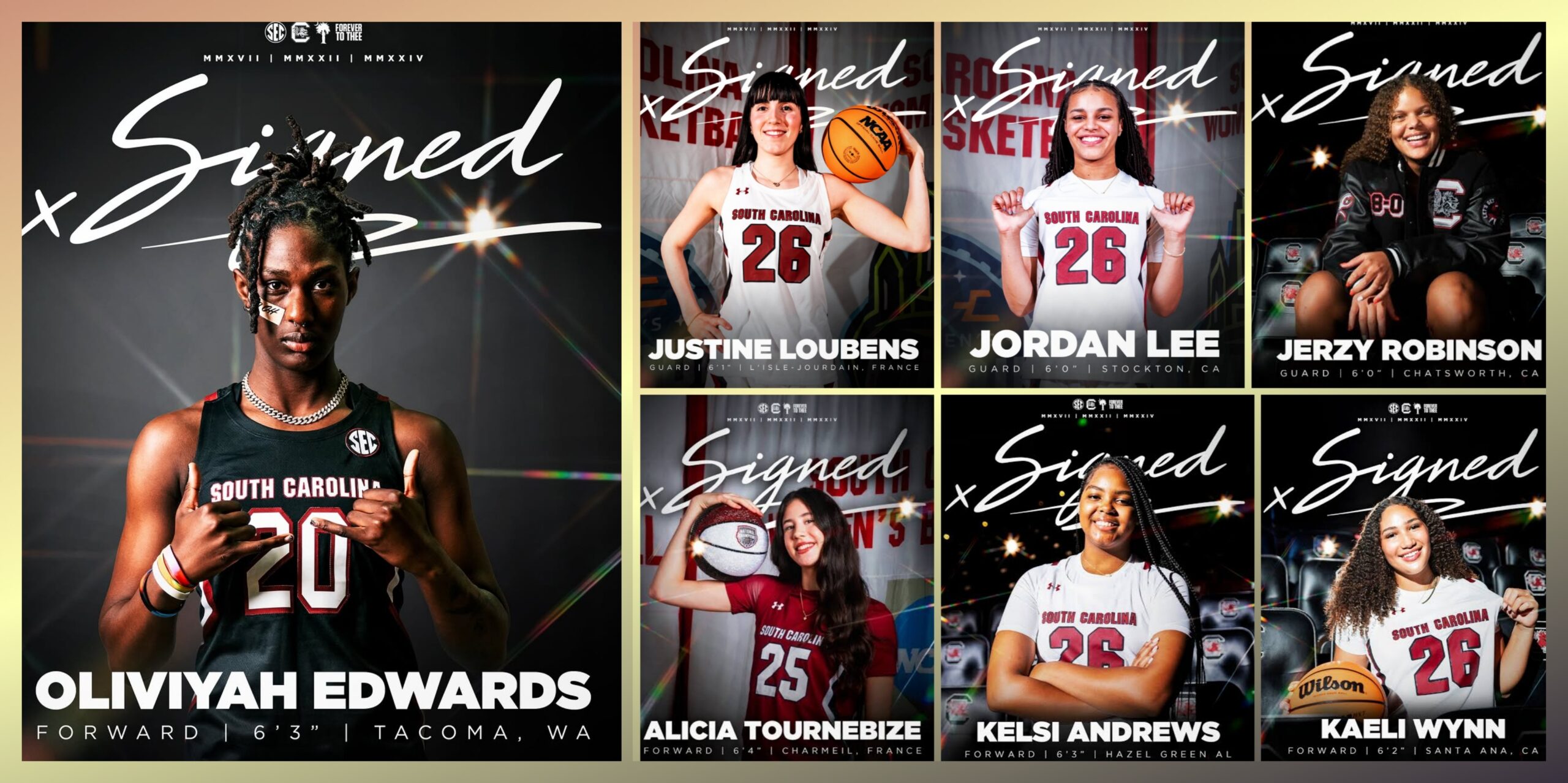
The national championship loss to UCLA still stings. But Dawn Staley’s response to that defeat wasn’t panic — it was a recruiting blitz that has reshaped the outlook for 2026-27 so dramatically that the Gamecocks are now being discussed in the same breath as the greatest classes in program history.
Five freshmen are headed to Columbia. Two of them are top-five talents in the country. And the expert who knows this recruiting landscape better than almost anyone is making it clear: this class is different.
A Class Built in Layers
South Carolina’s incoming group reads like a wish list. Five-star Oliviyah Edwards arrives as the No. 3 recruit in the nation — a 6-foot-3 forward who was previously committed to Tennessee before being released from her scholarship in April and signing with South Carolina shortly after. Five-star Jerzy Robinson comes in ranked No. 6 nationally. Five-star Kaeli Wynn is No. 19. Four-star Kelsi Andrews, South Carolina’s first commitment in this class, ranks No. 30 — among the highest-rated four-stars in the entire country. And rounding out the group is French international prospect Justine Loubens, who ESPN recruiting analyst Shane Laflin considers a four-star talent even though international prospects fall outside the standard Top 100 ranking system.
In one recruiting cycle, Staley assembled four players in the top 30, two of them in the top five. ESPN’s final rankings placed South Carolina’s 2026 class at No. 2 in the nation — up from No. 4 in March — a jump driven almost entirely by the late addition of Edwards and Loubens in April.
“Dawn doesn’t bring in untalented classes,” Laflin told The State. “But, I mean, this is two top five talents, right? And then two others that had been injured and very well could have been higher than that. It’s just kind of how the chips fell for them. This class stacks up there. … Four kids in the top 30, two of them essentially top-five players in that range. It’s got to be up there.”
The Edwards Effect
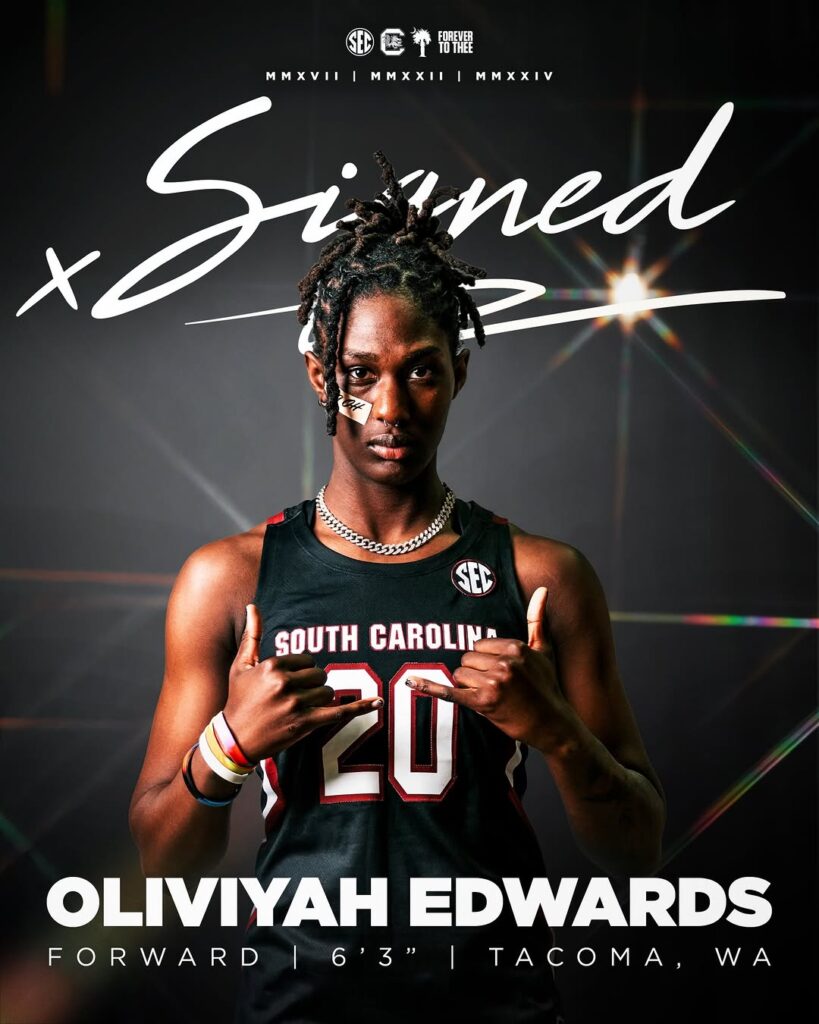
No single addition reshaped the trajectory of this class more than Oliviyah Edwards. Her late arrival from Tennessee’s commitment list — she was released from her scholarship in April before immediately pivoting to South Carolina — injected top-three national class energy into a group that was already highly regarded.
Laflin described her plainly as a “massive outlier of a talent,” and elaborated on what her presence means for South Carolina’s overall class standing.
“It shoots them up into the discussion of the best class in terms of talent,” Laflin said. “Ultimately, our debate, as we finalize this, will come down to what Southern Cal has coming in, and then Texas as well. I think an argument could be made for any of them. Ultimately, I don’t think they would get the number one spot. … But adding Oliviyah late certainly shoots them into that conversation that they were not in before adding Oliviyah.”
Southern Cal held the No. 1 spot in ESPN’s final rankings, with Texas, Duke, and Notre Dame rounding out the top five behind South Carolina. But the margin between No. 1 and No. 2 in any given recruiting cycle is rarely a talent gap — it is often simply a matter of positional needs, injury histories, and the kind of subjective judgments that don’t always hold up once the games begin. South Carolina’s class has the raw material to outperform its ranking, and in Staley’s program, that has happened before.
The Historical Precedent Is Significant
The benchmark comparisons being drawn aren’t casual. Laflin explicitly connected this class to two of the most consequential recruiting groups in South Carolina’s modern era — the 2019 “Freshies” class and the 2021 class that went on to win two national championships. That is an extremely high bar, and the fact that a credible, independent evaluator is making that comparison before any of these five players have taken a single collegiate rep speaks to the quality of what Staley has assembled.
The 2026-27 season will mark only the second time in Staley’s nearly two-decade tenure in Columbia that the Gamecocks will carry a full 15-player roster — a structural milestone that reflects both the depth of the returning group and the ambition of the incoming class.
The Real Challenge: Fitting In, Not Standing Out
Here is where the analysis requires honesty: talent and minutes are not the same thing. South Carolina returns nine players from last season — every one of whom now carries championship-game experience — and adds proven Texas transfer guard Jordan Lee to the mix. The freshmen are not walking into a rebuilding program or a team searching for contributors. They are walking into one of the most veteran, battle-tested rosters in the country.
That creates a dynamic that the best recruiting services in the country cannot rank: the ability to subordinate individual instincts in service of a winning team structure. Staley’s program has a specific culture and a specific way of playing. Players who adapt thrive. Players who don’t find themselves on the bench regardless of their star rating.
Laflin was direct about this reality.
“I think all of them come in with the mentality that they know they’ve got to get better,” he said. “Some are used to playing with other good players, and from that mentality, and some are not. I think a lot of times with freshmen, understanding how to slide into that supportive role versus being that volume type of player is really an indicator of whether they’ll get on the floor. That’s going to be the thing they’ve got to learn within a group of returners and veterans that Dawn has.”
He also offered a nuanced read on how Staley historically manages the introduction of talented freshmen into high-stakes environments.
“I think Dawn has proven in the past to let her talent kind of get out there sometimes and learn the ropes, and then she reigns them back in, teaches them the lesson,” Laflin said. “I expect to see some early-season minutes, and then the rest will be how they adapt, which you just don’t know ’til the lights come on. … These players can certainly fit in multiple combinations, so they’ll give themselves an opportunity to be there.”
That is not a warning — it is a roadmap. Early-season chances, a learning curve, an adjustment period, and then the cream rising. It is the exact process that produced Aliyah Boston, Raven Johnson, Brea Beal, and the back-to-back champions before them.
What It All Points To
South Carolina lost the national championship game in April. By May, Dawn Staley had signed the No. 2 recruiting class in the country, secured the return of Ashlyn Watkins and Chloe Kitts from ACL injuries, and added a proven transfer in Jordan Lee. The roster for 2026-27 is being constructed with a singular purpose — to get back to that championship game and finish it differently.
The freshmen are not the answer by themselves. But combined with what is already in that locker room, they form one piece of a puzzle that, when assembled, has legitimate title contender written across every layer of it.
The lights will come on in November. Based on everything happening in Columbia right now, this group should be ready.
About The Author