More Than Basketball: Te-Hina Paopao Is Carrying an Entire Culture Into the WNBA
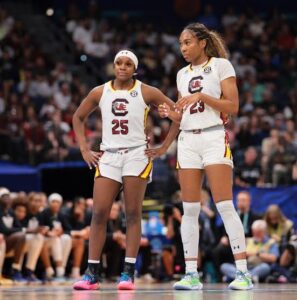
Two former South Carolina Gamecocks are making headlines in very different arenas this week — and both are doing it in ways that go far beyond the box score.
As Asian American and Pacific Islander Heritage Month takes center stage in May, Atlanta Dream guard Te-Hina Paopao has stepped into a role that transcends basketball. Meanwhile, in Manila, South Carolina sophomore Joyce Edwards is putting on a clinic in the FIBA 3×3 Women’s Series Pool Phase, delivering yet another performance that is turning international heads. Two former Gamecocks, two continents, one common thread: Dawn Staley’s program produces players who show up when it matters most — on and off the court.
Te-Hina Paopao: Carrying a Culture With Every Game She Plays
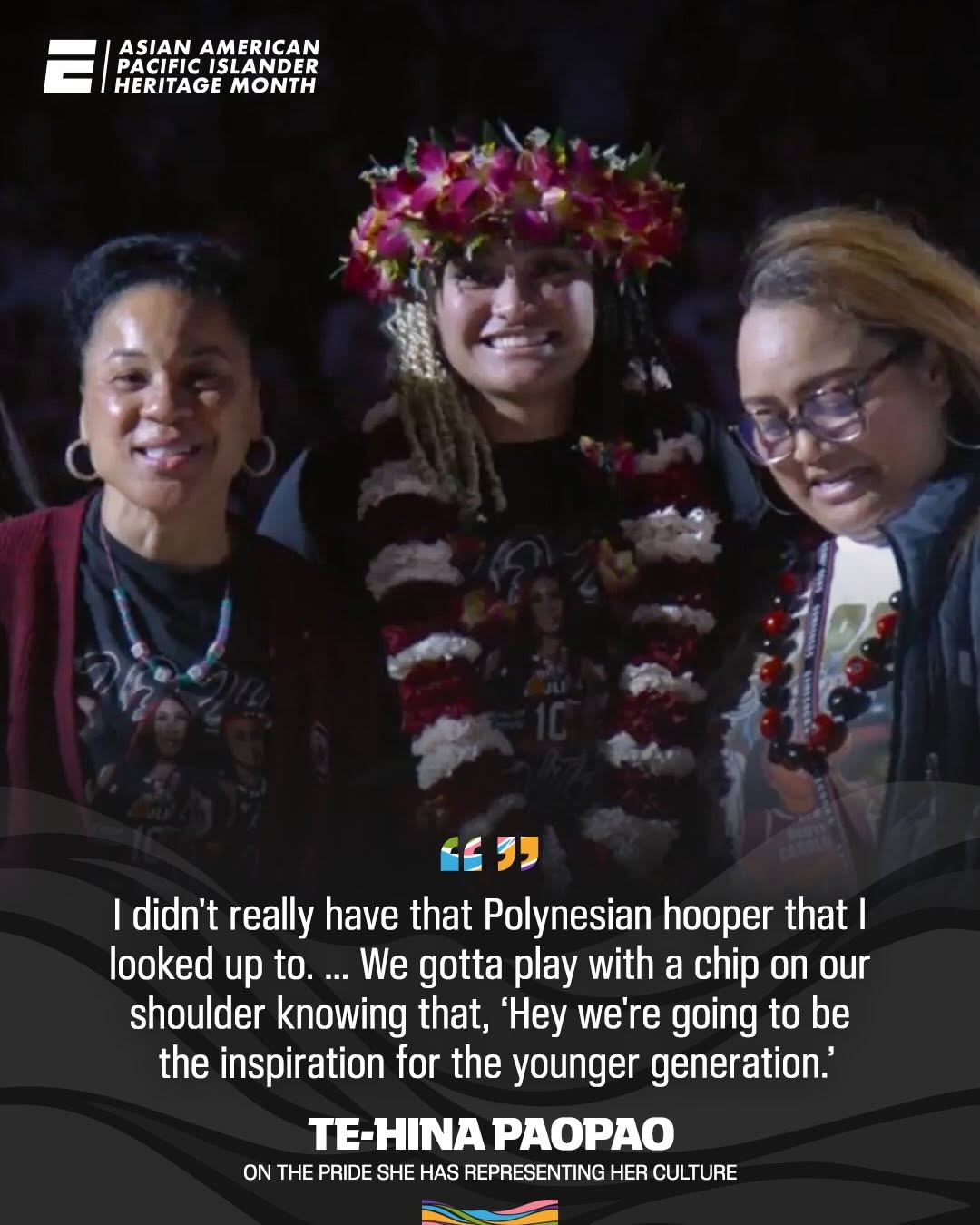
There is a photograph that tells Te-Hina Paopao’s story more powerfully than any statistic. She is standing with her family, draped head-to-toe in traditional Polynesian leis, the kind of elaborate, beautiful adornment that marks a moment of communal celebration in Samoan culture. The smile on her face isn’t the polished expression of a professional athlete at a promotional event. It is the genuine, radiating joy of someone who knows exactly where she came from and exactly who she is playing for.
Paopao, who wears No. 2 for the Atlanta Dream, carries dual Polynesian heritage — Tokelauan and American Samoan roots that she has never once hidden or downplayed in her rise through college basketball and into the professional game. In the spirit of Asian American and Pacific Islander Heritage Month, ESPN spotlighted the Dream guard this week, and what she said offers a window into a value system that has defined her since childhood.
“What makes Polynesians and Samoans so unique is the togetherness,” Paopao said. “We’re taught from a young age that family is important. That we just have to be genuine, support each other and love each other. It’s very important in our culture as well as my family to have sports be a part of who we are.”
Anyone who followed Paopao during her time at South Carolina recognizes that togetherness as a lived reality, not a talking point. Her family was a constant presence at games — in the stands, in the leis draped around her neck at senior ceremonies, in the community she brought with her everywhere she went. That isn’t unusual in the abstract; plenty of athletes have supportive families. What distinguishes the Paopao dynamic is the cultural intentionality behind it. For Polynesian families, showing up is a communal obligation, a declaration of values through presence. When her family fills seats at a Dream game, it is not just attendance — it is culture in action.
The Weight of Being a Pioneer
The most striking thing Te-Hina Paopao said this week was not about what she has achieved. It was about what she never had — and what she is determined to give someone else.
“I didn’t really have that Polynesian hooper that I looked up to,” she said. “We gotta play with a chip on our shoulder knowing that, ‘Hey we’re going to be the inspiration for the younger generation.'”
That statement deserves to sit with anyone who has watched Paopao play. She arrived at South Carolina as one of the most celebrated guards in recruiting, transferred from Oregon, thrived in Dawn Staley’s system, and developed into a WNBA player. Every step of that journey happened without a roadmap drawn by someone who looked like her at the highest level of the sport. She built the path herself.
That is the specific, clarifying weight that Polynesian and Pacific Islander athletes carry that players from more represented backgrounds often don’t have to think about. The visibility gap isn’t imagined. It is real, measurable, and felt by every young girl in American Samoa or Tokelau who watches the WNBA and searches for her reflection in the players on the court.
When Paopao says they have to play with a chip on their shoulder, she is not describing bitterness. She is describing purpose — the understanding that her performance on a professional basketball court carries meaning beyond wins and losses for a community that has been largely invisible in this space. She is the Polynesian hooper she never had. And she is bearing that responsibility with pride.
The intricate traditional tattoos visible across her arms and legs are not aesthetic choices. They are declarations of identity — cultural markers worn publicly and permanently, on a body that performs at the highest level of professional women’s basketball, seen by millions. For the young girls in Polynesian communities watching at home, seeing Te-Hina Paopao in a WNBA uniform with her heritage written across her skin is something that cannot be overstated in its impact.
The Gamecock Thread
What connects Te-Hina Paopao’s cultural pride in Atlanta is the same thing that has connected every former South Carolina player who has succeeded beyond Columbia: a program that develops the whole person, not just the athlete.
Dawn Staley’s teams are built on identity, accountability, and the conviction that what you stand for matters as much as what you produce. Paopao learned to carry her culture with pride at South Carolina. Edwards learned to compete at the highest level without apology. Both are now doing exactly that — one in a WNBA locker room during AAPI Heritage Month, the other under international lights in the Philippines.
The Gamecocks are everywhere. And in the month of May 2026, two of them are reminding the world exactly why.
About The Author