Dawn Staley Uses Columbia Black Expo Stage to Deliver a Master Class in Faith, Advocacy and Legacy
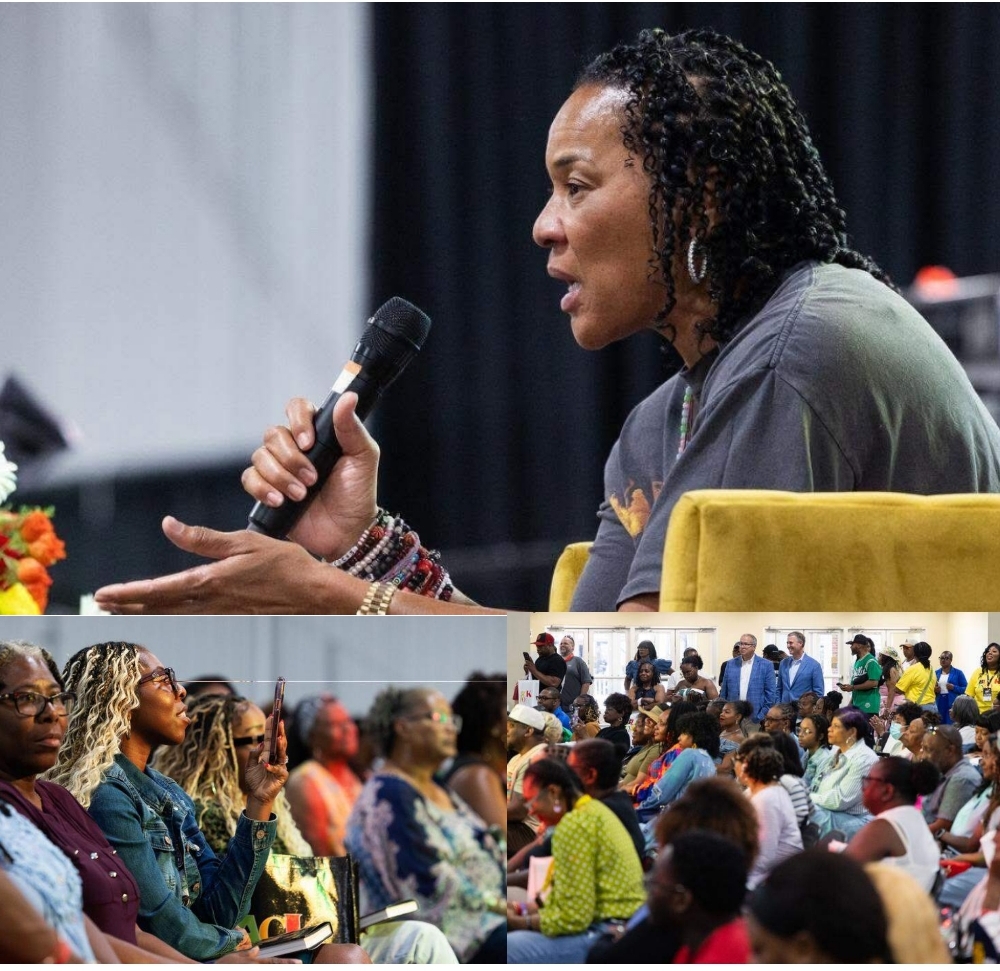
Dawn Staley has never been one to separate who she is from what she does. At Saturday’s Columbia Black Expo — now in its 29th year — the South Carolina women’s basketball coach made that connection as clear as ever, using a candid onstage conversation to trace a through-line from the projects of North Philadelphia to the pinnacle of college basketball.
Introduced as a “three-time champion coach,” Staley arrived not just as an athletics figure but as a community voice, and she delivered accordingly.
Faith as a Framework
Central to Staley’s remarks was a phrase she has leaned on publicly since South Carolina’s 2024 national championship: “uncommon favor.” She described it as blessings that defy conventional explanation — things “somehow bestowed on you” — and grounded it in a specific moment of spiritual reckoning.
The context matters here. South Carolina entered the 2023 Final Four undefeated and still fell short. Rather than frame that as failure, Staley used it as the setup for what came next: a truly perfect season in 2024, something she had never accomplished in her coaching career.
“I do think that was the Lord just saying, ‘I can show you better than I can tell you,'” she said.
That framing — viewing a championship not as the product of strategy alone but as something larger — reveals how Staley processes success. It also connects directly to her book, also titled Uncommon Favor, which she described as built around “13 life lessons” drawn from three pillars: basketball, her North Philadelphia upbringing, and her mother.
The Foundation Behind the Icon
Staley was unambiguous about what shaped her. She said she would not change growing up in “the projects” in North Philly, treating her origins not as a hardship to overcome but as a foundation to build upon. Basketball, she explained, served as both compass and shield.
“My neighborhood guys made sure they protected me from any negative things,” she said.
Her mother looms equally large in that origin story. Staley described a woman who cleaned houses and consistently put her children’s wants above her own needs — a standard of sacrifice that Staley said directly informs how she runs her program.
“She sacrificed her needs to give her kids their wants — not just their needs,” Staley said.
That distinction — wants versus needs — is a subtle but telling one. It speaks to Staley’s standard of excellence: doing more than the minimum, giving more than what’s required.
The Equal Pay Fight: Patience Over Emotion
Perhaps the most substantive portion of Saturday’s conversation centered on Staley’s well-documented pursuit of equal pay. Now earning $4 million annually as the highest-paid coach in college women’s basketball, she walked the audience through exactly how she got there — and it was a study in strategic patience.
Staley described comparing the sustained success of the women’s program against the pay trajectory on the men’s side and concluding that the disparity “didn’t quite sit well.” Critically, she framed it not as a personal grievance but as a matter of principle — a distinction that changes both the tone and the leverage of any negotiation.
Her tactical decisions were equally revealing. Rather than allow her agent to lead the charge, Staley said she asked her agent to “stand down” and instead hired a local lawyer — someone who understood the university’s internal dynamics and the community’s decision-makers.
“It took about six months to get it done,” she said.
The lesson embedded in that process goes beyond athletics. Staley emphasized knowing when to deploy emotion and when to set it aside, advocating for having both “mentors” — people who guide you daily — and “sponsors” — people “in the room where the decisions are being made.”
“The facts will speak for themselves,” she said.
That philosophy — building an airtight case and then letting it do the talking — is as applicable in a boardroom as it is in a contract negotiation. Coming from a Black woman who had to fight for pay that reflected her program’s dominance, it carries particular weight.
Legacy, Statues and the Weight of Representation
Eighteen years into her tenure in Columbia, Staley was candid about what the city’s support has meant. She credited the community’s relationship with Gamecock women’s basketball as something she feels she “cannot repay” — a remarkable statement from someone who has delivered three national championships.
The statue discussion added another dimension. Staley revealed that Columbia Mayor Daniel Rickenmann persuaded her to accept the honor by sharing a striking statistic: women represent approximately “4% of all statues” worldwide, with Black women comprising an even smaller fraction.
“I really can’t believe it,” she said.
That disbelief feels genuine — and it points to something important. For all her accolades, Staley remains attuned to the larger significance of her visibility. The statue isn’t just about her; it’s about who gets memorialized, whose legacy gets preserved in stone, and what that communicates to the next generation of young Black girls in Columbia and beyond.
She closed with a quote she attributed to a program fan, who passed it along from his grandmother: “When you treat people good, they treat you better.”
“That sums up my entire career,” Staley said.
It’s a simple line — but from a coach who has built a dynasty on culture as much as talent, it may be the most accurate summary of all.
About The Author