LaNorris Sellers Has a Point to Prove: Why South Carolina’s QB Situation Is More Promising Than His ESPN Ranking Suggests
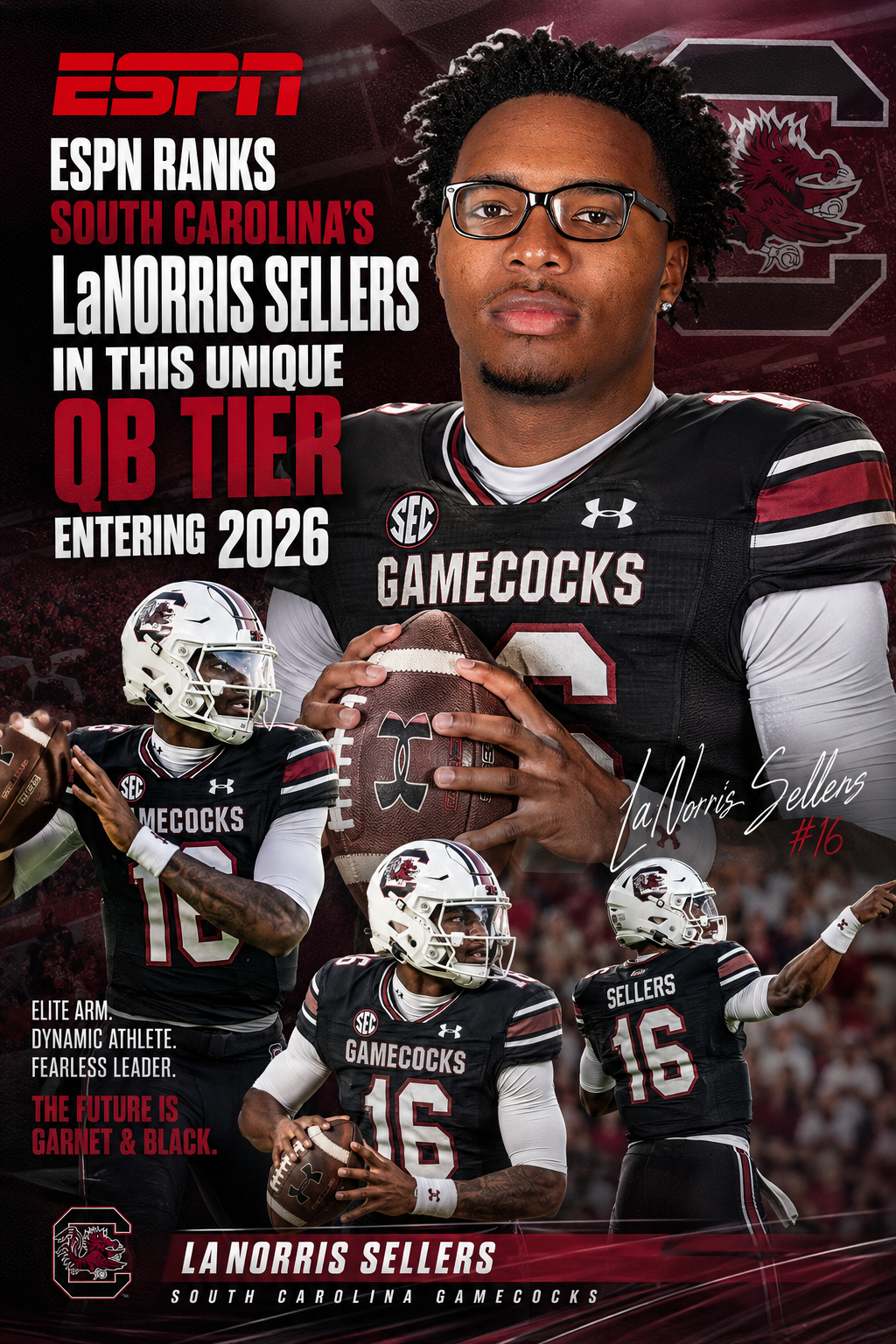
LaNorris Sellers is back in Columbia, and the conversation around his 2026 season is already one of the most compelling storylines in college football. A quarterback who looked like a rising star in 2024 before enduring a difficult and often brutal 2025 campaign, Sellers enters his third season with the Gamecocks carrying both the weight of regression and the genuine upside of a player who has not come close to his ceiling.
ESPN’s David Hale recently ranked every starting quarterback situation across all 138 FBS programs, placing Sellers in Tier 9 — labeled “Crafty Veterans” — and slotting him second behind Kansas State’s Avery Johnson. It is a placement that tells part of the story. The full story is considerably more interesting.
What the Numbers Say — and What They Don’t
Hale’s analysis of Sellers is grounded in real data, and the regression from 2024 to 2025 is not a narrative — it is documented and significant. His assessment was direct:
“Sellers forced 48 missed tackles in 2025 — the same total as 2024, when he seemed like the toughest QB on the planet to tackle. But his yards per rush went from 4.1 in 2024 to 1.8 in 2025, and his sack rate jumped from 8.7% to 11.1%. Sellers played eight teams that finished with a winning record in each of the past two years. In 2024, he was 4-4 and averaged 7.5 yards per dropback — seventh best among qualified Power 4 players. In 2025, he was 0-8 and averaged 5.51 yards per dropback, ranking 58th. His sack total nearly doubled from 18 to 34, too.”
Those numbers are damning at face value — and they accurately reflect how difficult 2025 was for Sellers from a statistical and situational standpoint. But there is critical context embedded in those same numbers that the ranking alone does not capture.
The 48 forced missed tackles figure is the most revealing data point in Hale’s entire excerpt, and it is perhaps the most underappreciated. Sellers produced that number in both 2024 and 2025 — identical totals — despite playing behind one of the most porous offensive lines in the SEC, absorbing a career-high 43 sacks, and operating under an offensive coordinator in Mike Shula whose scheme was so ineffective that Shane Beamer made the rare decision to fire him before the season even concluded. That Sellers was still making defenders miss at the same rate under those conditions is not a footnote — it is evidence of a player who was fighting through circumstances largely beyond his control.
The drop in rushing yards — from a dynamic open-field threat to a career-low 274 yards — was not a function of Sellers losing his athleticism or his instincts. It was a function of an offensive line that gave him nowhere to go and a play-calling structure that failed to create opportunities for him to operate in space. The system failed him far more than he failed the system.
The Infrastructure Around Sellers Is Transforming
The most important development heading into 2026 is not Sellers himself — it is everything being built around him. South Carolina’s offseason has been defined by a clear and urgent investment in fixing the problem that derailed the 2025 season before it started: the offensive line.
The Gamecocks have added transfers Jacarrius Peak and Emmanuel Poku to an offensive front that also benefits from the hiring of offensive line coach Randy Clements — a well-regarded developer of linemen whose arrival signals a philosophical commitment to protecting the quarterback and creating running lanes. Those are not marginal additions. They are direct responses to the single most identifiable reason Sellers’ numbers collapsed last year.
Perhaps even more consequential is the hiring of Kendal Briles as South Carolina’s new offensive coordinator. Briles brings a proven, uptempo scheme that has historically maximized the abilities of dual-threat quarterbacks — precisely the profile Sellers fits. Under Briles, the offense is not just projected to be better in 2026; it is projected to be structurally aligned with what Sellers does best.
Put simply: the quarterback did not change. The environment around him is being rebuilt from the ground up.
A Tier 9 Ranking With Tier 1 Potential
Placing Sellers in the “Crafty Veterans” tier alongside Syracuse’s Steve Angeli, Texas Tech’s Kirk Francis, and UCF’s Alonza Barnett III is a reasonable reflection of where he stands entering the season — a player with genuine talent whose recent production demands measured expectations. That is fair.
But the ranking was built on 2025 context. The 2026 context is meaningfully different. A healthier offensive line, a modern and quarterback-friendly scheme, and the maturity of a player who has experienced both breakout success and humbling adversity all point toward a significant bounce-back. Sellers still has the athleticism, the arm talent, and the competitive character that made him look like a program-defining player in 2024.
The 2025 season was a chapter, not a conclusion. And with the pieces now being assembled around him in Columbia, LaNorris Sellers has everything he needs to remind the country what he looked like when he was the toughest quarterback in America to bring down.
About The Author