Kendal Briles — is The Reason 2026 Is Nyck Harbor’s Year to Finally Deliver on Five-Star Promise
The résumé was always there. The physical tools were always there. The question surrounding Nyck Harbor was never whether he could become an elite wide receiver — it was always whether the right system, the right coach, and the right moment would arrive at the same time.
In 2026, for the first time in his South Carolina career, all three may have converged at once.
The Man Who Changed Everything
Harbor doesn’t speak about new offensive coordinator Kendal Briles the way a player talks about a coordinator. He speaks about him like someone who finally understands him.
“I love him,” Harbor said following his youth football camp Saturday in Columbia.
That’s a loaded statement — and it tells you everything you need to know about the relationship dynamic Briles has already established in Columbia. For a player who has spent four years at South Carolina steadily climbing toward his potential, finding a coach who not only recognizes what he has but actively builds around it is more than a tactical upgrade. It’s a transformational shift.
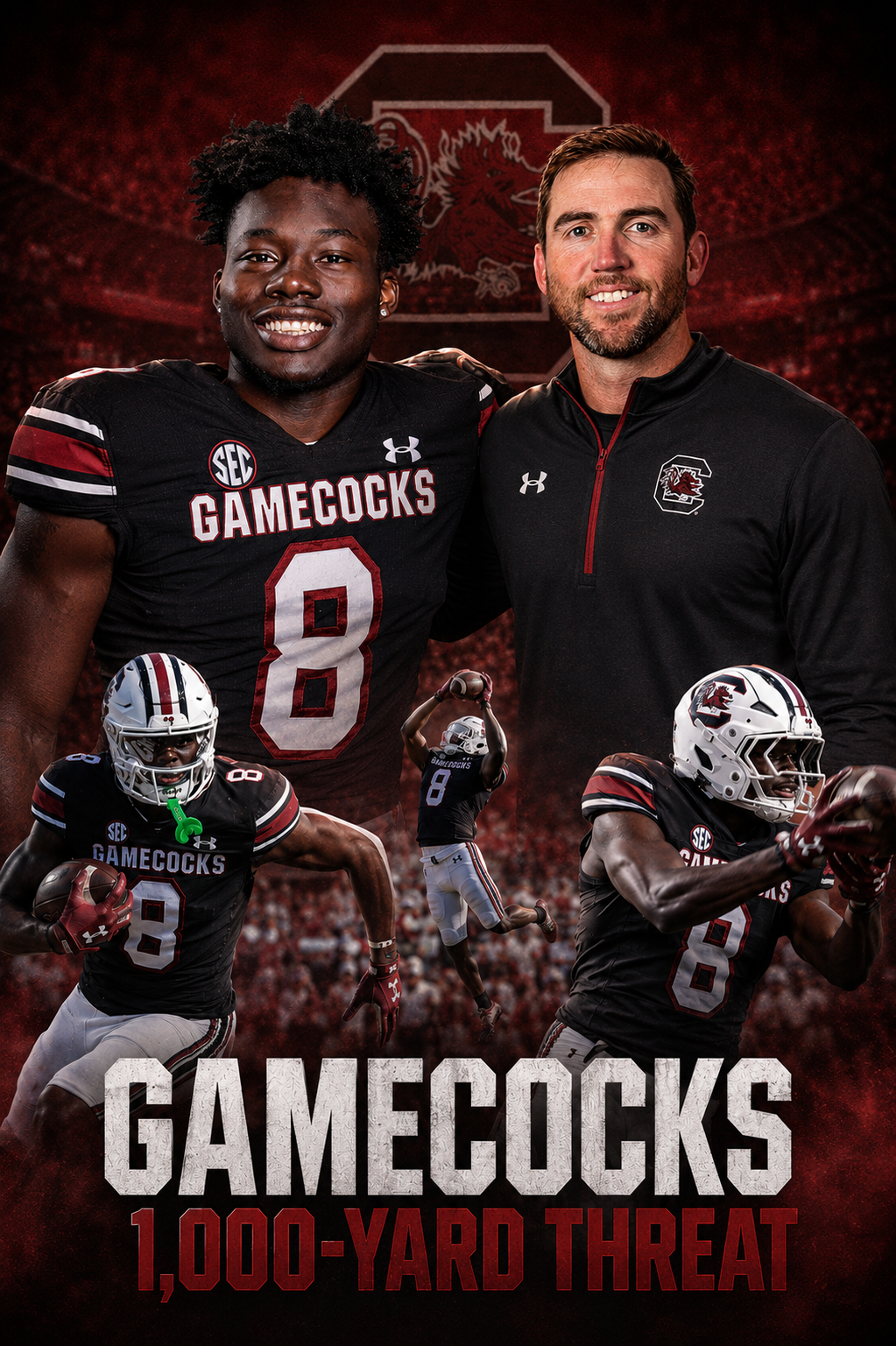
Briles, whose uptempo, spread-based offensive systems have consistently produced elite receiver production at every stop of his coaching career, didn’t just inherit Harbor. He recognized the weapon sitting in front of him — a 6-foot-5, 242-pound former Olympic Trials qualifier whose sprinting ability makes him one of the most physically freakish receivers in all of college football.
“He’s gonna get the ball to his playmakers,” Harbor said. “Coach Briles is giving me the opportunity to do what I want to do and, now, I’m ready for it.”
When pressed on exactly what that means, Harbor’s answer was simple but telling: “Putting me in spots to be me.”
That sounds like a sound bite. It’s actually a program indictment. For four years, South Carolina had an Olympic-caliber athlete at receiver who wasn’t consistently being put in spots to be himself. Briles’ arrival changes that premise entirely.
Four Years of Incremental Growth
To be fair to everyone involved, Harbor’s development arc has followed a logical — if frustratingly gradual — trajectory. He arrived in Columbia as a five-star prospect who had barely played receiver in high school, which created a learning curve that couldn’t simply be coached away in a single offseason.
Harbor himself breaks it down with striking self-awareness:
“First year was just learning to play receiver. Second year was, ‘OK, now you’ve played it, made a play or two, now can you be consistent with it?’ Third year was, ‘OK, now become the best deep threat in the country.’ Fourth year, now put it all together.”
The numbers validate that framework. As a true freshman in 2023, Harbor caught 12 passes for under 200 yards. As a sophomore, he hauled in 26 receptions for 376 yards. Last season, he elevated again — 30 catches, 600-plus yards, and a career-high 6 touchdowns. Each year, measurably better. Each year, still leaving the unmistakable sense that the ceiling hadn’t been touched.
That’s both the encouragement and the frustration of the Harbor story. A 600-yard, 6-touchdown season for a player with his athleticism profile is genuinely impressive. It is also well below what his tools suggest is possible. The question entering 2026 isn’t whether Harbor has improved — he clearly has. It’s whether the sum of four years of development plus the right offensive system plus the hunger born from a 4-8 season will finally produce the breakout everyone has been waiting for.
The 4-8 Shadow Hanging Over Everything
One of the most revealing moments in Harbor’s postgame comments had nothing to do with Briles, touchdowns, or personal milestones. It had to do with accountability.
“I feel just different this year,” he said. “Everybody’s willing to work, everybody’s coming in the building to work, nobody was playing around. I mean, we went 4-8 last year. That’s nothing to laugh about, and I think the whole building knows that.”
Those words carry weight — especially considering the Gamecocks’ coaching staff publicly identified a lack of leadership as a primary factor in last season’s collapse. A team that went 4-8 with the talent on South Carolina’s roster didn’t just underperform on the field; it underperformed as a program. The culture had cracks, and the people inside that building know it better than anyone.
Harbor is one of only three players on the Gamecocks’ roster — alongside DB Judge Collier and TE Maurice Brown — who have played three full seasons at South Carolina without a redshirt. That distinction matters. In a locker room being rebuilt around new offensive energy and renewed hunger, veterans with genuine institutional memory are invaluable — and Harbor is now being asked to operate as exactly that.
Wide receivers coach Mike Furrey has accelerated that transition deliberately. “He’s kind of given me the opportunity to be a mini-coach,” Harbor said. “Like sometimes he’ll tell me, ‘OK, you know what they (another WR) did wrong, go tell them that.'”
That’s not just a coaching technique — that’s succession planning. Furrey is transforming Harbor from the program’s most athletic receiver into its most influential one.
The Case for 1,000 Yards
The stars are aligning in a way they never quite have before. Briles’ offense — designed to create matchup nightmares and push the ball vertically — is tailor-made for a receiver who can run a sub-4.4 forty at 242 pounds. Redshirt junior LaNorris Sellers returns under center, providing the veteran quarterback connection that Harbor needs to operate within a fast-paced system. The offseason culture reset has produced what Harbor himself describes as a fundamentally different building.
All of that, combined with a player entering his senior season with four years of accumulated receiver knowledge and a burning motivation to erase last year’s embarrassment, creates a genuine 1,000-yard scenario.
But scenarios and production are two different things. Harbor has never had a 1,000-yard season. He has never averaged more than 20 yards per game in a single year. The tools, the system, and the circumstance are aligned — but football is played on the field, not on paper.
The Bottom Line
Nyck Harbor is a five-star prospect who spent four years learning how to be a wide receiver. That’s not a criticism — it’s context. The position was genuinely new to him, and he improved every single year without the benefit of a system built around his specific gifts.
Now he has that system. Now he has that coordinator. Now he has the motivation of a season he would rather forget and a senior year he doesn’t want to waste.
“He’s gonna get the ball to his playmakers.”
Nyck Harbor is South Carolina’s most dangerous playmaker. In 2026, Kendal Briles intends to prove it — and Harbor, for the first time in his college career, has every reason to believe him.
About The Author