The Coach Who Won’t Say No — But Won’t Say Yes Either
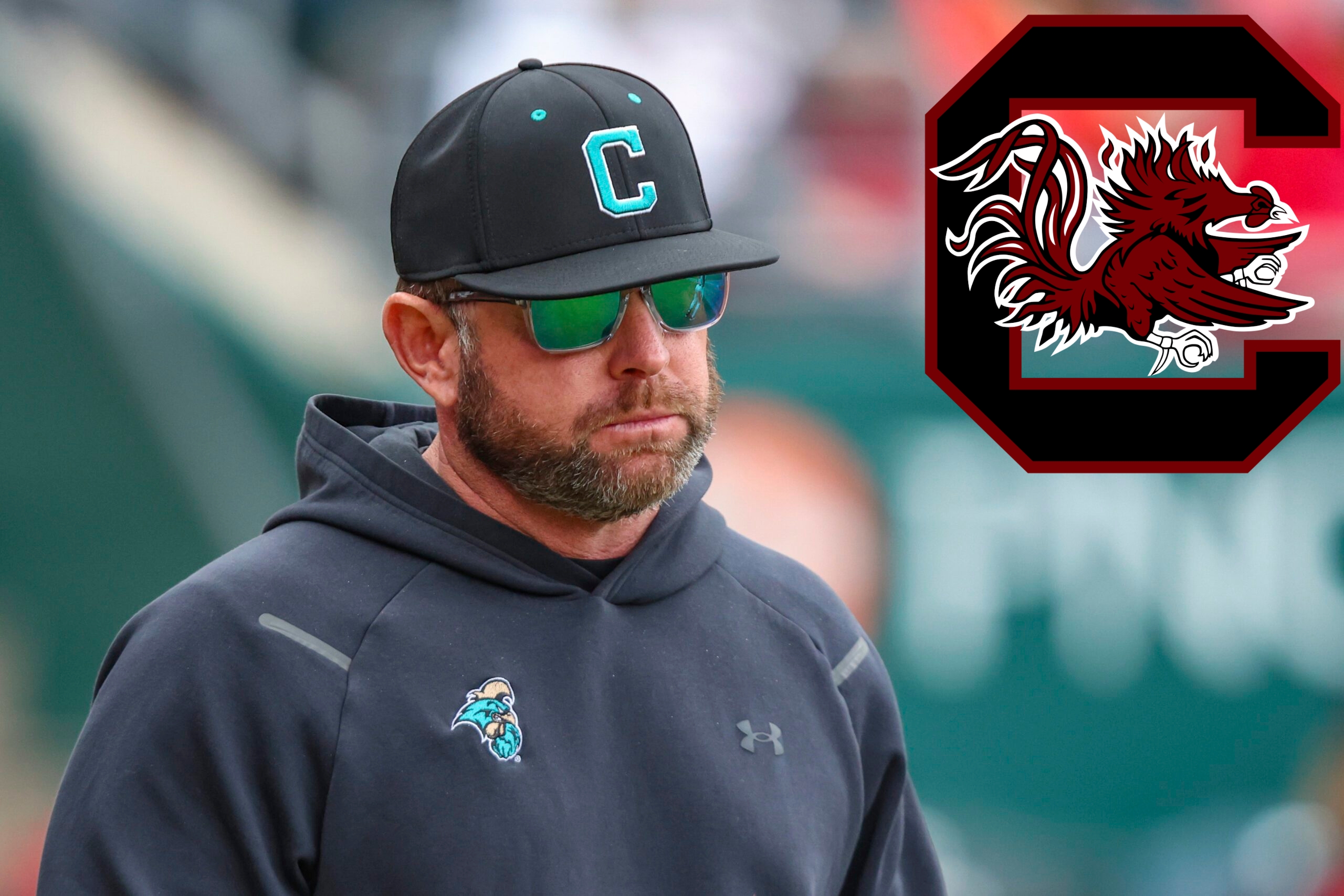
Coastal Carolina head coach Kevin Schnall walks onto the field during an NCAA baseball game against Ohio State in Jacksonville, Fla., Saturday, Feb. 22, 2025. (AP Photo/Gary McCullough)
Kevin Schnall just watched his season end. Within hours, he was answering questions about someone else’s job opening.
That’s the reality of being one of the most successful coaches in college baseball right now, and Schnall — to his credit — handles it with a self-awareness that reveals as much about his character as his 93-36 record does about his coaching ability.
What Schnall Actually Said
The framing matters here. Schnall didn’t dodge the South Carolina questions after Coastal Carolina’s 2-1 elimination loss to Florida State on May 30. He answered them directly, with language that was carefully chosen and worth examining closely.
“I’ve got a five-year contract at Coastal. I’m the head baseball coach at Coastal Carolina,” Schnall said. “I can’t stress it enough.”
That is not a man saying he isn’t interested. That is a man reminding everyone — including himself — of his current professional reality. There’s a meaningful difference between “I’m not leaving” and “I have a contract.” Schnall offered the latter.
Then came the more revealing quote. Asked why he thinks his name keeps surfacing for Power Four vacancies, Schnall didn’t deflect or perform false modesty.
“As long as we continue to be successful, people are going to continue to call Coastal Carolina to gauge interest in us in their jobs,” he said. “I don’t blame them. I would too.”
That kind of candor is rare in college athletics, where coaches typically either over-perform loyalty to their current program or conspicuously leave doors open for bigger opportunities. Schnall did neither. He acknowledged the market logic at play — good coaches get pursued, that’s how it works — and used it to validate what Coastal Carolina has built rather than to signal ambition.
The Numbers Behind the Pursuit
The interest from South Carolina isn’t abstract or sentimental. It’s grounded in production.
In two seasons as Coastal Carolina’s head coach, Schnall has compiled a 93-36 record — a winning percentage that places him among the elite in the sport regardless of conference affiliation. In his first season alone, he guided the Chanticleers to a program-record 56 wins and a runner-up finish in the College World Series Finals. This season added 37 wins and another NCAA Tournament appearance, sustaining the program’s national relevance even in a down year by their own elevated standards.
The broader context makes those numbers even more impressive. Schnall has achieved this without the recruiting budgets, facilities arms race, or brand recognition that Power Four programs take for granted. Building a perennial College World Series contender at Coastal Carolina is a significantly harder task than maintaining one at South Carolina, and the Gamecocks’ administration almost certainly understands that distinction.
Where the Process Actually Stands
What Schnall has confirmed publicly is notably limited, and deliberately so. Before the tournament, he acknowledged that his agent had been in contact with a South Carolina search firm but characterized the information exchanged as “very little.” He confirmed he has not spoken directly with anyone in USC’s athletic department.
That’s the standard holding pattern for a coveted candidate who isn’t ready to publicly engage with a situation he hasn’t yet decided how to handle. The agent contact is meaningful — it keeps the conversation alive without committing Schnall to anything. The five-year contract language is equally meaningful — it signals to Coastal Carolina’s administration that he isn’t bolting at the first opportunity, while also implicitly communicating to South Carolina that acquiring him would require a serious, structured offer.
South Carolina parted ways with Paul Mainieri on April 22 after a mutual agreement to separate, then fired interim coach Monte Lee when the season concluded. Athletic director Jeremiah Donati has said publicly that the search timeline isn’t fixed, but Coastal’s elimination removes the last scheduling obstacle. If Schnall is genuinely the target, the conversations can now move past search firms and into direct dialogue.
D1Baseball’s Kendall Rogers reported on May 29 that West Virginia head coach Steve Sabins is also a leading candidate — a reminder that South Carolina has options and isn’t simply waiting on Schnall to make up his mind.
The Decision Beneath the Decision
What makes Schnall’s situation genuinely interesting isn’t the job market mechanics. It’s the underlying question of identity.
Schnall is a Coastal Carolina alum who spent nearly two decades building this program from the inside before taking the top job. The Chanticleers’ rise to national prominence isn’t something he observed from afar — it’s something he helped construct, brick by brick, from 2001 onward. Leaving now, two years into his first head coaching role at his alma mater, means handing off something deeply personal.
South Carolina is a bigger platform, a bigger budget, and a program with genuine historical pedigree — it just needs someone to restore it. For many coaches, that combination would be impossible to pass up.
For Schnall, it’s clearly more complicated than that. And the careful, contract-citing, agent-distancing language he’s using suggests a man who hasn’t fully resolved that complexity yet.
The next move belongs to South Carolina. Whether Schnall makes one depends on what they put in front of him.
About The Author