
Jordan Lee Is Not a Stopgap — She Is a Strategic Fit: Why Dawn Staley’s Latest Portal Move Makes Perfect Sense
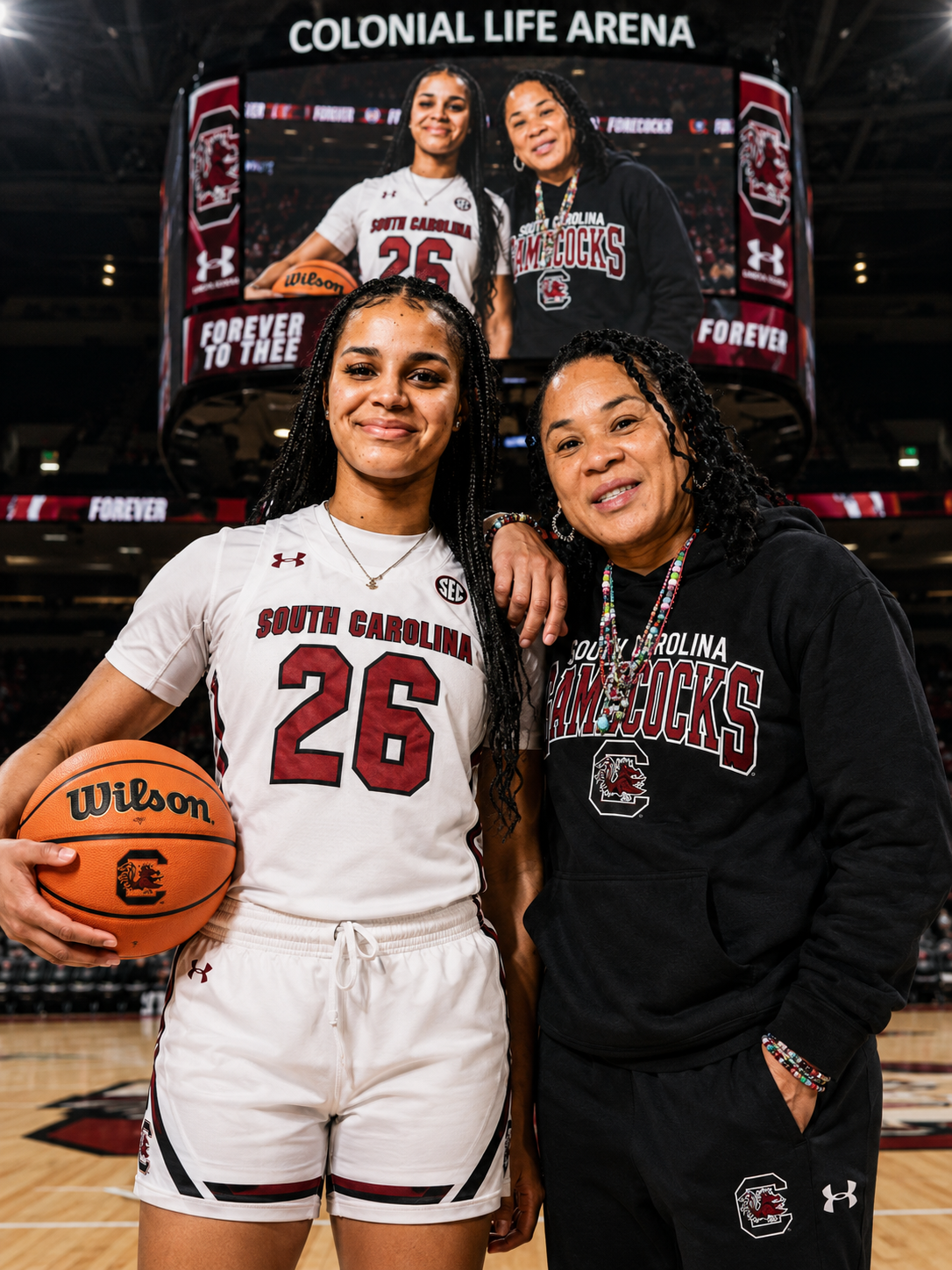
COLUMBIA, S.C. — When Dawn Staley goes to the transfer portal, she does not go searching blindly. Every addition she has made in recent cycles has been surgical — identifying a specific void, finding the precise player who fills it, and integrating that player into a system already built to win. Madina Okot filled the true center void. Te-Hina Paopao addressed the three-point shooting deficiency. Each move was deliberate, purposeful, and ultimately successful.
Jordan Lee is a different kind of portal addition — and in some ways, a more sophisticated one. The 6-foot guard is not arriving in Columbia to fill an obvious hole. She is arriving to raise the floor of a roster that was already good and make it better in ways that may not show up immediately in a box score but will absolutely show up on the scoreboard when March arrives.
After two seasons at Texas, Lee is staying in the SEC but switching sides — from one of the Gamecocks’ most persistent recent tormentors to the program she helped beat twice last season. That context alone makes this commitment fascinating. Staley knows exactly what Lee is capable of, because she has watched her dismantle her team from across the court.
The Defensive Dimension: A Non-Negotiable Met
Start with the most foundational element of what Staley demands from every player on her roster, because it is the lens through which every addition must be evaluated: defense. As Staley said when Lee signed, “She has a good defensive mindset and can guard multiple positions.” In Dawn Staley’s program, that is not a compliment — it is a prerequisite. Minutes at South Carolina are earned on the defensive end first and everything else second. Players who cannot guard at an elite level simply do not play, regardless of what they offer offensively.
Lee does not just meet that standard — she arrives having played a large part in why Texas’ defense was stellar enough to hold down the SEC’s best defensive ranking. That is the same ranking South Carolina held for five consecutive seasons before Texas arrived in the conference in 2024. The Longhorns allowed an SEC-best 55.8 points per game this past season, ahead of the Gamecocks’ 57.8 — a gap that stung in Columbia and a defensive standard Lee helped maintain from the guard position.
The specific quality that makes Lee’s defense translatable to Staley’s system is her positional versatility. A guard who can defend multiple positions — switching onto wings, staying with quicker guards, and holding her ground against physical players in the post — is essential for a program that employs a variety of switching defensive schemes and demands that every player carry her weight in both half-court sets and pressure situations. Lee brings all of that, already proven at the SEC level.
Replacing What Was Lost — and Then Some
South Carolina enters the 2026-27 season without Ta’Niya Latson, who averaged 14.1 points per game, and Raven Johnson, who contributed 9.9. Those are significant departures, and it would be easy to frame Lee as the program’s answer to that scoring void. That framing would be inaccurate and ultimately undersell what makes this signing genuinely smart.
Lee is not here to be Latson’s statistical replacement. Staley still has four guards returning plus two incoming freshmen, giving the roster real guard depth even before Lee’s addition. What Lee does is add a proven, SEC-hardened contributor to a group that now has options — and when a team has options at guard, it has leverage in every matchup it faces throughout a long season.
Her offensive profile fits naturally within the system Staley runs. Lee is used to playing alongside a dominant forward, proven by her two seasons alongside Madison Booker, who averaged a team-high 18.9 points with Lee second at 13.2. Joyce Edwards has led the Gamecocks in scoring the last two years, including 19.2 points per game this past season. The offensive dynamic Lee is walking into — where a dominant frontcourt player commands the primary defensive attention and the guards must make smart reads, move the ball, and convert when that attention is diverted — is one she has lived in for two full seasons.
The parallel is not just superficial. Booker possesses arguably one of the best mid-range jumpers in women’s college basketball, drawing constant defensive attention. Edwards commands the low block with similar authority. In the Sweet 16 against Oklahoma, Edwards was nearly triple-teamed — forcing Latson, Tessa Johnson, and Raven Johnson to step up as secondary scorers. That is the same role Lee has filled consistently when defensive attention shifts to Booker. She understands what it means to be the second or third option in a system — and she understands how to be dangerous in that role.
The Transition Game: Where Lee Quietly Excels
One of the less-discussed but genuinely important elements of Lee’s profile is her fit within South Carolina’s transition-oriented offensive philosophy. She doesn’t necessarily avoid rebounding, averaging 2.5, but she sees the importance of beating the defense so she can create on the other end quickly. The implication is clear: Lee reads the play developing in real time, identifies when her team is about to secure a rebound, and is already moving before the ball is even secured. In Staley’s system, which loves to sprint in transition and punish opponents before they can set their defense, that instinct is not just useful — it is essential.
Her point guard experience at Texas also lends itself naturally to South Carolina’s offensive rhythm. Her point guard has always been Rori Harmon, who had the third-best assist-to-turnover ratio in the country at 3.8. Maddy McDaniel will likely take over for Raven Johnson as the point and, like Harmon, takes care of the ball without sacrificing speed. Lee already knows how to function within a system where the point guard is disciplined, pass-first, and pace-setting. That familiarity with the role McDaniel will play removes one of the most common adjustment hurdles for transfer guards entering a new system.
Beyond the transition game, Lee brings a technical offensive versatility that gives Staley real flexibility in halfcourt sets. She is not afraid of contact and has displayed particularly crafty inside moves — meaning she can finish through traffic on dump-off passes when McDaniel drives and draws. She also understands the importance of moving without the ball. And when teams swarm Edwards in the post, Lee is capable of stepping into open outside shots and converting. She is not a shooter who needs the ball to be useful, and she is not a driver who is helpless beyond the arc. That two-dimensional offensive profile is exactly what a team with Edwards as its centerpiece needs from its perimeter players.
The SEC Veteran Advantage
Perhaps the most underrated dimension of this signing is the simplest one: Jordan Lee does not need to learn the SEC. She already knows it. She has played two full seasons in the conference, competed in tough non-conference games, and played under Vic Schaefer — one of the most demanding defensive coaches in women’s college basketball. That should help her since Staley demands excellence and South Carolina likes a difficult schedule.
In the last two seasons, South Carolina has lost eight games — and three of those were to Lee and Texas. The Longhorns won twice this past season and she was a central part of the offense. Staley is not adding someone she has admired from afar. She is adding someone she has studied out of necessity, someone whose impact on her program’s record was real and measurable. That familiarity cuts both ways — Lee knows what South Carolina demands, and Staley knows precisely what Lee can deliver.
With Staley’s six straight Final Fours and three straight title game appearances, there is normally a learning curve when transferring into a program operating at that level of sustained excellence. The question for every new addition is never whether the talent is there — it is whether the player can absorb the system, build the chemistry, and meet the cultural expectations fast enough to contribute when the stakes are highest.
For Lee, it might come down to things like chemistry and learning the plays and system that decide how she does for the Gamecocks — because she brings quite a bit already. That framing is both honest and optimistic. The heavy lifting of physical adjustment, conference acclimation, and defensive development is already done. What remains is the integration work — and for a player who has spent two seasons inside the SEC’s most competitive environment, that integration timeline figures to be shorter than almost any other portal addition Staley could have made.
The Bottom Line
Jordan Lee is not a flashy portal addition. She does not arrive with a viral announcement or a statistical profile that jumps off the page. What she brings is something arguably more valuable for a program chasing a championship rather than building toward one: proven readiness, defensive credibility, offensive versatility, and the kind of SEC battle-hardening that cannot be taught in a practice gym.
South Carolina did not add Lee because the roster was broken. They added her because great programs are never satisfied with good enough — and in a conference where Texas has already demonstrated it can take the Gamecocks’ defensive crown, adding the player who helped take it is as sharp a response as Staley could have made.
This is not a stopgap. This is a calculated upgrade — and it fits exactly where Staley needs it most.
About The Author