South Carolina’s Point Guard Legacy Takes an Unexpected Turn Without Maddy McDaniel
For years, South Carolina has found a way to keep its point guard tradition alive. One leader leaves, another eventually emerges, and the Gamecocks continue moving forward.
This time, however, the transition looks considerably less conventional.
Maddy McDaniel appeared destined to become the latest name in a celebrated line of South Carolina point guards. After spending two seasons learning behind Raven Johnson, McDaniel was expected to inherit the responsibility of directing Dawn Staley’s offense. Her departure leaves the Gamecocks without a traditional point guard and forces South Carolina to reconsider how it wants to handle one of the most important positions on the floor.
But history suggests that Staley has never been afraid to improvise.
A Tradition Built on More Than Traditional Point Guards
When South Carolina’s basketball legacy is discussed, the conversation naturally gravitates toward dominant post players such as A’ja Wilson, Aliyah Boston and Kamilla Cardoso.
Yet the program’s history at point guard is nearly as compelling.
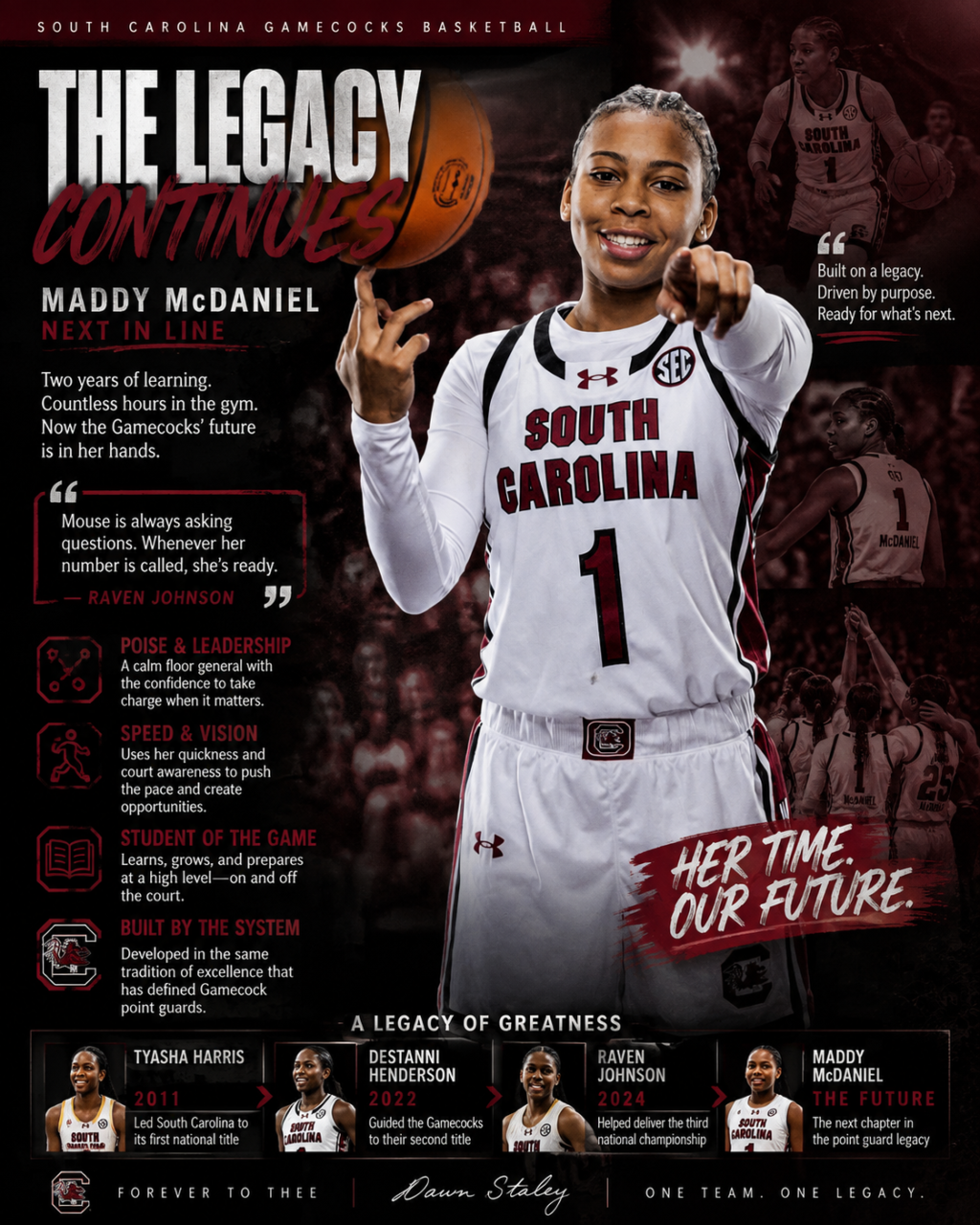
Tyasha Harris became the starting point guard midway through her freshman season and helped guide the Gamecocks to their first national championship. Destanni Henderson eventually succeeded her and was instrumental in South Carolina’s second national title in 2022. Raven Johnson then became the next major piece of the lineage and helped deliver the program’s third championship in 2024.
On paper, it looks like a perfectly organized succession plan.
In reality, the transitions were considerably messier.
Henderson experienced growing pains when she first became the starter. Johnson also wasn’t immediately handed the keys. After the 2022 championship, Staley brought in Kierra Fletcher to handle the starting role, demonstrating that even highly regarded future stars sometimes need time before becoming the team’s primary floor general.
The lesson is important: South Carolina’s point guard legacy has never been about simply handing a player the job and expecting everything to work immediately.
It has been about adaptation.
McDaniel Was Supposed to Be the Next Chapter
McDaniel seemed positioned to follow the same path.
She spent two seasons learning from Johnson, absorbing the expectations that come with playing point guard under Staley. Johnson herself had previously received the endorsement of Aliyah Boston after South Carolina’s 2023 Final Four disappointment.
“After the game, I told Raven, this is your team,” she said. “You’ve been in the system for two years now. Next year, people are going to look to you for that leadership role.”
Johnson ultimately delivered on that prediction, helping South Carolina finish undefeated and capture another national championship.
After Johnson’s departure, McDaniel appeared to be next.
Johnson was equally clear about her belief in the younger guard.
“She’s next up. When I’m gone, she’s going to be the next person to be in that position,” Johnson said. “To play point guard for Coach Staley, it’s hard. You have to be her version of her on the court. Mouse, she learned a lot from me. She’s always asking questions. Whenever her number is called, she’s ready.”
McDaniel’s limited playing time last season — 19.7 minutes per game — was partly a product of having an established senior point guard ahead of her. Still, Staley repeatedly showed confidence in her when the team needed an injection of energy.
“Maddy has been growing. A lot of times you forget that she’s just a sophomore, right? She’s one that is high-performing, especially in practice, low-maintenance, really quiet person. Just comes to work without complaint,” Staley said at the Final Four. “Maddy was definitely a momentum shifter for us because of her speed and her ability to make passes.”
That development appeared to make McDaniel the obvious successor.
Then everything changed.
An Unexpected Break in the Succession Plan
McDaniel stepped away from the program temporarily in July to focus on her mental health. By August, that absence became permanent.
Suddenly, the Gamecocks weren’t simply replacing a player.
They were replacing the only natural point guard on their roster.
That distinction matters.
South Carolina can replace McDaniel’s minutes. It can replace some of her scoring. But replacing a player whose primary responsibility is organizing the offense, initiating possessions and controlling tempo requires a different solution.
The obvious response would be to find another traditional point guard.
Staley, however, has rarely required her teams to fit neatly into conventional basketball structures.
The Point Guard Lineage Started Before Harris
The foundation of South Carolina’s point guard tradition was established well before Harris, Henderson and Johnson.
La’Keisha Sutton was Staley’s first recruit at South Carolina. She wasn’t necessarily a classic point guard, but her competitiveness and determination helped establish the identity of the program. Sutton eventually led the Gamecocks to the Sweet 16 during their first NCAA Tournament appearance under Staley.
After Sutton graduated, Ieasia Walker stepped into the backcourt leadership role, with Khadijah Sessions developing behind her.
Sessions eventually became the starter and helped South Carolina reach the Final Four while also contributing to an undefeated SEC season.
Those players weren’t necessarily the polished prototypes that would later become associated with South Carolina’s dynasty.
They were tough.
They were competitive.
And they helped establish the culture that Harris, Henderson and Johnson later elevated to championship level.
Their influence hasn’t disappeared, either. Sutton went on to play for the Harlem Globetrotters and later became a high school coach. Walker moved into strength and conditioning at Akron. Sessions remains part of the South Carolina program as an assistant coach.
In other words, the point guard legacy isn’t merely a list of players.
It’s a culture.
The Gamecocks Have Already Solved This Problem Without a Traditional Point Guard
The current situation may look unfamiliar, but Staley has faced similar challenges before.
During the 2021-22 championship season, Henderson was essentially the team’s only traditional point guard. When an ankle injury temporarily removed her from the lineup, Staley turned to forward Laeticia Amihere to assume the responsibility.
It wasn’t conventional.
It worked.
Amihere helped South Carolina beat Kansas State, Maryland and Duke before Henderson returned.
Earlier in Staley’s tenure, circumstance forced another unexpected adjustment. Injuries to Brionna Dickerson and Demetress Adams left South Carolina without two of its most important players, opening the door for Sutton to take on responsibilities she wasn’t necessarily expected to carry as a freshman.
She responded by growing into the opportunity.
That history should provide some comfort heading into the 2026-27 season.
South Carolina May Build a Committee Instead of Naming a Successor
Without McDaniel, the Gamecocks appear more likely to distribute point-guard responsibilities rather than appoint a single replacement.
Tessa Johnson, Agot Makeer and Jerzy Robinson all have experience handling the ball and running teams from their earlier basketball careers. Johnson and Makeer have also gained experience at the position within South Carolina’s system.
None is a direct McDaniel replica.
That might actually be the point.
Johnson can bring scoring and offensive aggression. Makeer offers size, athleticism and versatility. Robinson provides another long guard capable of creating opportunities with the ball.
Rather than asking one player to become “the next Maddy McDaniel,” Staley can potentially create a position-by-committee approach that makes South Carolina harder to defend.
It could mean more interchangeable lineups, more secondary playmaking and greater freedom for guards to attack rather than simply initiate.
The downside is obvious: turnovers and late-game organization could become concerns while the players adjust to increased responsibility.
But the upside may be even more significant.
Staley’s Greatest Strength May Be Her Ability to Adapt
South Carolina’s point guard history contains an important pattern.
Staley doesn’t necessarily force her players to become something they’re not.
Instead, she tends to identify what they already do well and build around it.
Even Sessions, despite being a three-year starter, wasn’t the stereotypical pass-first point guard. Her game was built heavily around toughness, emotion and physicality.
That philosophy remains relevant today.
“(Staley) allows us to be who we are,” Sutton told GamecockCentral’s Mingo Martin earlier this year. “In doing so, we’re going to make mistakes, but she allows us to think the game for ourselves before she tries to overcorrect or prevent us from making mistakes.”
That could become the defining principle of South Carolina’s 2026-27 backcourt.
The End of a Legacy—or Simply Another Evolution?
McDaniel’s departure undoubtedly interrupts what appeared to be a straightforward succession from Johnson to the next Gamecock point guard.
But calling it the end of South Carolina’s point guard legacy would probably be premature.
The program has already demonstrated that its best teams don’t necessarily depend on a textbook point guard.
Harris had one path.
Henderson had another.
Johnson took her own route.
And before all of them, Sutton, Walker and Sessions helped prove that toughness, adaptability and basketball intelligence can be just as valuable as traditional point-guard credentials.
Now Johnson, Makeer and Robinson have the opportunity to write another chapter.
The biggest question isn’t whether one of them can become the next Raven Johnson.
It’s whether South Carolina even needs another Raven Johnson.
The answer may be no.
Staley’s system has survived changing personnel for years because it evolves with the players available to her. McDaniel’s unexpected departure creates a significant challenge, but it also gives the Gamecocks another opportunity to demonstrate the principle that has quietly defined their point guard tradition all along:
The position can change. The standard doesn’t.
About The Author