Ashlyn Watkins’ Technical Foul Against UConn: Was the Officiating Fair, or Should Both Players Have Been Penalized?
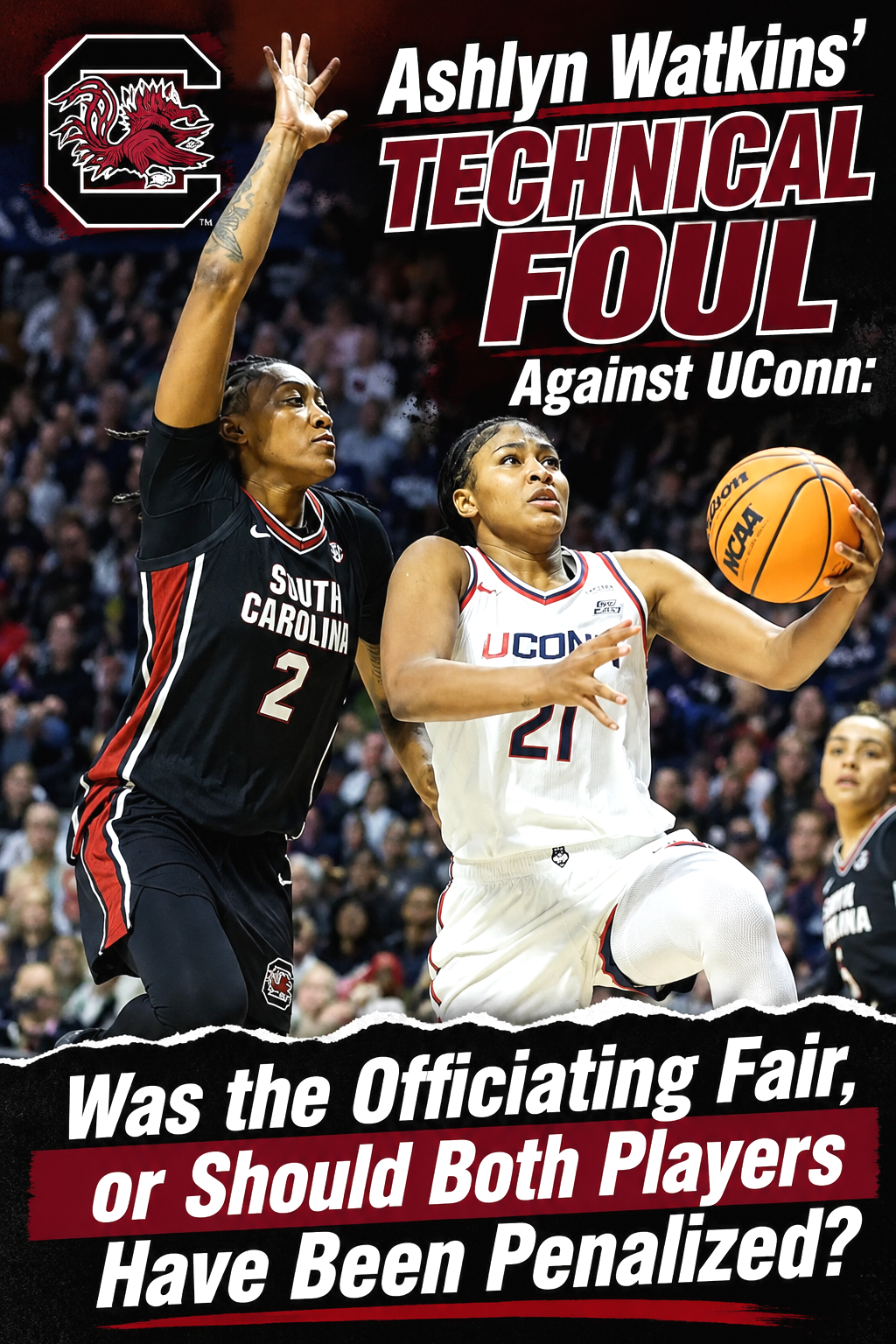
The technical foul assessed to South Carolina’s Ashlyn Watkins during the exchange with UConn’s Sarah Strong raises a legitimate question about consistency in officiating: If both players were exchanging words, why was Watkins the only one assessed a technical foul?
From the sequence described, it appeared that tensions were rising between the two players, with neither seemingly willing to back down. While officials have the authority to determine whether a player’s conduct warrants a technical foul, the decision to penalize only Watkins invites questions about whether the situation was handled consistently.
The Incident That May Have Started It All
To understand why Watkins reacted the way she did, it is important to consider what happened immediately before the confrontation with Strong.
Jana El Alfy had reportedly pushed Watkins in the back following a rebound. That incident could have been an opportunity for the officials to intervene before emotions escalated further.
A technical foul or another appropriate response at that moment might have sent a clear message that unnecessary physical exchanges would not be tolerated.
Instead, the tension continued to build, eventually resulting in the confrontation between Watkins and Strong.
Why Was Watkins the Only Player Penalized?
This is where the officiating decision becomes debatable.
If both Watkins and Strong were engaging in verbal exchanges, there is a reasonable argument that both players should have been assessed technical fouls. A double technical would have acknowledged the involvement of both players without placing the entire responsibility for the confrontation on one individual.
Of course, the officials may have heard or observed something that was not apparent to television viewers. It is also possible that Watkins crossed a line that Strong did not.
However, without knowing exactly what was said or what the officials witnessed, it is difficult to conclude that the decision was entirely justified.
Did Strong’s Foul Trouble Influence the Decision?
Another interesting possibility concerns Strong’s foul situation.
There is an argument that, had Strong not already been dealing with foul trouble, the officials might have been more inclined to assess a double technical rather than penalizing Watkins alone.
That remains speculation, not an established explanation for the call. Nevertheless, it raises an important question about whether the officials applied the same standard to both players.
Officiating should be based on the actions of the players involved, not the potential competitive consequences of adding another penalty to one team’s player.
The Case for Ashlyn Watkins
Watkins deserves some consideration in this discussion because her confrontation with Strong did not happen in isolation.
If the earlier push from El Alfy contributed to the growing frustration, then Watkins may have been reacting to a situation that officials could have addressed before it escalated.
That does not automatically excuse her response. Players are responsible for controlling their emotions, regardless of what happens before a confrontation.
However, holding only Watkins accountable while seemingly overlooking the actions that preceded the exchange creates a legitimate concern about consistency.
South Carolina should not receive special treatment, but neither should its players be singled out when multiple players appear to be involved in an incident.
The Final Verdict
The officials had discretion to assess technical fouls, but the bigger question is whether they managed the escalating tension appropriately.
A response to El Alfy’s earlier contact with Watkins might have prevented the confrontation with Strong. And if both players were equally involved in the verbal exchange, a double technical would arguably have been a more consistent decision.
Ultimately, Watkins must take responsibility for her reaction, but the officials also deserve scrutiny for how they handled the entire sequence.
The question isn’t whether Ashlyn Watkins deserved to be held accountable. It’s whether Sarah Strong and the preceding actions were evaluated by the same standard.
That is where the officiating decision deserves a closer examination.
About The Author