Dawn Staley Breaks Down the Kentucky Scare: Fatigue, Missed Layups, and Why It Still Counts as a Win
South Carolina escaped Lexington with a 60-56 victory over Kentucky, but the final score did not tell the complete story of a game the Gamecocks made far harder than it needed to be. In her postgame availability, Dawn Staley pulled no punches about what went wrong — and her answers, read carefully, reveal both the vulnerabilities and the competitive character of a 29-2 team preparing for a postseason run.
The Shooting Struggles Weren’t About Kentucky’s Defense — They Were About South Carolina’s Legs
The instinct after a 60-56 grind is to credit the opposing defense. Staley pushed back on that narrative directly.
“I don’t think Kentucky’s defense was anything different than what we’ve seen. I mean, they played a little bit more zone, but I don’t, you know, I don’t think the zone gave us an issue. I think what gave us issue was probably a little fatigue. We played a lot of players, a lot of minutes.”
That is a candid and, frankly, more concerning admission than crediting Kentucky’s scheme. Scheme problems are correctable with film and preparation. Fatigue is a physiological reality that does not disappear between sessions. It accumulates.
The specificity of Staley’s diagnosis matters here. The Gamecocks were not missing contested threes off broken plays. They were missing layups — the most routine and high-percentage shot in basketball. When a team misses at the rim at that rate, one of two things is happening: they are being physically outmuscled, or their legs are gone. In this case, Staley’s own read points squarely to the latter.
“Finishing at the rim was, I mean, we make our layups alone. I think it’s a different game coming down the stretch, where you know it isn’t call the timeout, advance the basketball, and run the play, cat and mouse type of thing. So it’s just making layups.”
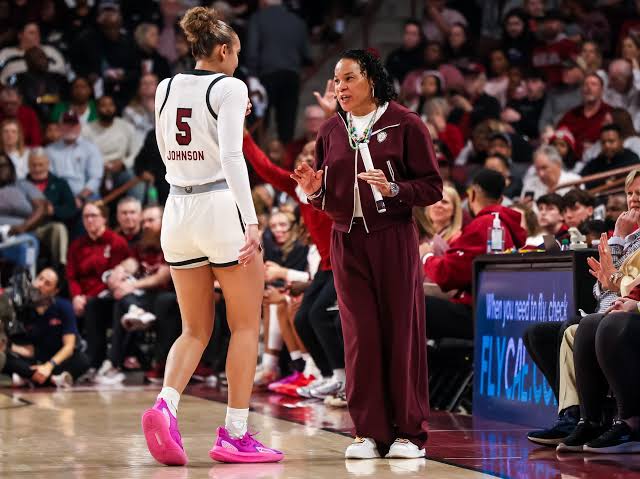
The phrase “we make our layups alone” is the most instructive line in the entire exchange. Staley is not exonerating her players — she is identifying the precise context in which their execution broke down. In a controlled, half-court setting, these are shots South Carolina converts. Under physical duress, in a loud hostile environment, with tired legs, the margin of error at the rim tightened and the Gamecocks paid for it repeatedly. Staley named Madina Okot, Joyce Edwards, and Tessa Johnson specifically — meaning this was not one player’s bad night. It was a team-wide finishing problem.
The Tessa Johnson Question: A Shooter Working Through a Cold Stretch
Tessa Johnson’s shooting slump was addressed directly, and Staley’s prescription for getting her back on track was both practical and psychologically grounded.
“One, keep shooting. I mean, for shooters that can shoot the ball, we don’t want her to get gun-shy at all. Shoot the ball, shoot the right shots.”
That’s the standard coaching response for a shooter in a slump, and it’s right. The research on shooting confidence is consistent — hesitation is the enemy of rhythm, and pulling a shooter from their spots often does more damage than the slump itself. But Staley went further, identifying a specific structural remedy rather than just offering encouragement.
“I think for Tessa, I think we need her to get to the free throw line a little bit more. So put it on the floor, get to the rim, just balance out. Sometimes shooters just need to see the ball go in, whether it’s a layup, whether it’s at the free throw line. I think that she’s a pretty darn good free throw shooter. Just doesn’t get there enough. So we want her to get to the free throw line. To mix up, mix up what she’s doing from outside the three.”
This is a more sophisticated analysis than the surface read suggests. Staley is not asking Johnson to stop shooting threes — she is asking her to add dimensions to her game that relieve the pressure of being a designated perimeter shooter. When a shooter is cold, opponents shade their coverage and the windows close faster. By attacking the rim and drawing fouls, Johnson accomplishes two things simultaneously: she gets easy looks that restore her confidence, and she forces the defense to respect her as a full offensive threat, which opens the exact three-point looks she thrives on.
The mention of Johnson’s free throw proficiency is not incidental. It is a coaching tool. Free throws are unguarded, pressure-free opportunities to see the ball go through the net — and for a shooter fighting through a rhythm disruption, that visual and sensory feedback matters more than it might seem.
End-of-Half Execution: The Bigger Picture
When pressed specifically on what broke down at the end of each half, Staley’s answer was consistent with her broader diagnosis — and included a revealing acknowledgment about the environment.
“I mean, I thought it was a tough environment, one. I don’t think that environment really phased us to that point. We looked back at the game, and I mean the layups alone. I mean Madina, Joyce, I mean, you name it. We were at the rim, Tessa, we were at the rim. We just got to hit it on that white square. It’s universal. You hit it on the square, where it’s supposed to go, it’s going to go in, but we had bad angles.”
The “bad angles” detail is worth examining. In basketball, bad angles at the rim are often a footwork problem — and footwork degrades when legs are tired. This loops directly back to the fatigue argument. It is not that these players suddenly forgot how to finish; it is that the physical precision required to attack the rim at the correct angle became harder to maintain as the game wore on. That is an execution problem with a physical root cause.
Staley’s willingness to mention the environment — Kentucky’s home court — before pivoting immediately back to self-critique is also characteristic of her coaching philosophy. She acknowledged the external factor without leaning on it. The implication is clear: the environment was real, but it is not an excuse, and the missed layups would have been missed layups anywhere.
The Most Important Quote of the Postgame
For all the tactical detail Staley provided, the most important statement she made was also the most emotionally direct.
“So I mean, we’re fortunate that our players really wanted to win the game, okay? They bore down and won the game. They could have easily given up. It doesn’t change anything for us. It changes everything for Kentucky. But we wanted to win the game.”
This is Staley at her most honest, and what she is describing is competitive will as a separating factor. The Gamecocks shot poorly. They missed layups they normally make. They gave up ground in the final minutes of each half. The architecture of that game gave Kentucky every reasonable opportunity to steal a result. South Carolina’s players did not permit it.
The line “it doesn’t change anything for us. It changes everything for Kentucky” deserves particular attention. It is a reminder that from South Carolina’s vantage point, the outcome — a road win — is binary. The manner of the win carries no consequence for seeding, preparation, or postseason trajectory. But for Kentucky, a loss at home to the nation’s top team, in a game they were in, is a different kind of result entirely. Staley is framing the outcome correctly: her team won on a night they played below their standard. That is a valuable data point about character, not a warning sign about ceiling.
What This Means for the Tournament
The fatigue Staley cited carries a specific implication heading into Greenville and the SEC Tournament. The Gamecocks play three games in three days — a format that rewards depth and physical conditioning above almost everything else. If tired legs produced missed layups against Kentucky over 40 minutes, the question becomes how South Carolina manages the physical demands of a compressed postseason schedule, especially with Ta’Niya Latson already listed as “under the weather” heading into the week.
None of this suggests the Gamecocks are in trouble. A team that wins when playing below its standard is not a team in crisis — it is a team with a competitive floor high enough to survive its own bad nights. That is precisely what distinguishes championship programs from contenders. But the Kentucky game was a diagnostic, and what it revealed — late-game finishing breakdowns, a shooter searching for rhythm, and a fatigue-induced execution drop — are the exact areas South Carolina will need to have answered before the bracket opens on March 15.