Championships, Seniors, and the Legacy of a Dynasty
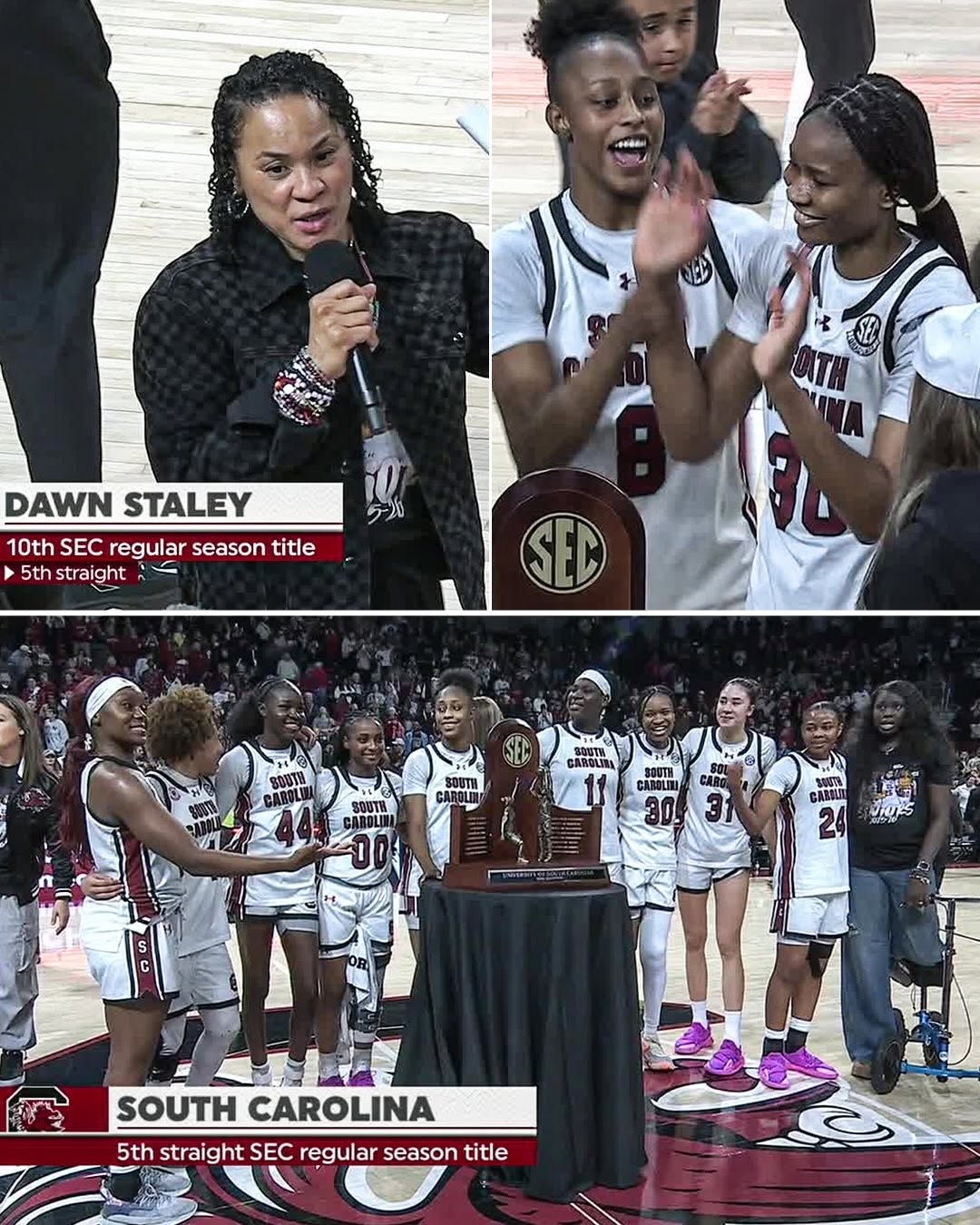
COLUMBIA, S.C. — The final score read 112-71. The SEC regular-season title was clinched outright. Four seniors had been celebrated in front of a packed Colonial Life Arena that gave them everything it had. And when Dawn Staley stepped to the podium for her postgame press conference, what followed was not a routine collection of coach-speak and score breakdowns — it was one of the most revealing, emotional, and analytically sharp postgame addresses of her career.
Here is a full breakdown of what she said, and what it means.
On Taking Care of Business — Without Being Told To
The night’s first question was deceptively simple: did this feel like a team that knew what was at stake, or did Staley need to manufacture urgency?
Her answer was equally direct. “I mean, no, I think they knew what was at stake,” she said. “We’ve been mentioning of just wanting to get outright and doing it on our home court, in front of the fans that really have supported us, to the end degree. And what better way to share it with them.”
The phrase “what better way to share it with them” is a window into how Staley frames championship moments for her players. This was not merely about winning a title. It was about winning it here, in this building, with these people watching. That sense of shared ownership — between program and community — is one of the most consistent features of how Staley communicates, and it explains in part why Colonial Life Arena has become one of the most intimidating home environments in women’s college basketball.
On 21 Assists and Learning to Share the Ball
Perhaps the most analytically interesting portion of the press conference came when Staley was asked about South Carolina’s 21 assists on 52% shooting. The numbers are impressive. The honesty behind them is even more so.
“We actually made a move in that area because we were…I think we had seven assists on 21 field goals at halftime,” she admitted. “And we just talked about sharing the basketball. And when we were able to do that and find who should shoot the ball in rhythm, we’re a much better basketball team that’s a lot more fluid offensively. I thought we did a really good job with that.”
Read carefully, this is a head coach acknowledging at halftime that her team was playing isolation-heavy, low-rhythm basketball and making a real-time tactical correction that produced the second half the box score eventually reflected. South Carolina went from seven assists on 21 first-half field goals to 14 assists in the second half — a dramatic shift that came not from personnel changes but from a philosophical adjustment communicated clearly at the break. That kind of halftime recalibration is what separates great coaches from good ones.
On Missouri’s Third-Quarter Run — and Why It Didn’t Matter
Even in a 41-point blowout, Staley found something worth correcting. Missouri scored 31 third-quarter points — an outlier in an otherwise controlled performance — and Staley did not brush past it.
“We gave up 31 points in the third quarter, that’s not a norm,” she said. “I think seven of those were threes. I think, I mean, this league is good, every team is really good. Every team has momentum; they take momentum during the game.” She acknowledged the three-point shooting “got a little bit out of hand” before explaining how the defense adjusted: better closeouts, more disciplined rotations, and a return to prioritizing shot quality on the offensive end.
What is most notable here is the refusal to dismiss a bad quarter simply because the overall result was comfortable. In Staley’s framework, a 31-point quarter against a struggling Missouri team is a data point — something to be noted, corrected, and filed away before Kentucky, the SEC Tournament, and March. The margin of victory does not soften the standard.
On Maryam Dauda: The Tribute That Deserved Its Own Press Conference
The most unexpected and moving segment of the night came when a reporter asked Staley about Maryam Dauda — the senior whose contributions rarely appear in a box score and whose role on the roster has required navigating the particular difficulty of being deeply valued and infrequently used.
Staley did not offer a polished tribute. She offered a genuine one.
“I mean, I have to credit Maryam with just being a high-character individual,” she began. “Super competitive and just being probably the greatest teammate through not playing, through being a senior, and, I mean, she’s never packed it in. She’s always come to play.”
Staley explained that Dauda had been placed on the program’s “Highlighters” practice team — the second unit used when starters needed rest — and never once treated it as a slight. “She never took that as a demotion,” Staley said. “I think she made it something of a positive thing that every time Joyce subs out, she wants to go to the Highlighters. Like, every time.”
But the line that crystallized everything came near the end: “I would hire her, like, quicker than I would hire someone that probably plays 30 minutes a game.”
From a head coach who has produced WNBA players, Olympians, and champions, that statement is not a consolation prize. It is a specific and deeply meaningful form of recognition — an acknowledgment that the qualities Dauda brings to a program are rarer and more durable than scoring averages.
On Madina Okot’s 26-Point, 17-Rebound Masterpiece
Okot produced arguably the most dominant individual performance of the night — 26 points, 17 rebounds, and a personal 12-0 run in the fourth quarter that sent the crowd into a sustained frenzy. Staley’s account of how it unfolded was characteristically entertaining.
“I mean, I was looking at her stats throughout the game, and we get to the fourth quarter, and she only played 14 minutes,” Staley recalled. “And I’m like, ‘Only 14 minutes?’ Then, I think she sent word up to the front of the bench that she wanted to play some more, so we got to get Madina what she wants.”
The image of one of the most dominant centers in the country sending word down the bench that she would like to re-enter a game she is already controlling is as funny as it is revealing. Staley’s willingness to honor that request — and the result it produced — speaks to the trust between player and coach that sustains this program’s offensive ceiling. “I think her teammates wanted her to score 30,” Staley added, “but she’s not that type of player where she’s not greedy like that.”
On Raven Johnson: The Noise, the Love, and the Legacy
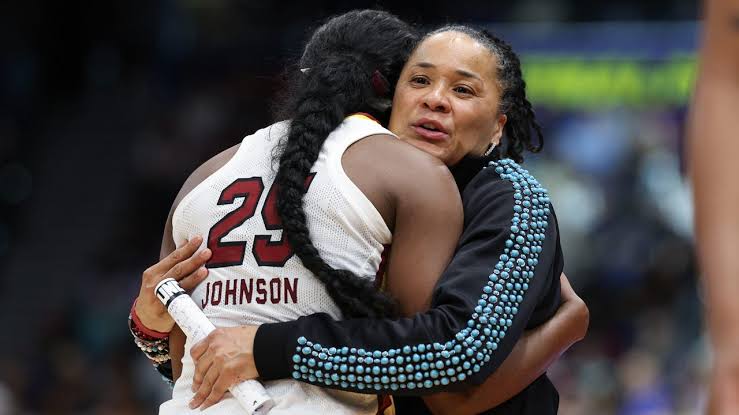
When the conversation turned to Raven Johnson’s final regular-season home game, the room went quiet in the particular way rooms go quiet when something genuinely important is being said.
Staley addressed the crowd reaction directly. “Everybody in this building has loved up on Raven,” she said. “And knowing it was going to be her last regular season home game, couldn’t go out any better way.” Then she added something that cut deeper than the ceremony itself: “I hope it understands, you know, some of the loud noise that people that have been forcing her way throughout her career, I hope it was muffled tonight by all of the FAMS that cheered her on every time she touched the ball and definitely when she exited the game tonight.”
It was a pointed, protective statement from a head coach who has watched her point guard navigate five years of external criticism and comparison. The standing ovation was not just a farewell. In Staley’s framing, it was a correction of the record.
Asked why she had previously said Johnson would be the player she missed most — more than anyone she had ever coached — Staley reached for something beyond basketball.
“One, Raven is just really consistent with how she comes in every day. She is incredibly funny, without even trying. Like, without even trying. Some of the stuff that comes out of her mouth, it brings me joy. Like, it really brings me joy.” She continued: “She knows who she is and she doesn’t mind speaking or living to that truth of hers. So I’ll miss that part of it, but I’ll certainly miss just her every day in practice.”
Then came the line that most precisely named the irreplaceable quality: “There’s a certain comfort level that you have with players to bring it every day. Like, they always give you a boost knowing that if they’re on the floor, we got a really good chance of winning. So I’m going to miss that feeling.”
That feeling — the absolute certainty of competitive excellence that a single player can install in an entire program’s daily rhythm — is what Johnson leaves behind. It cannot be recruited. It can only be grown over five years of showing up exactly the same way, every single day.
On the Seniors as a Collective — and What They Chose
The final question gave Staley the broadest canvas, and she used it to say something that the public rarely hears coaches say with this level of directness.
“Ta’Niya could’ve gone anywhere else in the country for a lot more NIL money, a lot more,” she said. “A lot more, right? She chose to come spend her last year with us, like, forever indebted to her for that.” The same was true of Okot. “Big Mama, again, could have gone anywhere in the country for a lot more, again, NIL money.” Both players chose South Carolina knowing full well what they were leaving on the table financially — a decision Staley did not take lightly and did not pretend to.
On what she hopes the seniors carry forward, wherever they go: “Raven, just her legacy of winning that she imparts to every one of her teammates. And I know, probably, the seniors all probably feel a little bit of what I’m feeling right now about Raven, because she just wants to win. It doesn’t matter if she’s got the spotlight, she’ll probably shun it to everybody else, but Raven wants to win. And I think that kind of sums up her legacy.”
The Full Picture
What Thursday’s press conference revealed, in its totality, is a coach who is fully present in the emotional complexity of a moment while simultaneously refusing to lose sight of what comes next. Staley allowed herself — and her players — the space to feel what Senior Night deserved to feel like. She was also back on the clock within 24 hours, focused on Kentucky, the SEC Tournament, and April 5th.
The dynasty she has built does not run on sentiment alone. It runs on standards, on relationships, on the kind of trust that makes a player send word down the bench that she wants back in — and on the kind of loyalty that makes two players leave NIL money on the table to be part of something they could not find anywhere else.
Twenty-four hours. Then back to work.
That is Dawn Staley’s program. That is what the Gamecocks are.
Source: on3