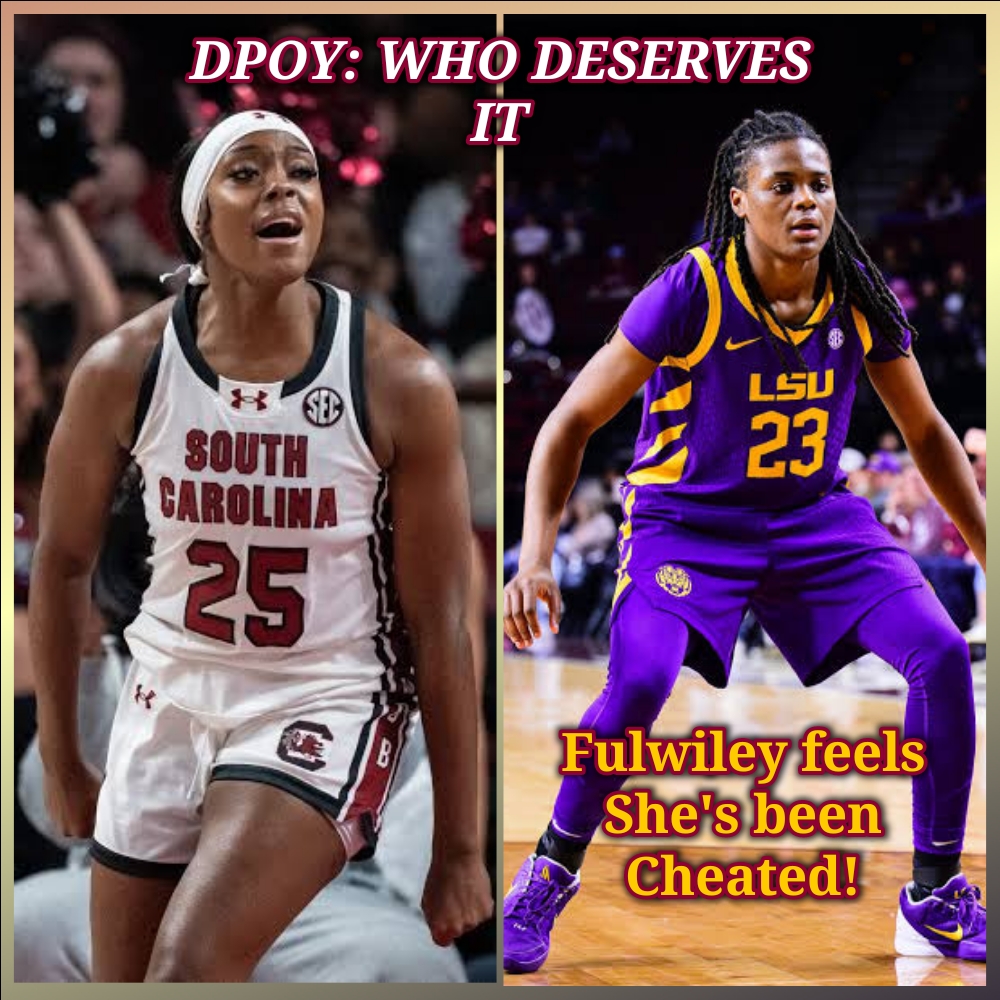
When the SEC unveiled its 2026 Women’s Basketball postseason awards on Tuesday, March 3, the conference handed South Carolina senior guard Raven Johnson the league’s most prestigious individual defensive honor — the SEC Defensive Player of the Year. For Gamecock fans, the announcement felt like a coronation. For LSU fans and Milaysia Fulwiley herself, it felt like a robbery.
Fulwiley, who transferred from South Carolina to LSU in the offseason, was not only passed over for the DPOY award — she was left off the SEC All-Defensive Team entirely. And the numbers she posted this season make that omission one of the most debated decisions in recent SEC history.
The Award Announcement: What the SEC Decided
The SEC coaches’ vote — the award is selected by the league’s 16 head coaches — resulted in the following All-Defensive Team: Raven Johnson (South Carolina), Rori Harmon (Texas), Ny’Ceara Pryor (Texas A&M), Madison Francis (Mississippi State), and Clara Strack (Kentucky). Fulwiley’s name was conspicuously absent.
Fulwiley did not walk away empty-handed. She was named SEC Sixth Woman of the Year for the second consecutive season — a distinction she first earned at South Carolina last year. She is now the third LSU player to claim that honor, joining Sylvia Fowles (2005) and Allison Hightower (2008). But for a player who dominated defensively by virtually every statistical measure, the Sixth Woman award felt like a consolation prize.
Breaking Down the Numbers: Fulwiley vs. Johnson
The heart of the controversy lies in the raw statistics. Here is a direct comparison of their key defensive numbers across the 2025-26 regular season:
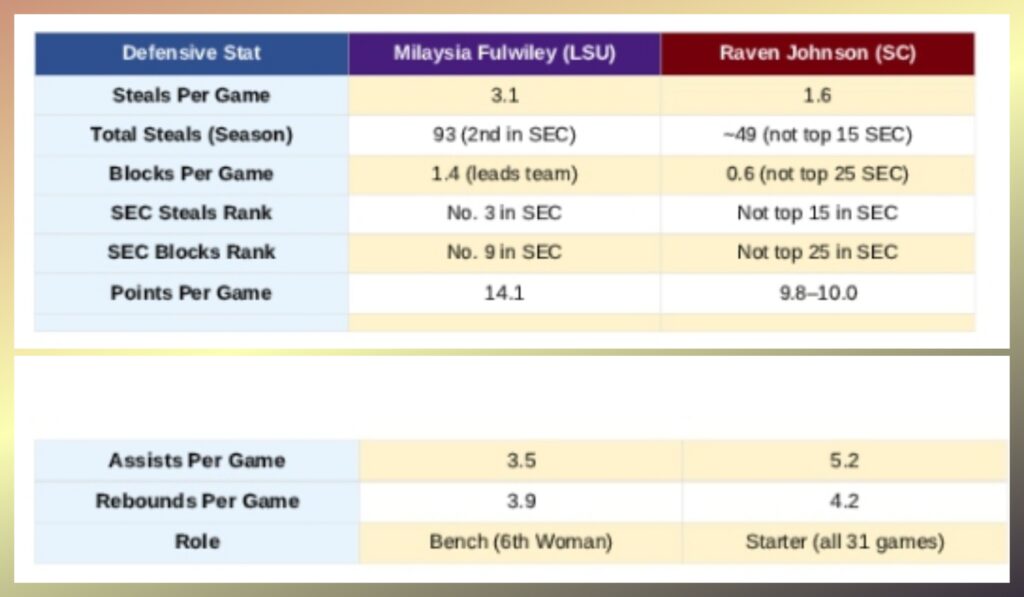
The numbers are jarring. Fulwiley ranked No. 3 in the entire SEC in steals per game and No. 9 in blocks among players under six feet — a remarkable achievement for a guard coming off the bench. Johnson, meanwhile, averaged 1.6 steals per game — a number that did not crack the SEC’s top 15 in the conference. Her 0.6 blocks per game did not rank among the top 25.
Fulwiley’s Response: ‘Ok Cool’
In the immediate aftermath of the snub, Fulwiley took to Instagram to express herself — subtly but unmistakably. She posted a compilation of photos of herself blocking shots, captioned simply: “ok cool.” The two-word post became a rallying cry for LSU fans and social media commentators who felt the message was clear — Fulwiley knew her worth, and the SEC’s decision did not reflect her impact.
This was not the first snub Fulwiley had faced this season. Earlier, the SEC Network released a video discussing candidates for the 2026 First Team All-SEC, and Fulwiley’s name was missing from the conversation entirely — despite her teammates Flau’jae Johnson and Mikaylah Williams being included. At the time, Fulwiley responded by praising the SEC’s competitiveness, displaying a level of poise that many noted only added to the injustice of the oversights.
Why Did Raven Johnson Win? The Case for the South Carolina Star
To be clear: Raven Johnson is a legitimate defensive force, and her award is not without merit. The coaches who voted for her were not operating in bad faith. Here is the strongest case for Johnson’s selection:
Consistency as a starter: Johnson started all 31 games for South Carolina this season, anchoring a defense that led the nation in field goal percentage defense (.335) and ranked fourth in scoring defense at 56.0 points per game. The impact of a true lockdown starter is arguably more systemic than that of a bench contributor, no matter how explosive.
Assignment defense — guarding the opponent’s best: Johnson regularly drew assignment to guard the opposing team’s best offensive player. In a marquee regular-season game against Ole Miss, she held Cotie McMahon — who entered the game averaging 20.7 points per game and had just scored 39 in her previous outing — to a season-low two points on 0-for-9 shooting. That kind of game-altering, assignment-specific defensive performance is difficult to capture in a box score but resonates deeply with coaches.
Defensive IQ and anticipation: Per CBS Sports, Dawn Staley and others close to South Carolina repeatedly emphasized that Johnson’s value is not reflected in traditional stats. Her ability to read passing lanes, set defensive traps, and disrupt ball-handlers at the point of attack is elite. In transition, her instincts allow South Carolina to shift defense into offense in seconds.
Legacy and reputation: Johnson is only the eighth guard to win the DPOY honor and the fifth Gamecock overall — following in the footsteps of A’ja Wilson and Aliyah Boston. Coach
The Case Against the Decision: Why LSU Fans and Analysts Cried Foul
Still, for all of Johnson’s defensive credibility, the statistical discrepancy between her and Fulwiley is difficult to ignore — and it’s not just numbers. As TigerRag put it on March 4, leaving Fulwiley off the All-Defensive Team entirely is “one of the league’s biggest recent embarrassments.”
Consider the context: Fulwiley was named to the Naismith Women’s College Defensive Player of the Year late-season watch list — a national recognition — alongside Johnson. She was producing those elite defensive numbers from the bench, in fewer minutes per game than a starter would receive, and was simultaneously fueling LSU’s No. 1-ranked offense by converting steals and deflections into transition baskets.
Her 93 steals on the season ranked second in the entire SEC and 13th nationally, with only 30 games played. She also led LSU in blocks — extraordinary for a 5-foot-10 guard. The argument that she was not just deserving of an All-Defensive Team spot but also a legitimate DPOY contender is well within reason.
The Role Penalty: Is Coming Off the Bench a Disqualifier?
One of the most nuanced aspects of this debate is the role question. Award voters — particularly for defensive honors — tend to favor starters. There is an implicit assumption that guarding a position for 30-plus minutes per game carries more defensive weight than doing so off the bench. Whether or not that’s fair, it appears to have factored into Fulwiley being overlooked.
But Fulwiley actually averaged more minutes at LSU than she did at South Carolina, where she also won the Sixth Woman award. She came off the bench in all 107 of her college appearances except four — meaning her impact is measured not by starting status but by the immediate energy and havoc she creates when she steps onto the court. Some might argue that her per-minute defensive production is even more impressive precisely because she achieves it without a starter’s minutes.
The Bigger Picture: A Transferring Star and a Complicated Narrative
There is an elephant in the room that cannot be ignored: Fulwiley transferred from South Carolina — where Raven Johnson remains — to LSU. She left the program where she won a national championship, earned the SEC Tournament MVP, and became a fan favorite. Her transfer created a storyline, and while award voters are supposed to evaluate on merit alone, human bias is difficult to eliminate.
Did Fulwiley’s transfer from South Carolina create a subconscious disadvantage when the South Carolina coaching staff (and other coaches who had long admired Johnson) cast their votes? It is impossible to know definitively. What is knowable is the statistical record — and it does not easily explain why Fulwiley was excluded from the All-Defensive Team while Johnson won the top individual award.
Where Things Stand Heading Into the SEC Tournament
As the SEC Tournament tips off, the debate over Fulwiley’s snub will continue to simmer. LSU (26-4, 12-4 in SEC) enters as the No. 4 seed, while South Carolina (29-2, 15-1) enters as the top seed and heavy favorite. The two programs could potentially meet in the tournament, which would add enormous weight to the ongoing individual comparison.
Fulwiley, for her part, has not let the snub shake her. Her ‘ok cool’ Instagram post may be the two most composed words in women’s college basketball this week. She has responded the right way — by continuing to dominate games and letting her play speak for itself. The SEC coaches may have made their verdict. But Fulwiley clearly believes the season is not over — and neither is her argument.
Sources: LSU Athletics, South Carolina Athletics, TigerRag.com, Saturday Down South. Stats reflect 2025-26 regular season.