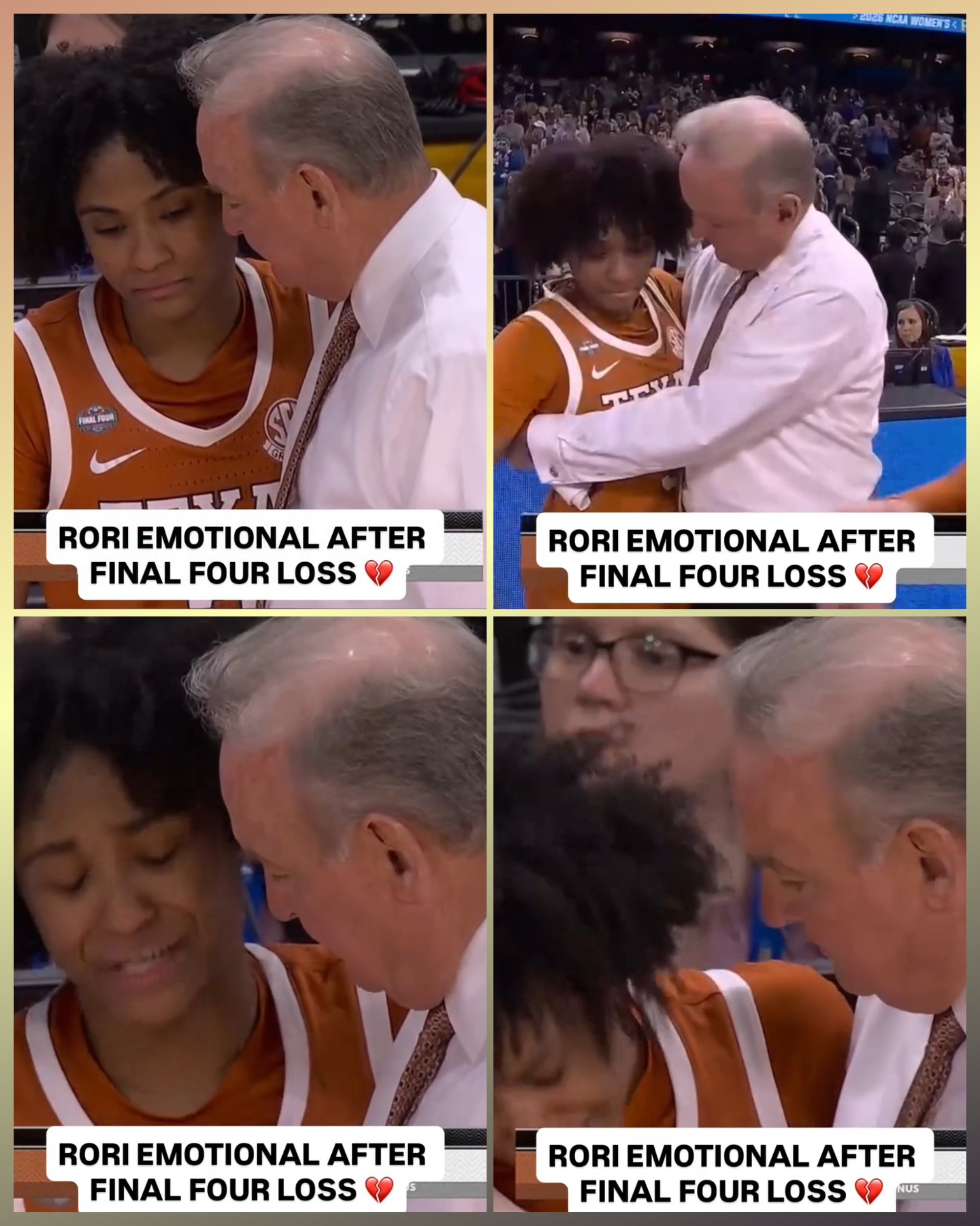
PHOENIX — When the final buzzer sounded on UCLA’s victory over Texas in the national semifinal, Rori Harmon walked off the court for the last time as a Longhorn. What followed was one of the most emotionally raw postgame moments of the entire Final Four weekend — not just from Harmon herself, but from the coach who has watched her do the impossible for years and could no longer contain his frustration at how little the broader world has acknowledged it.
Vic Schaefer did not hold back. Not even close.
The Rant That Needed to Happen
Schaefer stood at the podium after the loss and delivered what can only be described as a forceful, passionate indictment of the award voters who have overlooked Rori Harmon throughout her college career. He did not ease into it. He came with numbers.
“This is a crime and a shame, so you hear me good,” Schaefer began. “Rori Harmon has scored 1,616 points, 977 assists, 659 rebounds, and 388 steals — and not one agency has ever voted her All-American.”
He let that land before going further.
“There’s not another player in the history of our game — you hear me — not another player in the history of our game that has had those four statistics. Not one. She’s won 137 games. You might as well get rid of whatever award you’ve got if she ain’t good enough to get one of them.”
And then, simply: “Rori Harmon is irreplaceable.”
What Those Numbers Actually Mean
Schaefer’s fury is not emotional theater. It is statistically defensible, and the numbers deserve to be examined on their own terms.
1,616 points. 977 assists. 659 rebounds. 388 steals. Across four seasons as a Longhorn, Harmon built a statistical portfolio that does not exist anywhere else in the history of women’s college basketball. No other player has reached those thresholds across all four categories simultaneously. It is not a close call. It is not a matter of interpretation. The combination of scoring, playmaking, rebounding, and defensive production she has produced is genuinely unprecedented.
And she did all of it while winning. 137 victories. Multiple Big 12 titles. Two Final Four appearances with Texas, adding to the ones she made earlier in her career. She has been, by every measurable standard, one of the most complete and impactful players the college game has produced in a generation.
Not one All-American selection.
Schaefer’s point is not that Harmon deserves sympathy. It is that the award system has a credibility problem if a player with her statistical and competitive record cannot earn a single All-American vote. “You might as well get rid of whatever award you’ve got” is a harsh statement. Given the numbers he cited, it is also a defensible one.
Harmon’s Own Words
While Schaefer was raging on her behalf, Harmon herself was processing the end of her career with the quiet dignity that has defined her throughout it.
“I just look at it — like I said, I’m proud of myself and I’m so proud of my team to get to this moment,” she said, her voice carrying the unmistakable weight of finality. “I’m not saying I never would have thought, but just to come back like I did and get to the Final Four like we did — it just means a lot to me.”
The phrase “come back like I did” carries significant weight. Harmon has navigated injury and adversity throughout her career, and returning to compete at this level — reaching a Final Four in her final season — represents a personal triumph that she is choosing to lead with rather than the disappointment of the loss.
That is who she has always been. The assists leader who makes everyone else better. The defender who takes the opponent’s best guard. The player who fills every statistical category that does not show up on a highlight reel. The person who, even in her final postgame interview, leads with pride in her team rather than frustration about her own legacy.
The Recognition Gap
The disconnect between what Harmon has produced and how she has been recognized tells a story about how women’s college basketball awards are determined — and who they tend to favor. High-usage scorers. Players on the most visible programs. Players whose contributions show up in the most obvious statistical categories.
Harmon’s game has always been about everything else. She is the player who makes the right pass before the assist. The defender who takes charges and forces turnovers that do not always show up cleanly in a box score. The point guard who controls pace and personnel in ways that only become visible when you watch what happens to a team without her.
Those contributions are real. Schaefer has watched them up close for years, and his postgame outburst was the accumulated frustration of a coach who has seen his best player overlooked repeatedly while understanding exactly what she does for a team.
“Rori Harmon is irreplaceable” is not hyperbole coming from him. It is a statement of operational fact from the person who has had to build a program around her and will now have to build one without her.
The End of Something Special
Rori Harmon’s college career is over. She leaves Texas with numbers no one in the history of the sport has matched, a winning percentage that reflects sustained excellence, and — inexplicably — no All-American recognition to show for it.
Vic Schaefer made sure Friday night that if the award committees had not given her the recognition she deserved during her career, at least the sport would be forced to confront that omission on one of its biggest stages.
The career is over. The argument Schaefer made on her behalf is just beginning.