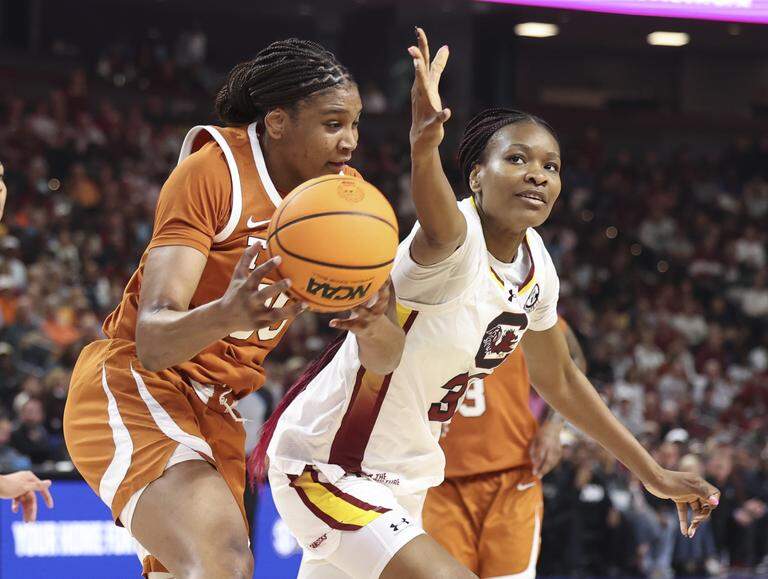
Maryam Dauda: South Carolina’s Most Valuable Intangible
In a program built on stars and championships, Maryam Dauda occupies a different but essential lane — the kind that doesn’t show up in box scores but shows up in wins.
The 6-foot-4 senior transferred from Arkansas to South Carolina ahead of last season, a decision that came with an obvious trade-off: fewer minutes in exchange for a shot at something bigger. At Arkansas, Dauda was a legitimate contributor, averaging 10.1 points and 6.3 rebounds as a sophomore while leading the SEC with 2.8 blocks per game in conference play. She was, by any measure, a featured piece.
At South Carolina, she became a reserve. Her playing time dropped to 6.4 minutes per game last season and has risen to 11.5 this year — still a far cry from the featured role she once held. Yet when asked whether she regrets the move, her answer is immediate.
“Absolutely not. The second I got here, I knew I made the right decision,” Dauda said. “I never doubted my decision one second. I’m just glad to be here.”
That acceptance isn’t passive resignation — it’s a deliberate competitive recalibration. The analytical case for her transfer is actually straightforward: players develop differently within elite systems. Dauda traded raw opportunity for exposure to championship-level culture, defensive schemes, and coaching infrastructure under Dawn Staley that Arkansas couldn’t offer. The returns aren’t measured in personal stats — they’re measured in program impact and postseason readiness.
That impact has been tangible in moments that mattered. During the SEC Tournament quarterfinals, Dauda logged 17 minutes and contributed five points and three rebounds. Against LSU in the semifinals, her offensive rebound and bucket early in the fourth quarter helped shift momentum back to the Gamecocks — a small play with outsized situational value. Associate head coach Lisa Boyer recognized exactly this dynamic.
“She gets a stop, she gets a rebound — a key rebound — and the team knows it,” Boyer said. “She comes to play and she comes to win, and she’s going to do whatever to help this team win. That’s a gift in itself.”
What Dauda represents is a case study in role clarity — understanding that in elite programs, depth players who fully embrace their function elevate the collective ceiling. This season, with post depth depleted by Adhel Tac’s absence since mid-February, Dauda’s reliability has shifted from a luxury to a necessity.
Her teammates notice. Joyce Edwards, a typically composed presence, lights up when Dauda’s name comes up. “That’s my girl,” Edwards said. “Every time she gets in, she’s ready to play.” Raven Johnson went further, describing a senior night moment where Dauda actively declined a late-game scoring opportunity to keep the ball moving — a selfless read that speaks directly to program culture.
“She wants to see others eat,” Johnson said. “She’ll give up her last meal for somebody else.”
Perhaps most telling is Dauda’s off-court influence. Staley credits her with impacting virtually every recruit who has visited the program over the past two years. That kind of cultural ambassadorship is difficult to quantify and impossible to manufacture.
“I would hire her, probably quicker than I will hire someone that probably plays 30 minutes a game,” Staley said.
That assessment reframes the entire narrative around Dauda’s South Carolina tenure. Her contributions aren’t a consolation prize for diminished stats — they’re a different category of value entirely. In a program chasing another national title, Dauda has figured out exactly what that requires. And she’s delivering it.