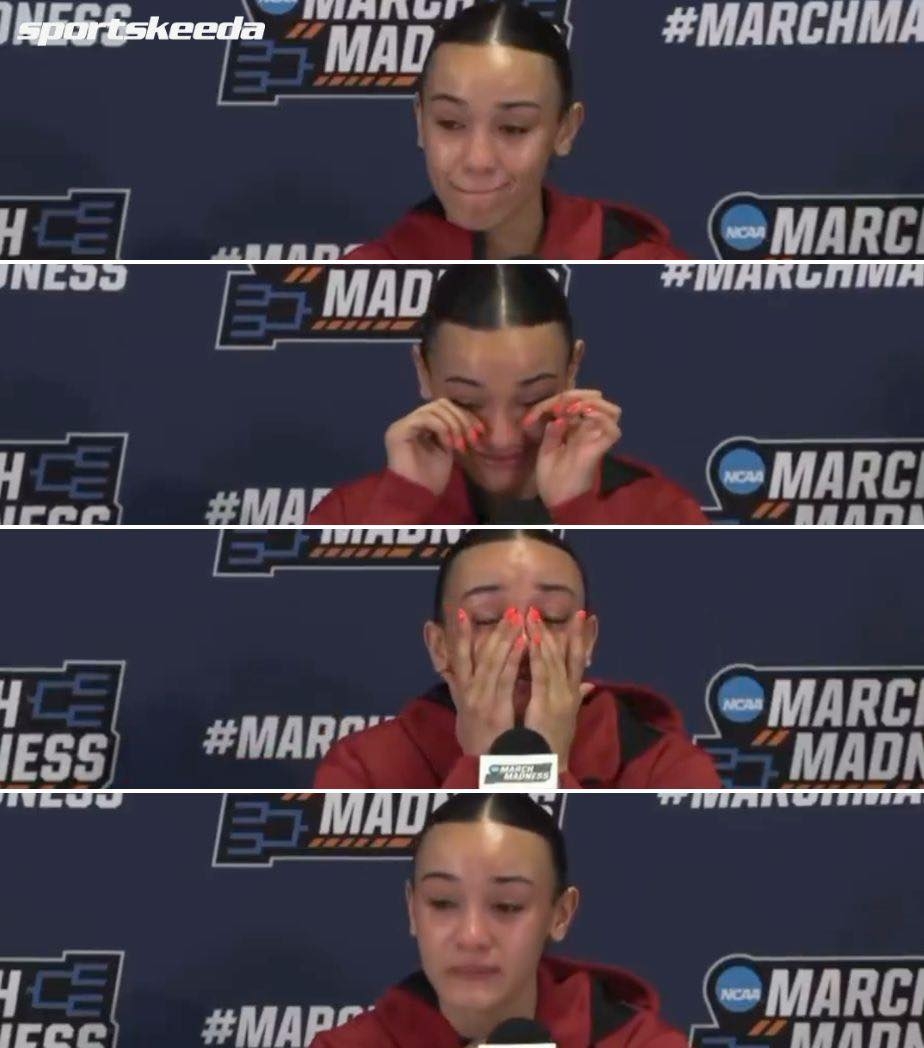
The press conference room at Colonial Life Arena was quiet in the way that only devastation can make a room quiet. Jazzy Davidson wiped tears from her eyes as she sat before the media following USC’s lopsided second-round loss to South Carolina. Londynn Jones, seated beside her, stared at the back of the room as her own eyes filled up. The season was over. The dream of avenging last November’s defeat in Los Angeles, of proving this Trojan team belonged on the same floor as the country’s best — all of it was finished in a 101-51 defeat that no one inside that program saw coming at quite this scale.
And yet, even through the tears, Jazzy Davidson spoke with a clarity and accountability that said everything about the kind of player — and the kind of person — she already is at just 19 years old.
The Moment That Broke the Room
The image that will endure from Monday night is not a made basket or a highlight reel play. It is a freshman, decorated beyond any other first-year player in the country this season, sitting at a press conference table with tears streaming down her face — not for herself, but for the people she shared the season with.
“Oh, my God, they mean everything to me,” Davidson said of her teammates. “They have gotten me through some really hard times this season, and I’m just so grateful to have been teammates with them, even if it was only for one season.”
That sentence — “even if it was only for one season” — carries the particular weight of a freshman who understands, perhaps for the first time with full emotional force, that rosters change, seasons end, and the people you fight alongside in March will not always be there the following year. For a player who led a team she had just met through the grind of an entire season, the grief of losing alongside them hit harder than any individual stat line ever could.
Accountability Without Excuses
What followed her emotional tribute to her teammates was equally striking — a moment of personal accountability delivered with no deflection, no softening, and no attempt to hide behind the team narrative she had just offered.
“I need to get better,” Davidson said. “That’s the bottom line. It’s hard to lose in general, but losing this way really sucks, and I think I could have done a lot better for my team today.”
That is not boilerplate athlete-speak. That is a player staring directly at a 5-for-15 shooting night — on the heels of a 31-point overtime masterpiece just 48 hours earlier — and refusing to manufacture distance between herself and the failure. Individual success took a backseat to the bigger picture on Monday night, and Davidson made clear her focus has already shifted toward elevating her team to championship contention.
The honesty of that assessment is what separates extraordinary players from merely excellent ones. Davidson didn’t blame the crowd. She didn’t cite fatigue from 45 minutes of overtime ball two days earlier. She didn’t reference the foul trouble that forced her to the bench with three fouls before halftime. She simply said: I need to be better. Full stop.
The Season That Was
To understand the full weight of Monday’s loss, you have to hold it against the extraordinary season that preceded it. Davidson finished the year leading USC in points, rebounds, assists, steals, and blocks — a rare across-the-board statistical sweep that underscores her all-around value and is almost unheard of for a freshman. She was named Big Ten Player of the Year, National Freshman of the Year by The Athletic, and was the only freshman in the conference to appear on all three of the First Team All-Big Ten, the All-Big Ten freshman team, and the All-Big Ten defensive team.
Just two days before the tears in Columbia, she became the first freshman in the last 25 years to record more than 30 points, five rebounds, and five assists in an NCAA Tournament debut — a 31-point, six-rebound, five-assist performance in overtime against Clemson that had the country buzzing about what she might do against the No. 1 seed.
She had walked into Monday’s game with full belief. “They’re everything they’re advertised to be,” Davidson had said the day before. “We’re really just focused on taking away the things that they do best, which is rebounding and limiting their touches.” It was the scouting report of a player who had studied her opponent and genuinely believed her team had an answer. “We play with a lot of grit and heart,” she said after the Clemson win. “And when we’re clicking, I think that can be scary for a lot of teams.”
South Carolina answered by outrebounding them, suffocating Davidson with the length of Agot Makeer and Raven Johnson, and building a 30-point halftime lead before the Trojans could organize a response.
What the Tears Actually Revealed
The image of Davidson crying will travel further than any of her statistics this season, and that is worth unpacking carefully — because the tears were not about her. They were about Londynn Jones, a transfer senior whose college career ended Monday night. About Kara Dunn, another senior saying goodbye. About a group of women who played through an up-and-down season, fought through the pain of JuJu Watkins watching helplessly from the bench for a second consecutive year, and gave everything they had for a program that needed them to.
The Trojans lost for the fifth time in their past six games, with this being the largest margin of defeat in their NCAA Tournament history, surpassing an 85-51 loss to Duke in the second round in 2006. The result was brutal. But the freshman at the center of it refused to let the brutality define what she took away from the season.
Davidson walks away from her freshman year as arguably the most complete first-year player in the country, even accounting for Monday night. She reflected after the loss on how much the season shaped her both on and off the court, emphasizing growth as the foundation for what comes next. The tears were real. The resolve behind them was even more so.
“I need to get better. That’s kind of the bottom line.” It was the last thing she said that mattered — and the first sentence of the chapter she is already writing.