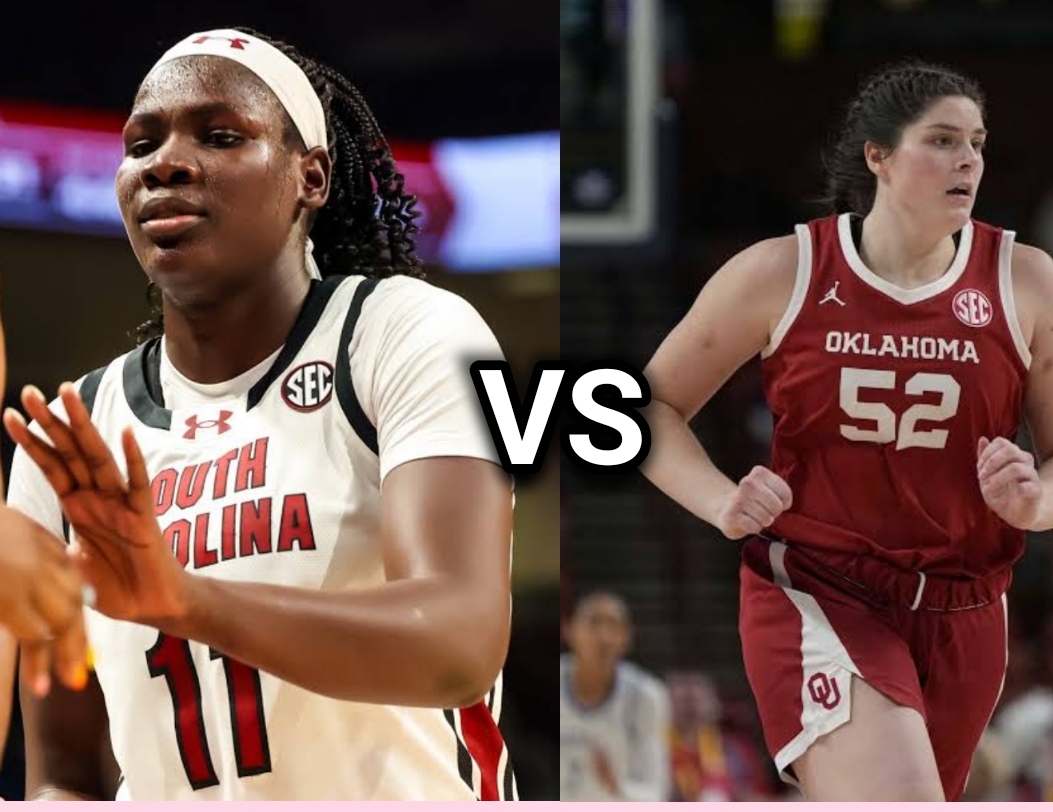
In January, it wasn’t a contest. Raegan Beers dominated. Madina Okot disappeared. Two months later, one of them has transformed — and the other knows it.
The January Blueprint and Why It No Longer Applies
On January 22 in Norman, Oklahoma, the interior matchup between South Carolina’s Madina Okot and Oklahoma’s Raegan Beers was decided before halftime. Okot played just 16 minutes, finished with six points, four rebounds and three turnovers. Beers, on the same floor, produced 18 points and 14 rebounds — a performance that anchored the Sooners’ 94-82 overtime victory and handed the Gamecocks their only SEC loss of the season.
That result established a clear hierarchy in the paint. But it established it in January. And in college basketball, two months of daily development, film study, and competitive refinement can render a January result almost entirely obsolete.
The No. 1 seed South Carolina Gamecocks (33-3) and No. 4 seed Oklahoma Sooners (26-7) meet again on March 28 at 5 p.m. ET on ESPN at Golden 1 Center in Sacramento, with an Elite Eight berth at stake. The Okot-Beers matchup will once again sit at the center of everything. But the terms of engagement have changed dramatically — and both programs know it.
Madina Okot: A Different Player Than the One Who Struggled in Norman
The statistical transformation Okot has undergone since the January loss in Norman is not subtle. It is one of the more remarkable individual development arcs in women’s college basketball this season.
Following the Oklahoma loss, Okot was moved to the bench for three games. That decision — difficult in the moment for any player with competitive pride — became the catalyst for an extraordinary run of production. In 10 of South Carolina’s last 12 games, Okot recorded a double-double. She tied her season-high of 17 rebounds twice and scored more than 20 points in two separate games. Her season averages now sit at 13.5 points and an SEC-leading 10.9 rebounds, shooting an efficient 58.4% from the floor.
Those numbers tell the story of a center who absorbed the most difficult night of her season, processed the feedback from her coaching staff, and responded with sustained elite-level production. The player who managed six points and four rebounds against Beers in January has become one of the most productive post players in the conference — peaking at exactly the right moment of the season.
But the development that may matter most on Saturday is one that extends beyond the paint entirely.
Okot has established herself as a credible threat from the three-point line, shooting 46.2% from deep on the season. For a 6-foot-plus center to shoot better than 46% from three is genuinely unusual — and it fundamentally changes how opposing defenses must approach her. Oklahoma cannot simply pack the paint and surrender the perimeter. They cannot sag off Okot and load up against South Carolina’s guards. Every defensive decision Beers and the Sooners make in the post now carries a perimeter consequence.
Oklahoma head coach Jennie Baranczyk acknowledged that dimension of the challenge directly.
“I think Madina Okot has had an incredible season,” Baranczyk said. “Just her versatility, she’s shooting the 3-ball more. You can’t just sit and pack the paint.”
That statement from an opposing head coach — on the eve of a Sweet 16 game — is the clearest possible confirmation that Okot’s growth has registered at the highest level of preparation. Baranczyk is not saying Okot is improved. She is saying Okot has changed the defensive parameters of the entire matchup.
Okot herself has identified the specific dimension of facing Beers that will require the most deliberate attention. She knows she must “be ready for the physicality” and that winning “the physicality battle” in the low post will be critical to the Gamecocks’ advancement.
“She’s so good around the rim and in the paint and defensively, she’s so good grabbing the ball,” Okot said of Beers.
That assessment — honest, specific, and undecorated — reflects a player who has done her film work and understands exactly what she is preparing to face.
Raegan Beers: The Standard Against Which Okot Is Measured
If Okot’s storyline this season is one of emergence and transformation, Beers’ storyline is one of sustained excellence and historical consistency.
The Oklahoma center is averaging 15.8 points while shooting 61.7% from the floor — numbers that place her among the most efficient post scorers in the country. She is second in the SEC in rebounding at 10.5 per game, a fraction behind Okot’s conference-leading 10.9. The separation between the two players statistically is minimal — which makes the head-to-head matchup genuinely compelling rather than a predetermined conclusion.
The historical record between Beers and the Gamecocks, however, favors the Oklahoma center significantly. In four career meetings against South Carolina, Beers has averaged 16 points and 9.5 rebounds — figures that span different South Carolina rosters, different game environments and different competitive contexts. She produced 19 points and 10 rebounds against the Gamecocks at Mississippi State last season — in a game South Carolina’s predecessor program won, but in which Beers was individually dominant.
That career body of work against South Carolina reflects something beyond individual talent. It reflects a player who elevates in this specific matchup — who treats the challenge of facing one of women’s basketball’s premier programs as a competitive laboratory. Beers made that orientation explicit in her Friday media availability.
“I’ve played anywhere from Kamilla Cardoso to now Okot, two phenomenal post players. And so, I’ve just gotten better every time I’ve played them,” Beers said. “I’m excited to go up against them for the fifth time.”
That framing — “I’ve just gotten better every time” — is the most analytically significant thing Beers said. She is not approaching this as a survival exercise against a superior opponent. She is approaching it as the next chapter in a personal development narrative built specifically against South Carolina’s frontcourt. Four games. Four opportunities to learn. And by her own account, four steps forward.
Her assessment of Okot was equally specific and respectful.
“She is a phenomenal rebounder, offensive rebounder specifically. She gets in there, so we have to be able to focus on that, obviously,” Beers said. “And then she’s a threat on the block. And that girl can score. So, it’s going to be really important, obviously, to keep her far away from the basket as possible tomorrow. I’m excited to go up against her again.”
The phrase “keep her as far away from the basket as possible” is a coaching instruction disguised as a media quote. It reveals exactly how Oklahoma plans to defend Okot — pushing her away from her most dangerous zones, forcing her to beat them from positions where she is less comfortable. Whether Okot’s three-point shooting percentage negates that defensive strategy is one of Saturday’s defining tactical questions.
The Broader Stakes: What This Matchup Means for the Game
Interior dominance in women’s college basketball is not merely about individual statistics. It is about how a post matchup shapes everything else on the floor — spacing, transition opportunities, second-chance points, defensive load on the perimeter, and the cumulative physical and psychological toll across 40 minutes of play.
In January, Oklahoma won the rebounding battle 54-39 — a plus-15 margin that is extraordinary against a Dawn Staley-coached team. That edge created transition opportunities, extended Oklahoma possessions, and forced South Carolina’s offense into half-court sets against a prepared defense. The Sooners held the Gamecocks to 82 points across 45 minutes — well below South Carolina’s season average — and Beers’ dominance of Okot was the structural foundation of that defensive performance.
If that rebounding margin repeats on Saturday, Oklahoma’s path to an upset becomes credible. If Okot’s transformation — the double-doubles, the physicality, the three-point threat that Baranczyk cannot ignore — flips that interior battle in South Carolina’s favor, the Gamecocks’ depth, athleticism and coaching advantage across the rest of the roster become decisive.
This is why both programs have identified this matchup as pivotal. Not because centers are the only players on the floor, but because what happens between Okot and Beers will define the structural conditions within which every other player operates.
Two centers. Five career meetings. One Sweet 16. And a result in January that one of them has spent every day since working to reverse.
Saturday in Sacramento, the paint decides everything.