PHOENIX — The final score was 62-48. But the story of UConn’s Final Four loss to South Carolina cannot be told through the scoreboard alone. It ran through a ripped jersey, a foul disparity that infuriated Geno Auriemma, a sideline interview that made national news, and a postgame confrontation that required assistant coaches to intervene.
It was, by any measure, a complicated night in Phoenix.
The Jersey Incident
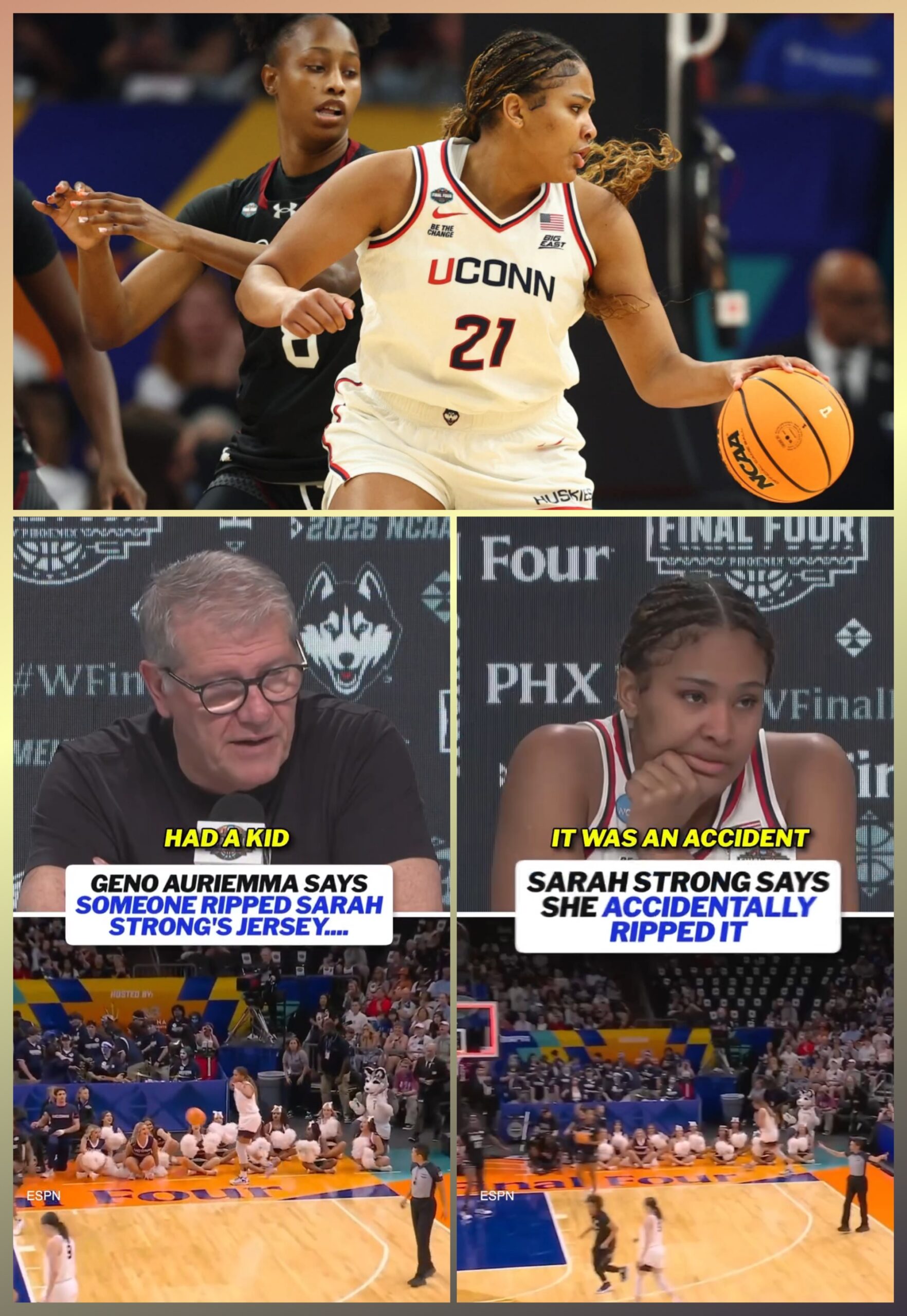
With the third quarter winding down and UConn trailing, Sarah Strong — the Huskies’ best player and a legitimate National Player of the Year candidate — drove and attempted a shot at the buzzer while taking contact. The shot did not go in. No foul was called. Strong looked down at her No. 21 jersey and, in a moment of visible frustration, pulled at it — tearing it in a way that made it unwearable.
She emerged for the fourth quarter in No. 55.
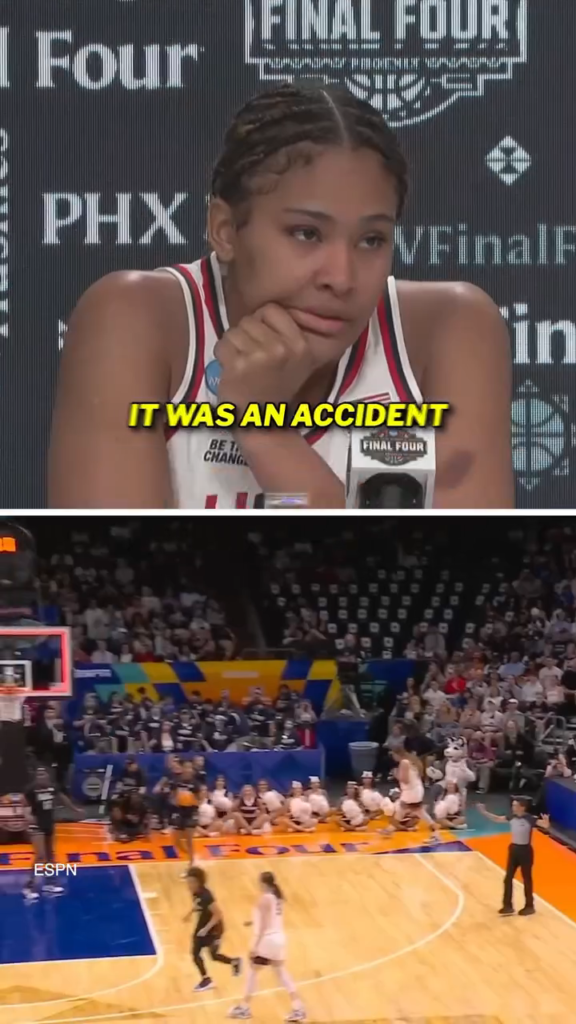
Strong’s explanation was straightforward and self-accountable.
“It was an accident,” she said. “I missed my shot. Ripped it by accident.”
Auriemma’s account was different. He implied — without being able to prove it definitively — that a South Carolina player had torn the jersey during the physical contest on the play, and that the officials had failed to see or call it.
“I’ve been coaching a long time. I’ve never had a kid have to change their jersey because somebody ripped it and the official said, ‘I didn’t see it,'” he said.
The video evidence available is inconclusive. What is clear is that Strong and her coach had different recollections of the same moment — and that Auriemma chose to treat it as emblematic of a larger officiating problem rather than an isolated incident.
LOL CLICK HERE 👇 TO WATCH
The Foul Disparity: The Numbers Auriemma Kept Returning To
The jersey incident was the flashpoint, but the underlying frustration had been building all game. The numbers are difficult to dismiss entirely: UConn finished with 17 team fouls to South Carolina’s eight. The Gamecocks shot 22 free throws. UConn shot six. In the third quarter specifically, UConn was whistled for six fouls while South Carolina was called for none.
Auriemma addressed the disparity directly and repeatedly.
“I’m just saying there was not a single foul called on them in the third quarter,” he said. “I have a kid that’s one of the best players in the country and has got the ball a lot and is trying to get something done, and you mean to tell me there was never a time when she got fouled? Find that hard to believe.”
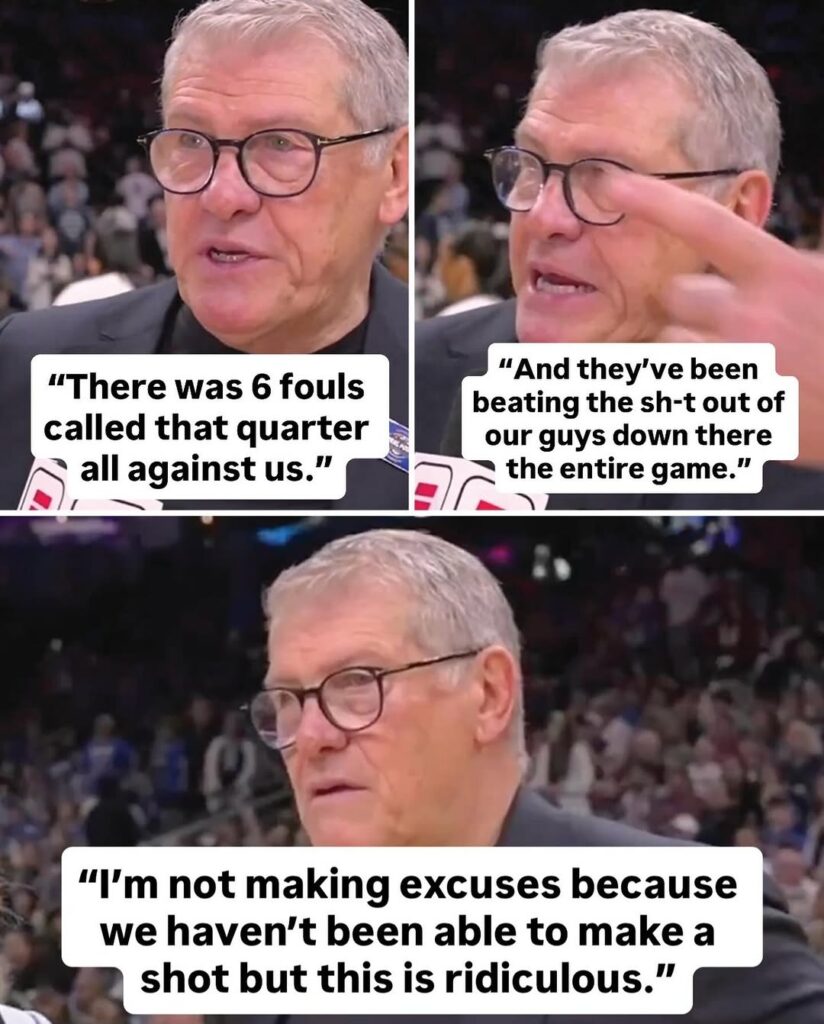
The question of whether the disparity reflected legitimate officiating or institutional bias is one that cannot be definitively answered. South Carolina’s defense is designed to be physical and disruptive — they finished the game with eight fouls, which suggests either disciplined positioning or favorable treatment, depending on your perspective. Auriemma clearly believed it was the latter.
The Double Standard Allegation
Beyond the foul counts, Auriemma leveled a more pointed accusation — that Dawn Staley had communicated with officials in a manner that would have gotten him ejected, and that no consequence followed.
He doubled down on those comments postgame without hesitation.
“I just want to make sure there’s not a double standard,” he said. “I’m of the opinion that if I ever talk to an official like that, I would get tossed. So, I just want to make sure there’s not a double standard, that some people are allowed to talk to officials like that and other people are not. That’s it.”
He was careful, however, to clarify that he was not retroactively calling for Staley’s ejection.
“It’s not my place to judge whether any coach should ever get tossed,” he said. “I’m not suggesting that that should have happened tonight at all. Not at all.”
The distinction matters. Auriemma was not asking for a different outcome. He was asking for consistent application of officiating standards — a complaint that is difficult to verify but also difficult to completely dismiss, given that it comes from a coach with 41 years of experience and 25 Final Four appearances.
The Handshake That Started It All
By the time the final buzzer sounded, the tension that had accumulated across forty minutes had nowhere left to go. Auriemma approached Staley for the postgame handshake — and what followed required assistant coaches from both programs to step between the two head coaches.
Auriemma’s specific grievance was a pregame protocol he felt Staley had not followed — coaches are expected to meet at halfcourt before the game for a formal handshake that is announced over the public address system. He said he waited at halfcourt for approximately three minutes.
“The protocol is before the game, you meet at halfcourt. Anybody see that before? Two coaches meet at halfcourt and they shake hands. They announce it on the loudspeaker. I waited there like three minutes. So it is what it is.”
Staley’s account differed. She told ESPN’s Holly Rowe that she had gone down pregame and shaken the hand of every member of Auriemma’s coaching staff. Her position was that she had fulfilled the spirit of the pregame courtesy, even if the formal halfcourt meeting had not occurred as Auriemma expected.
“I guess he thought I didn’t shake his hand at the beginning of the game. I don’t know,” Staley said. “I went down there pregame, shook everybody on his staff’s hand. But hey, sometimes things get heated. We move on.”
She also made clear she was not going to let any of it diminish what her team had accomplished.
“I’m super proud of our kids, and I’m not going to let any of this here take anything away from the performance on the floor.”
What Actually Decided the Game
Lost in the officiating controversy is the basketball reality: South Carolina outplayed UConn across forty minutes, held the nation’s most efficient offense to 48 points, and did not allow a single basket in the final four to five minutes of the game. The Gamecocks won because they executed their defensive game plan better than anyone has against UConn all season — not because of foul calls.
The disparity in free throw attempts is real and worth scrutiny. But it does not explain a 14-point loss. UConn’s empty possessions at the start of the third quarter, their inability to generate clean looks in the half-court, and South Carolina’s offensive efficiency in the second half are what actually decided the outcome.
Auriemma, to his credit, acknowledged as much in the same press conference.
“The game wasn’t played the way we want to play it. It was played the way South Carolina wanted to play it. I think they did a great job of doing that.”
The jersey will be a footnote. The foul disparity will be debated. The handshake confrontation will be replayed. But South Carolina is in the national championship game, and that is the fact that supersedes everything else from Friday night in Phoenix.
The rest is noise. Important, complicated, genuinely interesting noise — but noise nonetheless.