Todd Ellis and the Rarest Double: South Carolina’s Record-Setter Who Never Really Left
The South Carolina Football Hall of Fame’s class of 2025 is headlined by five inductees whose careers span multiple decades and programs — but the most layered story in this year’s group belongs to Todd Ellis, a man whose relationship with Gamecock football is now approaching four decades and shows no signs of ending.
Ellis arrived in Columbia as one of the top quarterback prospects in the 1985 class, redshirted his first year, and then did something increasingly rare in modern college football — he stayed. Four full seasons as the primary starter, during which he rewrote the program’s passing record book in ways that have proven remarkably durable.
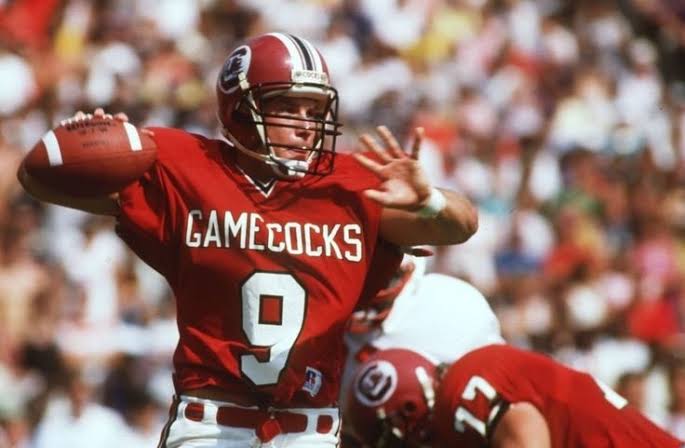
The numbers hold up under scrutiny. Ellis’ 9,953 career passing yards remain the all-time program record — a figure that has survived the modern era’s pass-heavy offenses, spread systems, and transfer portal churn that has accelerated statistical inflation across college football. That the record still stands is itself an analytical statement about how productive Ellis was within the constraints of late-1980s offensive football, when passing attacks were far less prolific by design. He also sits second in program history in completions and fourth in passing touchdowns, and is one of just four Gamecock quarterbacks — alongside Connor Shaw, Phil Petty, and Garry Harper — to win at least eight games in a season twice.
What separates Ellis from a straightforward statistical induction, however, is what came after his playing days. Rather than departing Columbia for professional opportunities, Ellis stayed connected to the program through broadcasting, eventually ascending to the play-by-play role in 2003 — a position he still holds today. The SCFHOF explicitly cited both his playing career and his broadcasting contributions as qualifying factors for induction, which is notable. Hall of Fame criteria that account for post-playing contributions are relatively uncommon, and the organization’s decision to frame Ellis’ candidacy this way reflects the genuine dual nature of his legacy.
For over two decades as the Voice of the Gamecocks, Ellis has narrated the program’s highest highs and lowest lows — calling games from the broadcast booth for the same program he once led from under center. That continuity of commitment, from recruited freshman in 1985 to the voice of the fanbase in 2025, is the kind of institutional loyalty that programs increasingly struggle to cultivate in any era, let alone sustain across generations.
This induction is also Ellis’ third hall of fame honor in South Carolina. He entered the University of South Carolina Lettermen’s Hall of Fame in 2005 and the state of South Carolina Athletics Hall of Fame in 2020. The progression — institutional, then statewide, now sport-specific — reflects a recognition that has built methodically and appropriately over time rather than arriving all at once.
The rest of the 2025 class is equally accomplished. Jerry Butler’s path from Ware Shoals to Clemson to the Buffalo Bills represents one of the state’s great receiver stories. Dexter Coakley, from Mt. Pleasant through Appalachian State to the Dallas Cowboys and St. Louis Rams, built a professional career that belied his recruiting profile. A.J. Green’s trajectory from Summerville to Georgia to a decorated NFL career with the Cincinnati Bengals needs little elaboration — he is among the most gifted wide receivers the state has ever produced. Legacy inductee Bob Jeter, whose journey from Union to Iowa to the Green Bay Packers and Chicago Bears spans a different era entirely, rounds out a class with genuine geographic and generational range across South Carolina.
The enshrinement ceremony takes place April 16, with Gamecock football coach Shane Beamer’s wife Emily Beamer honored separately as the SCFHOF’s 2025 Humanitarian of the Year.
For Ellis, the date will mark something worth pausing on — formal recognition of a career that never actually stopped.