February 18, 2026
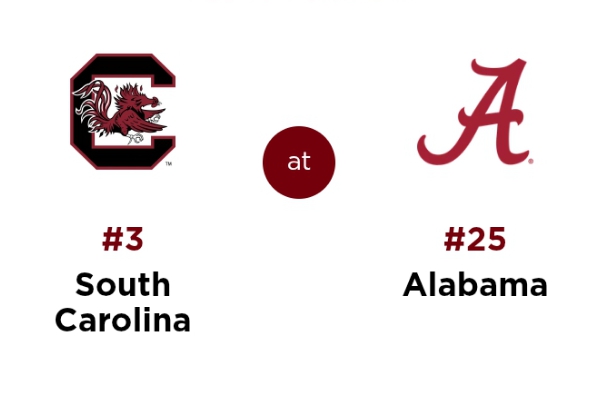
After a Valentine’s Day statement that sent shockwaves through the SEC and beyond, No. 3 South Carolina women’s basketball has no time to exhale. The Gamecocks — fresh off their stunning 79-72 road victory over No. 6 LSU in Baton Rouge — pack their bags and head straight back into enemy territory on Thursday, February 19, for a 7:30 p.m. CT rematch with No. 25 Alabama at Coleman Coliseum in Tuscaloosa. It is the second and final meeting between these two programs in the 2025-26 regular season, and with the SEC race in its final stretch and Selection Sunday less than a month away, every possession carries monumental weight.
Here is everything you need to know heading into one of the most anticipated matchups left on the women’s college basketball calendar.
The Historical Blueprint: A Rivalry Rooted in Dominance
The series between South Carolina and Alabama stretches all the way back to the 1979-80 season, establishing a rivalry that has now produced 46 meetings in the women’s game. In those 46 encounters, Alabama has won 15 times, while South Carolina has claimed 31 victories — and notably, the Crimson Tide has not triumphed in the last 22 meetings.
Under head coach Dawn Staley specifically, the Gamecocks have turned this series into something closer to a coronation than a contest. South Carolina is 32-15 all-time against Alabama and holds a dominant 22-0 mark in the Dawn Staley era, which began in the 2008-09 season. NCAA That is a streak of two-plus decades without a single loss to the Crimson Tide — a stunning testament to Staley’s program-building and the gap between these two programs at the highest level.
The most recent meeting between the two programs this season only reinforced that narrative. When the teams squared off on New Year’s Day in Columbia to open SEC play, Joyce Edwards scored 25 points and South Carolina won its 24th straight game over previously undefeated Alabama 83-57, extending the Gamecocks’ dominance emphatically. College Sports Network After the blowout, Alabama head coach Kristy Curry reflected plainly on the loss, saying: “I think it’s important to understand they had a significant size advantage, and I thought they physically overtook us in the third and fourth quarters. We’ve got to do a better job showing more resistance and defending the paint. Their size really affected us down the stretch.”
It was a candid admission — and a preview of the tactical adjustments Curry has had months to implement ahead of Thursday’s rematch in her home building.
The Recent Form: Two Teams Heading in Very Different Directions
South Carolina’s trajectory since that New Year’s Day win has been nothing short of extraordinary. The Gamecocks, now 25-2 overall and 11-1 in the SEC, head to Tuscaloosa on the back of one of the most electric performances in the SEC this season. Tessa Johnson scored 21 points as the Gamecocks beat No. 6 LSU 79-72 on Saturday night, extending their winning streak over the Tigers to 18 games. South Carolina Athletics Raven Johnson contributed 19 points, and Madina Okot delivered a dominant double-double with 12 points and 17 rebounds. It was a victory that not only kept South Carolina’s SEC title hopes firmly alive but also marked Dawn Staley’s 500th career win with the program.
Alabama, ranked No. 25 in the current AP poll, comes in having gone through genuine turbulence in the SEC’s second half. The Crimson Tide sit at 20-6 overall and 6-6 in the SEC heading into Thursday, having just dropped a 79-71 home decision to No. 10 Oklahoma, their second consecutive loss. On3 The Tide have shown they are capable of beating ranked opponents — they defeated No. 25 Georgia earlier this month — but have been inconsistent in ways that will concern head coach Kristy Curry as tournament bracket positioning comes into focus.
The divergence in form between these two teams is striking. South Carolina is locked into a No. 1 seed in ESPN bracketology. Alabama is fighting to hold on to its ranking and build its tournament résumé. The motivation levels on Thursday night could not be more different.
Style of Play: A Classic Chess Match Between Power and Pace
Understanding how this game will be won or lost requires understanding what each team does best — and what each team desperately wants to prevent.
South Carolina under Dawn Staley is built on the concept of controlled force. The Gamecocks are one of the deepest and most physically imposing programs in the country, deploying multiple forwards and bigs who can overpower opponents in the paint while an elite backcourt generates offense from every angle. South Carolina ranks 14th in the nation in scoring defense, allowing just 54.6 points per game, and eighth in field goal percentage defense at .342 — a reflection of a defensive system that blends size, length, and intensity in ways few programs can replicate. ESPN Asheville
The Gamecocks operate at a deliberate, half-court pace but are equally dangerous in transition when the ball is moving and guards like Raven Johnson are orchestrating. Their ability to get to the free-throw line — as demonstrated in their 82 percent clip in the New Year’s Day win — and dominate the glass gives them an almost structural advantage in close games.
Alabama’s identity under Curry is defined by guards and three-point shooting. Karly Weathers leads the Crimson Tide with 2.1 made three-pointers per game, and Alabama relies heavily on their perimeter game to generate offense. Tiger Rag Their pace is quicker, their offense more spread-oriented, and their success is deeply tied to whether shooters like Jessica Timmons and Weathers are connecting from deep. When those shots fall, Alabama can sustain long stretches of offensive momentum and keep even elite teams uncomfortable. When they don’t, the Tide can go cold quickly and find themselves chasing the score.
The stylistic clash here is significant: South Carolina wants to make this physical, interior-dominant, and slow. Alabama needs it to be open, pace-driven, and three-point-friendly. Whichever style asserts itself in the first half will likely determine the game’s outcome.
Players to Watch
Tessa Johnson, G, South Carolina — Coming off back-to-back 20-point games against AP Top-10 opponents, Tessa Johnson became the only South Carolina player with consecutive 20-point performances against top 10 AP opponents since Aliyah Boston in the 2019-20 season. She is the SEC’s leading three-point shooter, and her combination of off-the-dribble creation and deep-range shooting makes her one of the hardest individual matchup problems in the country right now. If Alabama cannot contain her early, the Crimson Tide could be in for another long night.
Joyce Edwards, F, South Carolina — Edwards leads the Gamecocks in scoring at 21.4 points per game, adding 6.1 rebounds and 2.8 assists per contest, while also pacing the team with 2.0 steals and 1.5 blocks per game. She was the dominant force in the first meeting, going for 25 points. In the road environment of Coleman Coliseum, her interior presence will be tested, but her ability to get to the line and convert remains a significant weapon.
Raven Johnson, G, South Carolina — Often the overlooked piece in a roster full of standouts, Raven Johnson is a do-everything engine who makes South Carolina functionally dangerous on both ends. Her 19-point, 7-rebound, 6-assist night against LSU was a reminder that when she is locked in, the Gamecocks have a five-player starting lineup that can damage any defense in the country.
Madina Okot, F/C, South Carolina — Okot leads South Carolina in rebounding at 11.2 per game. Her 17-rebound, 12-point double-double against LSU showcased why Alabama’s coaching staff identified the paint as their primary area of vulnerability after the January blowout. If Okot controls the glass in Tuscaloosa, South Carolina’s second-chance opportunities could prove decisive.
Jessica Timmons, G, Alabama — Timmons is Alabama’s leading scorer at 15.5 points per game and tops the roster in assists at 3.0 per game. She recorded 12 points in the first meeting and has been one of the Tide’s most consistent performers throughout the season. Her ability to create off the dribble and connect from mid-range and beyond gives Alabama an offensive focal point that South Carolina will need to account for.
Diana Collins, G, Alabama — Collins is Alabama’s most reliable secondary scorer, combining with Timmons for 29 of Alabama’s 57 points in the first meeting. South Carolina Athletics Her ability to hit contested three-pointers under pressure — including a buzzer-beating triple that cut South Carolina’s halftime lead to six in January — makes her a dangerous player to lose in any crowd.
Possible Upsets and What Could Derail South Carolina
On paper, the Gamecocks are overwhelming favorites. But college basketball, especially in hostile road environments deep into February, does not always honor paper records. There are genuine scenarios in which Alabama could pull off one of the biggest wins of the Crimson Tide women’s program’s recent history.
The primary path to an upset runs through three-point shooting. Alabama shot 9-of-29 from beyond the arc in the January blowout — just 31 percent — a number well below their season average. If the Tide can shoot closer to their true capability from deep and generate early momentum in front of a Coleman Coliseum crowd that will be desperate to see the streak end, the energy dynamics of the game shift dramatically. Alabama’s home building creates noise and rhythm; South Carolina will need to weather an early Crimson Tide run and respond with discipline.
South Carolina’s depth has also been tested this season by injuries, and the road environment removes the guaranteed energy of Colonial Life Arena. If the Gamecocks are slow out of the blocks — as they briefly were against LSU before recovering — Alabama has the firepower to capitalize on a dormant start.
Weaknesses and Injury Watch
South Carolina’s most significant ongoing vulnerability is exactly what it has been all season: depth disrupted by injuries. South Carolina has been hit with several injuries and a suspension in November for Maddie McDaniel that have tested its depth. On3 Ta’Niya Latson has had injury issues that, while she appears to be healthier now, remain a point of concern heading into the season’s final stretch. When Latson is healthy and aggressive, South Carolina’s offense gains another dimension. When she is limited, the offensive burden falls even more heavily on Edwards and Johnson.
Alabama’s key injury concern centers on their guard rotation. Sarah Ashlee Barker, a 6-foot guard, has been dealing with a lower leg injury, and was ultimately declared out in the final availability report ahead of their last matchup with the Gamecocks. NCAA Her status for Thursday will be among the most closely watched updates of the week. In the three games she has missed, Alabama went 2-1 — manageable, but far from seamless, as her presence on the defensive end gives the Tide a versatile wing defender who can credibly contest South Carolina’s perimeter scorers.
Alabama’s structural weakness remains exactly what Curry identified in January: the inability to defend size. When South Carolina’s combination of Okot, Edwards, and their forwards physically impose themselves in the paint, the Tide’s smaller, guard-heavy lineups can be overmatched in ways that compound over four quarters.
The Bottom Line
This is a game that, on most measures, South Carolina should win. The Gamecocks have won nine SEC regular-season titles over the last 12 years, including the last four, and have not been outside the top two in conference standings during that stretch. Tide 100.9 Their dominance over Alabama is historical, comprehensive, and recent. Tessa Johnson is playing at an historic level. Raven Johnson and Joyce Edwards have been equally devastating. And Dawn Staley’s program simply does not lose focus in environments like Coleman Coliseum.
But Alabama is ranked No. 25 for a reason, plays with explosive guard play, and desperately needs this win to solidify its tournament résumé. Coleman Coliseum will be loud, the Tide will be motivated, and the ghosts of 22 consecutive losses carry weight that even the most experienced team in the country must process.
For South Carolina, this is not just about winning — it is about how they win. With the SEC title within reach and the NCAA Tournament bracket taking shape, another dominant road performance would send a powerful message to every program in the Fort Worth region and beyond.
Tipoff from Tuscaloosa is set for Thursday, February 19 at 7:30 p.m. CT on SEC Network.