It was meant to be a halftime instruction to her own players. Instead, Kim Mulkey handed Tessa Johnson something no marketing team could have manufactured — and Gamecocks Nation ran with it.
The Moment That Started Everything
There are turning points in a season that arrive quietly — a made shot, a defensive stop, a momentum shift that only becomes significant in retrospect. And then there are moments like February 14 in Baton Rouge, when LSU head coach Kim Mulkey asked her team a question that had no good answer.
Tessa Johnson had just buried four consecutive three-pointers in the opening minutes of South Carolina’s 79-72 victory over the Tigers. Mulkey, watching from the sideline as her defense unraveled against Johnson’s shooting, turned to her huddle and demanded accountability in the most direct way possible.
“Who can guard Tessa?”
She meant it as a challenge. It became a cultural moment.
That clip circulated through women’s basketball’s social media ecosystem with a speed that no promotional campaign could have replicated. Because it wasn’t manufactured. It wasn’t designed. It was a Hall of Fame coach, in the heat of competition, publicly acknowledging that one player had dismantled her defensive game plan in real time. That kind of authenticity doesn’t have a price tag.
From a Huddle to a T-Shirt to a Movement
Within weeks of that moment, fans began showing up to Colonial Life Arena wearing shirts bearing Mulkey’s inadvertent endorsement. The quote — stark, simple and devastating in its implication — needed no additional context. Anyone who follows women’s college basketball understood immediately what it meant and who it was about.
The merchandise operation was formalized through Athletes Thread, an NIL company specializing in custom athlete merchandise, with shirts priced at $44 — a figure that doubles as Johnson’s jersey number, a detail that fans immediately appreciated. Every dollar, according to the product listing, goes directly to Johnson. The link was posted on social media by Joe Shepard, who works in NIL for the Gamecocks, and the response reflected exactly the kind of organic fan enthusiasm that NIL opportunities are built to capture.
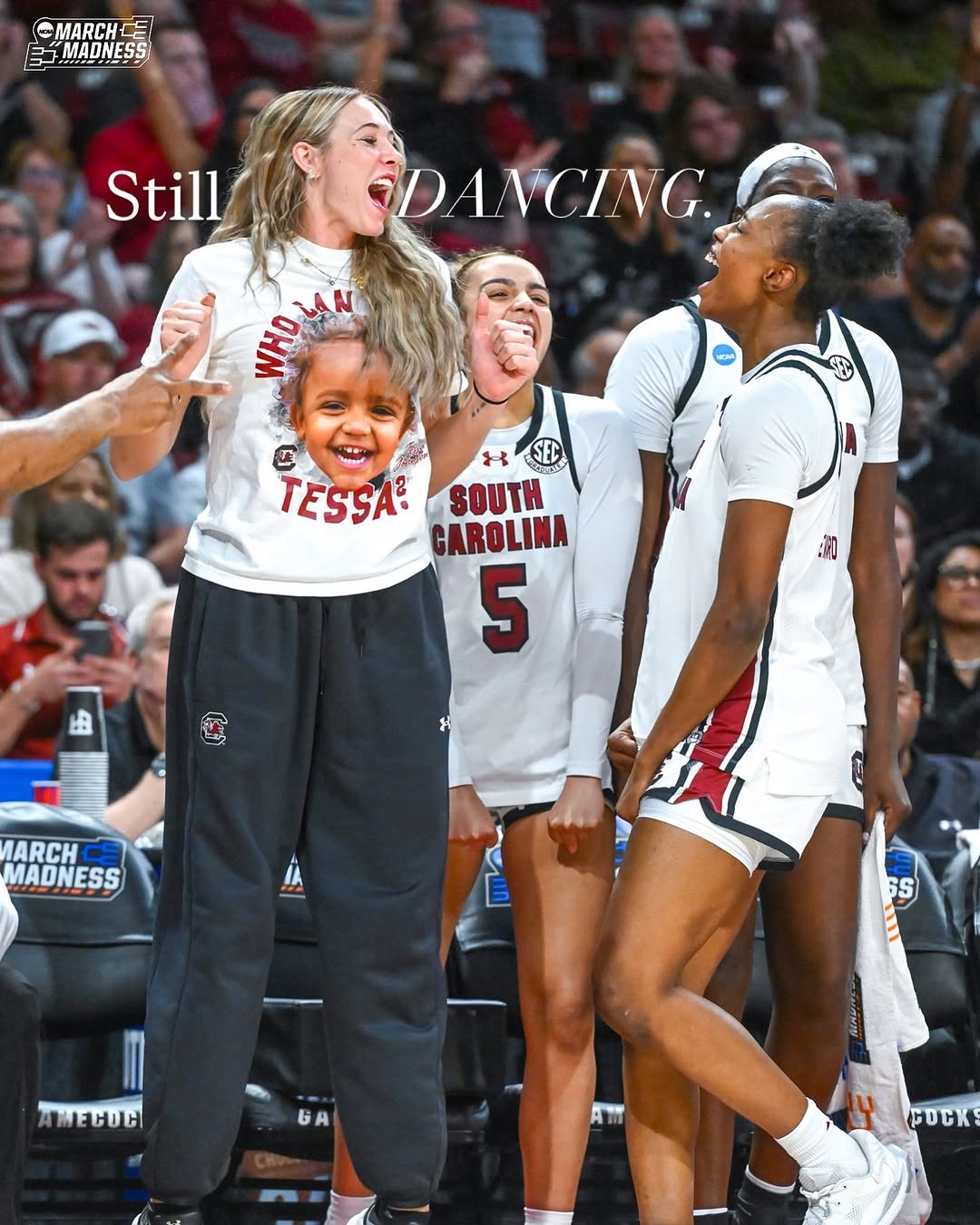
But the moment that elevated the shirt from fan merchandise to genuine program symbol came when Chloe Kitts wore one on the bench.
Kitts, who tore her ACL in October and has spent the entire season watching from the sideline — one of the most painful positions any competitive athlete can occupy — chose to wear a version of the shirt that included a baby photo of Johnson alongside Mulkey’s quote. The image of a teammate, sidelined by injury, publicly celebrating a peer’s breakthrough moment in the most personal way possible, said something about South Carolina’s culture that no press release could articulate.
Johnson’s response to that gesture was characteristically understated, which made it more powerful.
“I appreciate the support … our teammates bring confidence to everyone else. You can see it on the bench. You can see even the coaching staff or just our staff in general, it’s just like a family kind of culture,” Johnson said ahead of the Sweet 16 matchup against Oklahoma. “I feel like Chloe was wearing it to support me, and that just shows like a little bit of support that we all bring to each other.”
The baby photo, for its part, has its own origin story. South Carolina had requested baby pictures from the entire roster for some media project, and Johnson’s somehow made its way from that internal collection onto a piece of fan merchandise that is now being worn across the country.
“Then it just got out there,” Johnson said, with the kind of amused resignation that suggests she has made peace with her infant self becoming a cultural artifact.
The Player Behind the Slogan
The merchandise and the moment are compelling. The basketball player behind them is more compelling still.
Johnson is ranked seventh in the nation in three-point shooting at 44.5% — first in the SEC by a margin that reflects not just efficiency but volume and consistency across a full season of high-level competition. Those numbers establish her as one of the most dangerous perimeter threats in women’s college basketball, not just on the Gamecocks’ roster but nationally.
In the opening weekend of the 2026 NCAA Tournament, Johnson has been exactly what South Carolina needed across two very different game environments. Against Southern in the first round, she recorded her first career double-double — a performance that demonstrated her growth beyond the three-point specialist role her reputation might suggest. Against Southern Cal in the second round — a 101-61 South Carolina victory — she contributed 10 points in a game that was effectively decided before the second half.
This is Johnson’s third Women’s NCAA Tournament with South Carolina. In each of her previous two appearances, she has made it to the national title game. That is not coincidence. It is the product of a program infrastructure — coaching, culture, roster construction — that has consistently placed its players in position to compete for championships. Johnson has been one of the beneficiaries and one of the contributors to that infrastructure simultaneously.
Dawn Staley, coaching her 12th straight Sweet 16 game and pursuing her sixth consecutive Elite Eight appearance, has built a program where a moment like the Mulkey clip can occur organically — because the players are genuinely good enough to prompt that kind of involuntary acknowledgment from opposing coaches.
What the Slogan Actually Means
Strip away the merchandise and the social media virality, and Kim Mulkey’s question — “Who can guard Tessa?” — is one of the most honest evaluations of a player’s impact that a coach can offer. It was not spoken for public consumption. It was not a compliment directed at Johnson. It was a problem statement delivered to her own players in the urgency of a competitive huddle.
That is precisely what makes it resonate. Manufactured praise from an opposing coach is forgettable. An unguarded moment of frustration that inadvertently confirms a player’s elite status is the kind of validation that lives beyond a single game.
For Johnson — heading into a Sweet 16 matchup against an Oklahoma team that will have spent considerable time preparing for exactly the shooting threat Mulkey identified publicly — the slogan is a reminder of what she is capable of at her best and a challenge to deliver it again on the sport’s biggest stage.
Somewhere in Sacramento on Saturday evening, Kim Mulkey’s question is going to get answered one more time.
No. 1 seed South Carolina is counting on the answer being the same one it was on Valentine’s Day.
Nobody.