“Raven is a winner,” Kellie Harper’s Honest Reckoning: Respect, She Apologized to South Carolina, Praised Their Crowd, and Told the Entire Truth
Respect, Reality, and Raven Johnson After a Lopsided Night in Columbia
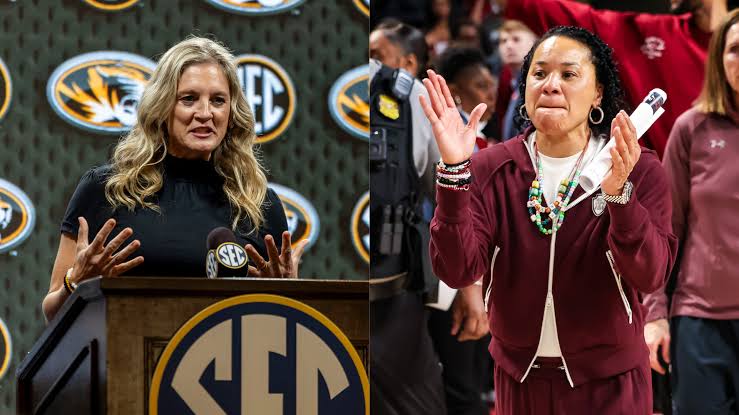
COLUMBIA, S.C. — When a team loses by 41 points on the road against the nation’s most dominant women’s basketball program, the postgame press conference can go one of two ways. A coach can retreat into vague deflections and damage control, or they can stand at the podium and tell the truth. Missouri head coach Kellie Harper chose the latter — and what she said revealed both the integrity of her character and the clear-eyed understanding of exactly where her program stands relative to the standard Dawn Staley has set in Columbia.
Here is a full breakdown of what Harper said, and what it means.
On the Third Quarter: Finding Something Real in a Difficult Night
The most charitable reading of Thursday’s result for Missouri was their third-quarter performance — a stretch in which the Tigers showed genuine competitiveness, made shots, and briefly interrupted South Carolina’s rhythm enough to generate 31 points. Harper was asked whether that sequence represented something meaningful.
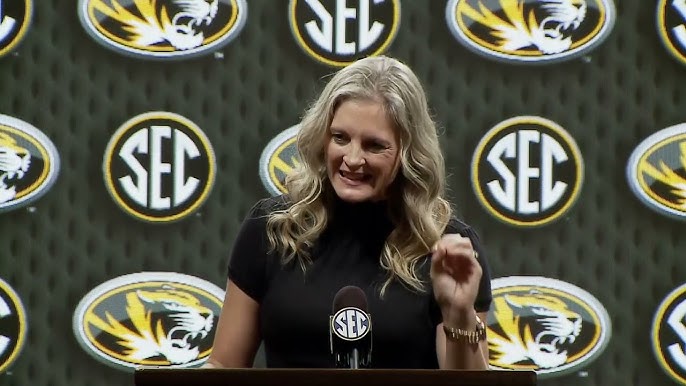
“Well, you know, in that third quarter, we made shots, and I thought we were able to get a few stops and get out in transition, not in terms of speed, but spacing,” Harper said. “I thought we did some good things there. Obviously, our players shared the ball well in that quarter and we were able to knock down some shots.”
The distinction Harper drew — “not in terms of speed, but spacing” — is worth examining. She was not claiming Missouri outran South Carolina. She was pointing to a brief tactical success: her team found gaps in the Gamecocks’ defensive rotations through ball movement and spacing rather than athleticism. It worked for one quarter. That it could not be sustained for 40 minutes reflects the fundamental talent gap between the two programs, but Harper’s ability to identify and articulate what actually functioned — rather than simply describing what went wrong — speaks to a coaching mind that is learning in real time even from a blowout.
On Losing Composure Early: An Honest Assessment of a Limited Hand
The first quarter was where the game was effectively decided. South Carolina’s 15-0 run turned a competitive opening into a rout before Missouri had time to adjust. Harper was asked what she saw from her players when things unraveled.
Her answer was remarkably candid: “Well, you know, in a game like this, you want to try to control as much as you can, and we’re very limited when we go out on the court, being able to control things against that team. We understand that.”
The phrase “we’re very limited” is not something coaches say lightly. It is an honest acknowledgment that Missouri’s roster, as currently constructed, does not possess the tools to match South Carolina in a standard game — a reality that Harper did not attempt to obscure with tactical explanations or excuses. She continued: “I thought we lost some composure there, we were able to kind of collect ourselves and get that back. You know, it’s a great place to play basketball, right. It’s a great environment but you’ve got to be able to handle it.”
Then came the line that best captured Harper’s philosophy for navigating games in which the outcome is predetermined by talent disparity: “You have to stay scrappy, and keep trying. You can’t just move out of the way for them, you’ve got to keep trying.”
It is a simple instruction, but it is the right one. The danger for programs in Missouri’s current position — outmanned, shorthanded, on a losing streak — is that a hostile environment and a rapidly expanding deficit can erode the competitive instinct entirely. Harper’s message to her team was not to win. It was to refuse to stop competing. Whether they succeeded in that narrower ambition is a more meaningful measure of Thursday’s night than the final scoreline.
On Saniah Tyler’s Foul: Accountability Without Excuse
The most uncomfortable moment of the evening came when Missouri’s Saniah Tyler committed a foul on South Carolina’s Maddy McDaniel that drew immediate reaction from the Colonial Life Arena crowd and raised questions about composure under pressure. Harper did not look for an exit from the topic.
“Well, you know, she lost her composure for that moment, and that’s not who we are,” Harper said directly. “And she is one of the sweetest kids to ever be around. I mean, she is just a wonderful person, and so I hate that she lost it and hate she did that. That’s not what we want to be, you know, we apologize to South Carolina for that. That’s not a good play. It’s not a good look, in particularly for somebody of that character.”
The public apology to South Carolina — offered without being asked for it — is an uncommon act in a coaching culture that often treats accountability as weakness. Harper’s willingness to name what happened, apologize for it, and separate it from the character she knows Tyler to possess reflects a coach who understands that how her team behaves in difficult moments matters as much as what they produce statistically.
She then did something equally important: she separated the crowd from the result. “I don’t want to…this is nothing negative against the crowd. The crowd’s amazing, but we could go scrimmage that team and that’s what the score is going to be. We could go scrimmage that team in a closed door arena, and that’s probably what we’re going to see. They’re good. They didn’t need the help tonight, but they have a lot of support tonight.”
The clarity of that statement is striking. In one breath, Harper defended Colonial Life Arena’s atmosphere — refusing to blame the environment for her team’s struggles — while also making the unambiguous point that the scoreline was a product of South Carolina’s excellence, not Missouri’s fragility. It is the kind of intellectual honesty that is genuinely rare at a podium.
On Raven Johnson: The Tribute From the Other Sideline
The evening’s final and perhaps most memorable exchange came when Harper was asked about Raven Johnson — a player she has coached against multiple times and watched develop across five remarkable seasons.
What she offered was not a scouting report. It was a tribute.
“Raven is a winner,” Harper said. “You know, it’s just watching her journey here, she’s been one of our favorite players to just watch. And she’s improved, and she’s accepted her role, or at least it looks as though she has accepted her role throughout her career. And she is so confident, and she is so poised, and she leads that team. I’m glad she’s a senior. But, she’s a terrific basketball player. It’s been fun to watch her journey.”
The phrase “I’m glad she’s a senior” landed with the dry humor of someone who has spent years devising defensive schemes that ultimately could not contain her. But the surrounding context makes clear it was delivered with genuine admiration rather than relief alone. Harper acknowledged Johnson’s improvement, her poise, her leadership, and the specific quality — winning — that transcends all statistics.
Coming one week after Ole Miss head coach Yolett McPhee-McCuin called Johnson the best point guard in the country, Harper’s assessment adds another layer to a growing chorus of opposing coaches who have reached the same conclusion from the other sideline. When the people who most want to stop you are also the people most willing to praise you, the argument for your greatness becomes essentially airtight.
What Harper’s Presser Actually Revealed
Kellie Harper came to Columbia on Thursday night with a depleted roster, a four-game losing streak, and no realistic chance of winning. She left having been outscored by 41 points. And yet her postgame press conference conveyed something that the scoreboard could not — the portrait of a coach who tells the truth, protects her players, respects her opponents, and refuses to manufacture excuses for circumstances that do not require them.
She acknowledged her team’s limitations without weaponizing them. She accepted accountability for a player’s loss of composure without throwing that player under the bus. She refused to blame the crowd for a deficit that had nothing to do with the crowd. And she praised Raven Johnson with the specific, informed admiration of someone who has watched her closely and understands exactly what makes her exceptional.
Missouri has a long way to go before they can compete with what Dawn Staley has built in Columbia. Thursday was not a night that moved that needle. But Kellie Harper’s conduct at the podium afterward suggested a coach whose character is equal to the challenge ahead — even when the scoreboard is not.
In a season full of nights that belonged entirely to South Carolina, Harper at least made the press conference feel like a fair fight.
About The Author