The Gamecock Export That Could Change Nigerian Basketball Forever: Maryam Dauda Joins D’Tigress on Historic Roadtrip
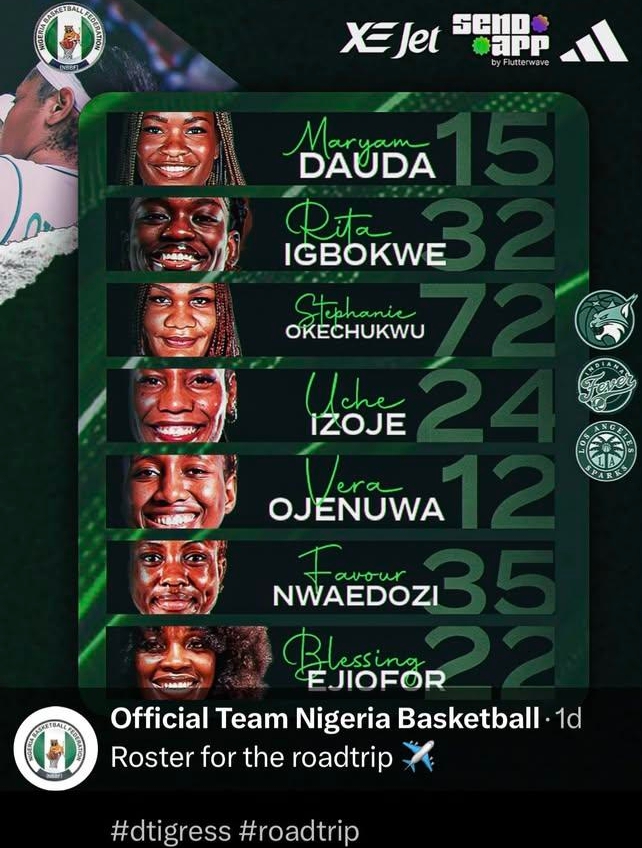
The South Carolina pipeline doesn’t stop at the WNBA Draft. Former Gamecock forward Maryam Dauda has been named to Nigeria’s D’Tigress national team roster, wearing jersey number 15 — and the timing of this call-up couldn’t be more significant for one of the most exciting women’s basketball programs on the African continent.
The Official Team Nigeria Basketball federation confirmed the news with a roster reveal captioned simply: “Roster for the roadtrip ✈️” — and Dauda’s name tops the list.
The Roadtrip: What’s at Stake Right Now
This is not a casual exhibition assignment. D’Tigress is embarking on a landmark three-game tour of the United States against professional WNBA franchises — the first time in the history of women’s basketball on the continent that an African team will take the court against professional franchises from the world’s leading domestic league.
The fixture list moves through three cities across 10 days. The tour opens against the Los Angeles Sparks at Viejas Arena in San Diego on April 25, before the squad travels to Kansas City for a meeting with the Minnesota Lynx at T-Mobile Center — a venue hosting professional women’s basketball for the first time in 20 years.
This is the environment Dauda is stepping into — not a tune-up, but a historic moment for African women’s basketball. And she brings a South Carolina pedigree perfectly suited for exactly this kind of challenge.
The Bigger Picture: FIBA Women’s World Cup — Germany, September 2026
The WNBA friendlies are the appetizer. The main course arrives in the fall.
The 2026 FIBA Women’s Basketball World Cup is scheduled for September 4–13 in Germany and will be the first to feature 16 teams, reflecting the growing profile of women’s basketball globally.
Nigeria earned their place at that table the hard way. D’Tigress have won the Women’s Afrobasket Championship a record five times in a row and seven times in total — winning in 2017, 2019, 2021, 2023, and 2025. They are not merely participants in this World Cup. They are the only African team to reach the quarterfinals of both the FIBA Women’s World Cup and the Olympics.
D’Tigress have been placed in Pot 2 for the World Cup draw, seeded alongside China, Belgium, and Spain — meaning they are guaranteed to face one of the tournament’s top seeds from Pot 1, which features host Germany, reigning champions USA, France, and Australia.
The WNBA tour against the Sparks and Lynx is preparation for exactly that level of competition. And Dauda’s presence in the squad signals that Nigeria is leaving no stone unturned in building their deepest, most complete roster for Germany.
What Dauda Brings From Columbia to the National Stage
To understand what Dauda contributes to D’Tigress, you have to understand what she represented at South Carolina — and that story is more nuanced than statistics alone can capture.
Dauda earned her undergraduate degree in services management with a minor in economics and is currently working on a master’s degree in retail innovation, with multiple SEC Academic Honor Roll recognitions to her credit. She is a complete person first — and that completeness translates directly into the kind of leadership and cultural intelligence that elevates a national team environment.
On the court, Dauda led the SEC in blocks per game during her most productive season at Arkansas and was a defensive machine — most memorably holding Oklahoma’s top scorer Reagan Beers, who averaged 17.8 points per game, to just seven points in the SEC Tournament semifinals. That defensive discipline — the art of game-planning against specific opponents, reading offensive tendencies, and executing defensive assignments under pressure — is precisely the kind of skill Dawn Staley’s program forges daily.
Dawn Staley herself framed Dauda’s contribution in terms that go beyond statistics:
“I think she made it something of a positive thing that every time Joyce subs out, she wants to go to the Highlighters. She’s just a great teammate, a great friend, a great, just special being — recruiting impact. Probably every recruit that over the last two years that we’ve had come into our program, Maryam has impacted.”
And Raven Johnson, one of South Carolina’s most decorated players, delivered perhaps the most telling assessment:
“Maryam is like good juju. Everything about her, it’s positive. She’s the person you need on your team. She may not get the praise and glory that she wants, but we need people like that on our team who’s always willing to do whatever. She may give her last anything up for somebody.”
That profile — the connector, the culture carrier, the player whose value exceeds her box score — is exactly what national teams need around their stars heading into a World Cup.
The Invitation She Quietly Earned
The call-up didn’t come from nowhere. Dauda revealed at the Final Four that she had received an invite to play on the Nigerian national team — describing it as “a huge opportunity” and something she planned on doing after her Gamecock career concluded.
That she has now been formally named to the roster — topping the D’Tigress list at number 15 — confirms the federation sees in her exactly what Staley, Johnson, and her South Carolina teammates always described: a player whose impact extends far beyond what any stat line captures.
The Dawn Staley Effect on a Global Stage
There is something deeply fitting about a Dawn Staley-developed player representing Nigeria at the sport’s highest international level. Staley’s program doesn’t just produce WNBA talent — it produces complete basketball players who understand defensive systems, championship culture, and what it means to subordinate individual ambition to collective success.
D’Tigress head coach Rena Wakama’s coaching philosophy centers on defensive discipline and quick ball movement — principles that were tested at the 2024 Olympic Games in Paris, where Nigeria became the first African basketball team to reach the quarterfinal stage.
Those are Staley principles. Those are South Carolina principles. And now they arrive in the D’Tigress locker room in the form of Maryam Dauda — a player forged in arguably the most disciplined defensive program in college basketball.
As Nigeria prepares to face WNBA franchises, qualify through continental competition, and ultimately compete at a 16-team World Cup in Germany, the Gamecock export wearing number 15 carries more than a jersey. She carries a system, a standard, and a culture that has produced championships at every level it has touched.
The D’Tigress roadtrip has begun. And South Carolina is going with them.
About The Author