Dawn Staley addresses issues that concerns the Gamecocks Wbb Ahead of Kentucky Gameday
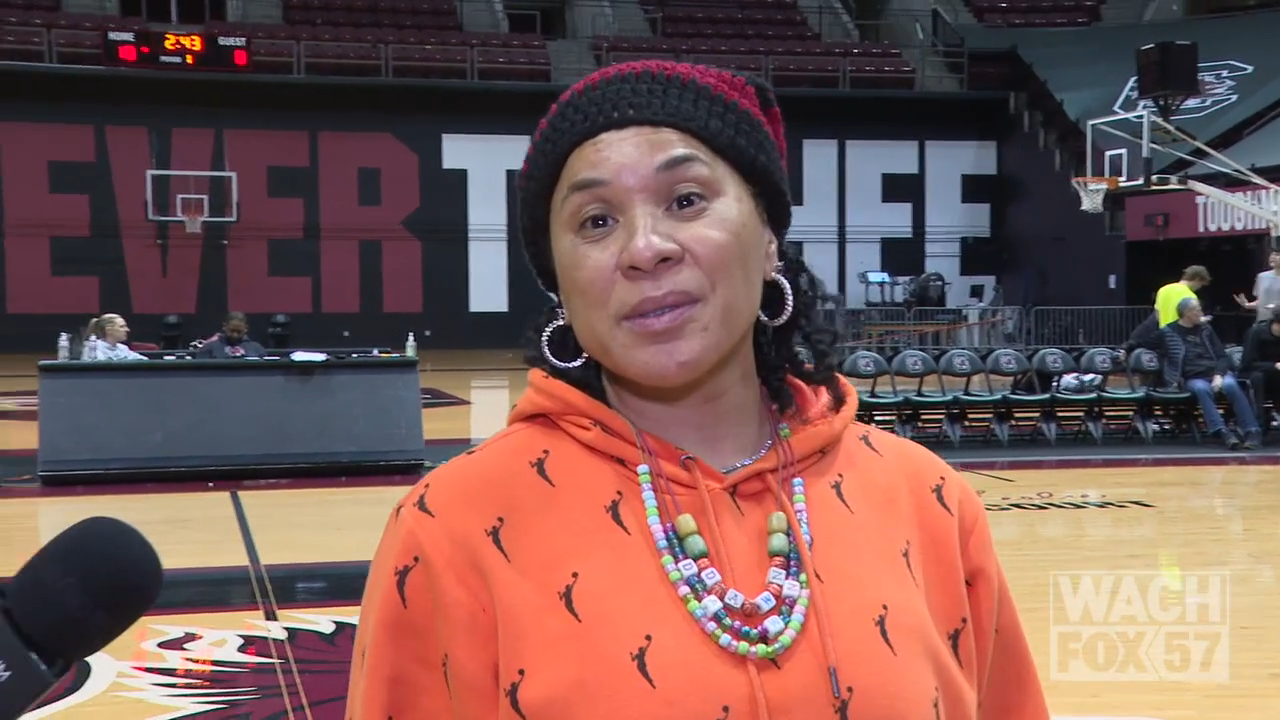
Dawn Staley’s Press Conference Before Kentucky: Film Study, Honorary Degrees, and the Team With No Name Yet
COLUMBIA, S.C. — Two days removed from a 112-71 Senior Night statement and one day before the final regular-season game of the 2025-26 campaign, Dawn Staley sat down with the media for a press conference that covered everything from Clara Strack’s interior toughness to a talking mascot, a free college degree, and the intellectual kinship between Aliyah Boston and Joyce Edwards. It was vintage Staley — analytically sharp, genuinely funny, and occasionally profound when the moment called for it.
Here is a full breakdown of everything she said, and what it means heading into Sunday’s road finale at Kentucky.
On Tessa Johnson’s Status: Yes, But Check the Report
The press conference opened with the question that has dominated South Carolina’s injury conversation since Thursday night. Is it safe to assume Tessa Johnson will be available for Sunday’s game at Kentucky?
Staley’s response was characteristically direct and characteristically evasive in equal measure: “Yes. Of course.” Followed immediately by the practical instruction: check the availability report.
The exchange tells you everything you need to know about how Staley manages injury information — she is neither alarming nor reassuring beyond what she is prepared to confirm officially. Johnson practiced. She appears headed toward availability. The SEC injury report, publishing Friday evening and again Sunday morning, will provide the formal confirmation. Until then, “yes” will have to do.
On Clara Strack vs. Madina Okot: A Battle of Wills
Kentucky’s Clara Strack presents one of the most compelling individual matchups of South Carolina’s regular-season schedule. The 6-foot-5 center averages 16.4 points and 10.2 rebounds per game — numbers that earned her First Team All-SEC recognition last season and have her on pace to repeat that distinction this year. Against Madina Okot, who has been one of the most dominant interior players in the country, the collision of two elite bigs promises to be the central physical storyline of Sunday’s game.
Staley did not underestimate the challenge. “She’s tough, like she’s really tough because she moves you around,” Staley said of Strack. “She’s unafraid. She’s really good on both sides of the basketball. Tough matchup for anybody, that’s why she’s been…was she first-team SEC last year? Yeah. I mean, in our league, and she’s repeating that.”
The acknowledgment that Strack is “tough for anybody” — from a coach whose program has produced arguably the most dominant center in the country in Okot — is meaningful context. Staley is not dismissing the matchup. She is preparing her team for a genuine battle. “I think it’ll be wills,” she added. “We got to put Madina in positions where she can be effective, and if Madina’s guarding her, then we got to give her a little bit of help. But I think Madina’s up for the challenge, and I’m sure they both are.”
The framing of the broader game as “not just them, a good point guard battle, just a good battle of two good SEC teams” reflects Staley’s understanding that Sunday is not a formality. Kentucky needs a win to solidify its tournament seeding. South Carolina needs the performance to validate its readiness for Greenville.
On Teonni Key and Gang Rebounding: Awareness as the First Defense
Kentucky’s Teonni Key presents a different kind of problem — one built on relentless activity, physicality, and the ability to impact the game in ways that do not always appear in the primary statistics. Staley’s approach to neutralizing that kind of player was instructive.
“One is be aware that she’s bringing that to the table,” Staley said. “And if you’re aware of what she can bring to the table, that’s half the battle.” She continued: “It’s hard. It’s really hard to shut a team, or really good individual players, like, down. And if you’re going to do something like that, it’s certain not just the head-to-head battle. It is how the team is actually gang rebounding, or helping off in the driving lanes.”
The concept of “gang rebounding” — the idea that neutralizing an elite rebounder requires collective effort rather than a single assignment — is a cornerstone of how South Carolina defends interior players throughout the season. Against Key specifically, the Gamecocks will need that collective commitment, because isolation defense against a player built on physical positioning and second-effort plays is rarely sufficient.
On Alicia Tournebize’s Rebounding: Adjustment in Progress
Freshman forward Alicia Tournebize posted a career-high five rebounds against Missouri on Thursday — a development worth noting for a player who is still adjusting to the physical demands of SEC basketball. The question posed to Staley was perceptive: is Tournebize missing rebounds because her extraordinary length allows her to reach balls outside her natural area, or does she simply need to rebound more aggressively?
Staley’s answer suggested it is largely the former, with room to grow toward the latter. “We need her to rebound. Like, we need her…I think she’s still adjusting, because it’s so very physical,” Staley said. “She’s getting her hands on the ball because I do think people are boxing her out, putting a body on her, so she’s trying to rebound out of her area.”
Then came the line that most precisely defines what Tournebize needs to develop: “Rebounding is about, less about a skill, more about a want, and a decision to do it.” That reframing — from technique to mentality — is the specific developmental leap Staley is asking her freshman to make. The athleticism and length are already there. The instinct to sacrifice positioning and demand the ball at its highest point is what separates good rebounders from great ones. Staley believes Tournebize is getting there. “She’s just getting more acclimated to things.”
On the Team Name: The Champs, For Now
Every great South Carolina team has had a nickname. The “Freshies” class of 2019 is perhaps the most legendary. The “Daycare” group that followed carried its own identity. When asked whether the current team had earned a similar designation, Staley’s response was equal parts honest and entertaining.
“Right now, they’re the Champs. SEC champs,” she said. “We don’t have one, they don’t really have…the Nicies? They’re real nice. They’re nice, young people. We don’t really have a name for them. Nothing really kind of jumps off the page like the Freshies or Daycare. I would say they’re more in the line of the Freshies than they are Daycare, thankfully.”
The comparison to the Freshies rather than Daycare is not a casual one. The Freshies class was celebrated for its maturity, its competitive intelligence, and its willingness to absorb the program’s culture and reproduce it at the highest level. That Staley sees the current group in that lineage — rather than the more volatile, emotionally complex Daycare era — suggests genuine confidence in the team’s character heading into the postseason.
On Cocky, the Talking Mascot
Not every press conference moment requires deep analysis, and Staley’s account of her encounter with South Carolina’s mascot Cocky at the men’s basketball game earlier this week was precisely the kind of unscripted moment that makes her press conferences must-watch viewing.
“Cocky caught me off guard with that one,” she said. “Every time I’m close to a mascot, I do ask them a question to see if they will talk back, not expecting they would talk back. He talked back, and kept talking. I was just asking what year he was. He said he was a junior, and he caught me off guard. I was like, ‘You’re not supposed to be talking!'”
A two-time national championship coach, startled by a talking mascot. The humanizing value of that moment cannot be overstated — and Staley delivered it with the comedic timing of someone who understands exactly how the story lands.
On 12 Straight Years Leading the Nation in Attendance: Surpassing Pat Summitt
Perhaps the most historically significant topic of the press conference arrived when Staley was asked about South Carolina’s 12th consecutive year leading the country in women’s basketball attendance — a streak that has now surpassed Pat Summitt’s Tennessee program for the longest such run in NCAA history.
Staley’s response was characteristically grounded. “Unbelievably grateful that we could do it in a place like this,” she said. “It’s hard. Let me just say this. It’s hard for any women’s basketball program, but the way that we build our attendance was based on just word of mouth, based on being accessible to our fans, and once you make people feel good, they make you feel better.”
She then offered a perspective that reframes the achievement in illuminating terms: “Most, probably almost, I would say probably say 100% of national champions create a home court advantage. And we haven’t won enough national championships that will equate to the amount of support that we’ve gotten over the 12 years that we’ve done it, but 25% ain’t bad.”
The implication is both modest and remarkable. South Carolina has led the nation in attendance for 12 consecutive years while winning two national championships during that stretch — meaning the program built and sustained that level of fan investment primarily through the quality of the product and the accessibility of its coaches and players, not the accumulated weight of championship banners. That is an organizational achievement as impressive as any on-court result.
On an Honorary Degree From Smith College: Getting It for Free
Staley received word that she will be awarded an honorary degree from Smith College — a prestigious all-female institution — and her reaction was as authentic as anything she said all press conference.
“I think it’s pretty cool, to not go to school and get a degree,” she said with a laugh. “One of my best friends, her daughter went to Smith. So, you know, I’m going to send a text out. ‘You spent all that time, you spent all that money, and look at me, I get it for free, right?'” She added: “I know the president, and it’s an all-female school that represents higher education. If any young person sees it, it feels like they’re impacted by that.”
The humor masks something genuinely meaningful. Staley being honored by an institution dedicated to women’s education is not merely a ceremonial gesture. It is an acknowledgment that her impact — on young women in athletics, on representation in coaching, on the visibility of women’s basketball — extends well beyond the court.
On Joyce Edwards: The Film Room Standard-Bearer
The observation that prompted Staley’s most revealing response about Joyce Edwards came from a reporter who noted that Edwards tends to deflect basketball questions with the phrase “it’s just basketball” — a habit that raises the question of whether she is extraordinarily humble or extraordinarily confident in her own understanding.
Staley’s answer suggested it is very much the latter. “Joyce is pretty good. Like, I do think that the habits that she formed from an academic standpoint just overflows into basketball, and I’m sure basketball is a lot easier than the classes that she’s taking,” Staley said. She described Edwards as a player who raises her hand whenever coaches ask about opponents during film sessions — and then has to be told to hold back so others can answer. “‘Don’t give it all to us. Save some for someone else, Joyce.’ So it’s just like that.”
The natural comparison Staley drew was to Aliyah Boston — arguably the most cerebral player in program history and one of the most decorated in the history of the sport. “Aliyah’s probably the person that watched the most, and if someone else is doing it, I didn’t know about it, but I knew about Aliyah. I know about Joyce because the answers that they give are answers that you know they’ve watched.”
Placing Edwards in the same intellectual category as Boston is not faint praise. It is a specific and credible assessment from a coach who has observed both players in the same environment. The fact that Edwards’ film study manifests in casual dismissals of basketball’s complexity — “it’s just basketball” — suggests a player whose mastery of the game has made it genuinely feel that way to her.
On Maddy McDaniel: A Ceiling Still Rising
Maddy McDaniel — known around the program as “Mouse” — produced four steals against Missouri and converted that defensive energy into offensive production in a performance that illustrated how far she has come this season.
Staley’s assessment of her development was direct and enthusiastic. “Mouse is…just her ceiling’s gotten even higher,” she said. “I think she wanted to impact our team. Like, wanted more than just being a backup point guard. Like, she’s an integral part of our success. Like, we lose nothing when we insert her into the game. We gain a lot, too, because Mouse is able to…she’s got really good court vision.”
On the defensive leap specifically: “Defensively is where she’s probably made the biggest jump, because her impact, you can see it on the ball, off the ball.” The phrase “we lose nothing when we insert her” is perhaps the highest compliment a head coach can pay a reserve player — the acknowledgment that the team does not simply maintain its level with McDaniel on the floor, but actively improves in specific areas.
On the Missouri Incident: An Apology Received
When asked about the crowd’s response to Saniah Tyler’s foul on McDaniel in the first quarter Thursday, Staley handled the moment with the grace that has characterized her public-facing leadership throughout the season.
“You know, after a whole, I wanted to say…let’s not,” she said, before acknowledging: “It really is a part of the game. It really is a part of the game, and we did get an apology from Coach Harper. We got an apology, and I told Mouse that she sent an apology. You know, we’re just happy that nobody got hurt and we’re able to continue to play.”
Kellie Harper’s public apology — offered at the podium immediately after the game — was acknowledged privately and generously by Staley. The exchange between two coaches who handled a difficult moment with mutual respect is a reminder that the competitive intensity of SEC basketball coexists, most of the time, with a genuine regard for the standards of the game.
The Bottom Line
Sunday’s game at Kentucky is, on paper, the final chapter of the regular season. In practice, it is the last rehearsal before the stakes become real. Staley’s press conference made clear that her program is prepared for the challenge, clear-eyed about Kentucky’s weapons, and focused on the standards that have produced 28 wins and five consecutive SEC titles.
The team may not have a name yet. But if Sunday goes the way Dawn Staley expects it to, the 2025-26 Gamecocks will have a postseason run to define themselves by — and a name will follow naturally after that.
About The Author