He Knew His Team Had No Chance. He Came Anyway —Southern’s Coach Just Described Dawn Staley’s Team Better Than Anyone Has All Season. The Rest Of The Bracket Won’t Like It
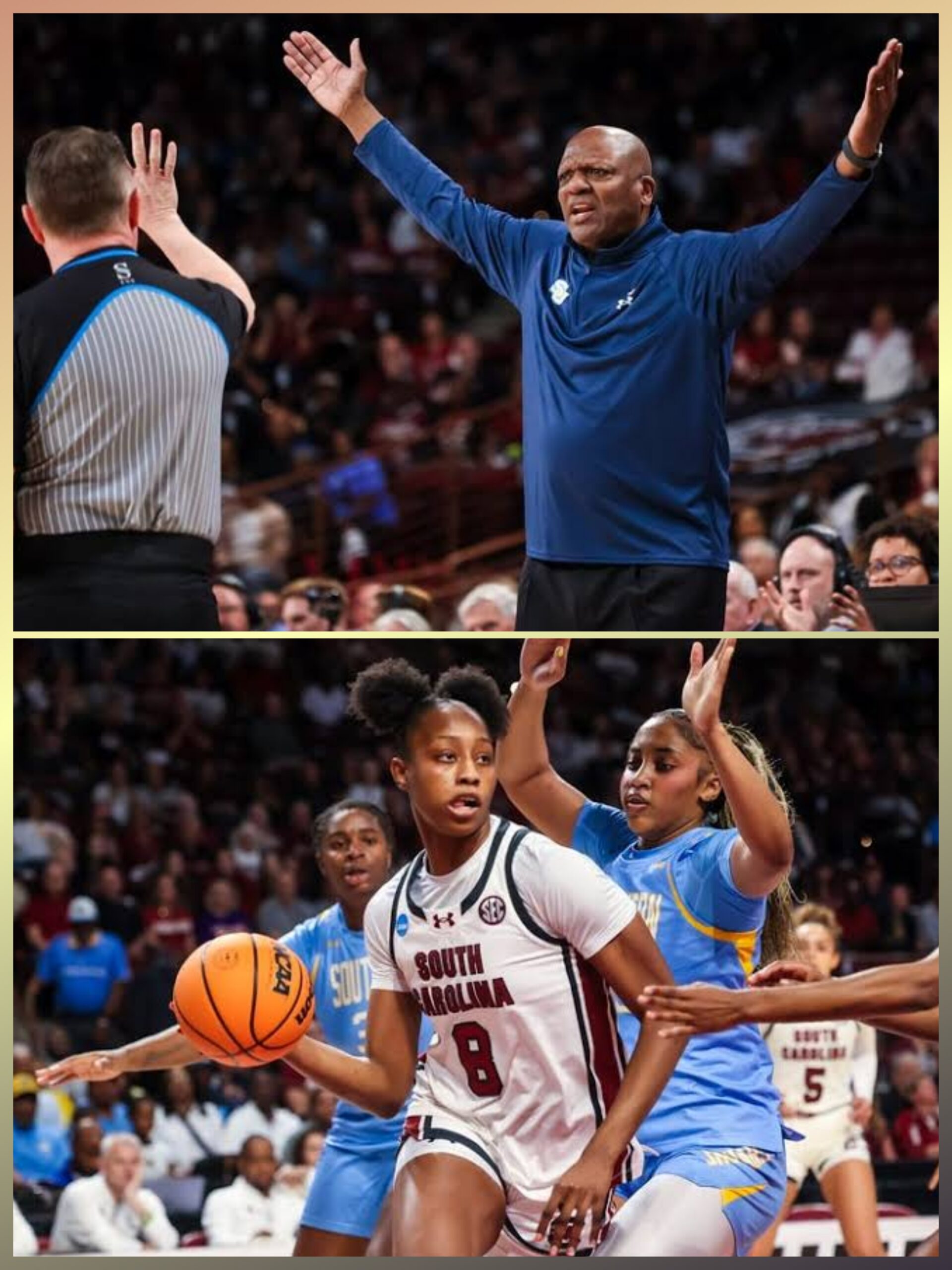
Outmatched But Unbowed: Southern’s Coach on Facing South Carolina and What Comes Next
There was no illusion going into Colonial Life Arena on Friday. Carlos Funchess knew exactly what his Southern team was walking into — and he said so plainly, from the opening words of his postgame press conference.
“I knew it would be an uphill battle from jump tip because they have a tremendous team. They have size. They have athleticism. Everything that you want in a basketball team, they have it, and they do a great job of coaching,” Funchess said.
That kind of clarity, delivered without deflection or excuse-making after a 69-point loss, reveals something about the coach standing at the podium. Funchess did not arrive in Columbia with false hope. He arrived with a realistic assessment of the gap, a game plan built around effort and structure, and a genuine pride in what his program had accomplished just by being in the building. What followed over the course of the press conference was a portrait of a coach who understood the moment completely — and refused to let the scoreboard define his team’s season.
On the Pressure and the Reality of the Matchup
When asked whether he expected South Carolina to press as relentlessly as they did throughout the game, Funchess didn’t flinch.
“I did. They’re trying to get ready to win a National Championship, and they have to come out and set that tone. That’s what they need to do, and that’s what we would do as well,” he said.
The framing is significant. Rather than positioning South Carolina’s aggression as something done to his team, Funchess contextualized it as something any elite program would do — and should do — in a first-round tournament game. It is the kind of perspective that requires genuine understanding of the sport at its highest level, and it stands in contrast to the grievance-oriented postgame takes that often follow lopsided defeats.
He had done his homework on what South Carolina’s defense was capable of. “I think they came in giving up 57 points a game in the SEC. I mean, that’s amazing. You’re playing against some of the best athletes in the country, in the world, I would say, in women’s basketball.” He had hoped someone on his roster might catch fire and produce 15 to 18 points to keep Southern competitive. It didn’t happen, and the final margin reflected that. But his read on what it would take to stay in the game was accurate, even if the execution fell short.
“I knew it was going to be tough. I was hoping that somebody could get extremely hot and give us 15 to 18 points, but it didn’t happen. But we kept fighting, kept battling. It’s frustrating. So I tried to keep them calm and just told them keep fighting, keep battling.”
The Season in Context: Adversity, Cohesion, and Growth
The most revealing stretch of the press conference came when Funchess was asked what he was most proud of from his team’s season. His answer had nothing to do with offensive efficiency or tournament seeding. It was about character under pressure.
“We went through a three-game losing streak, and they could have fractured, but they didn’t. They stuck together. They toughed it out. We had some key injuries at that time. But we had some players that didn’t play a lot early that stepped their game up, and that helped us down the stretch as we made a run the last four, five games of the season.”
This is the part of a program’s story that rarely makes headlines — the quiet stretch mid-season when things go wrong and the team’s true identity is revealed. Southern’s identity, by Funchess’s account, was resilience. A team that could have splintered under the weight of injuries and a losing streak instead found depth it didn’t know it had and closed the season strong enough to earn an NCAA Tournament bid. That outcome, regardless of what happened Friday, is a genuine achievement for a program at Southern’s resource level.
The strength of schedule that brought them to this moment was no accident either. Funchess acknowledged that Southern entered the year with the No. 1 strength of schedule in the country before conference play even began — a deliberate choice to test his team against the best competition available.
“Yes, I think it did prepare us. But as a player, certain things you can’t do anything about. If you’re playing against a 6’7″ and you’re boxing them out and they reach over top and get a rebound, that’s just they have a size advantage. They have some great athletes as well. So it did prepare us, but we couldn’t overcome the athleticism and their size.”
It is an honest accounting of the limits of preparation. You can replicate intensity in practice. You cannot replicate the physical dimensions of South Carolina’s frontcourt.
A Message That Looks Forward, Not Back
When asked what he told his team after the game, Funchess separated his message by what each group of players needed to hear — and both parts were anchored in the future.
“Just to stay hungry. Keep competing regardless of what the score is. You don’t worry about that. You go out and try to play with structure on both ends of the court,” he said. “To the ones that are leaving, I’m so thankful to be able to coach those young ladies because they gave me everything that they had. To the ones returning, we’re going to get back in the gym this summer and continue to work and try to get back to this point again.”
The phrase “try to get back to this point again” carries real weight when the point in question is an NCAA Tournament first-round game against the No. 1 seed. For programs at Southern’s level, simply qualifying for March Madness is an achievement that demands sustained effort and program-wide commitment. Funchess is treating it not as a ceiling but as a floor — a standard to return to and eventually build beyond.
Friday’s result was never really in doubt. South Carolina is built for moments like this, and Southern was always going to face a structural disadvantage that no amount of preparation could fully bridge. But the way Carlos Funchess carried himself — honest about the gap, proud of his team, and already focused on what comes next — reflected a program that understands what it is building and why the process matters more than any single scoreline.
The scoreboard read 103-34. The press conference told a different story.
About The Author