Caged No More: How South Carolina Turned a Painful SEC Loss Into a Tournament Identity
The Wound That Became Fuel
Sometimes the most important game of a season isn’t the one that ends with a trophy. For South Carolina, that game was the SEC Tournament final — and it didn’t go well.
The Gamecocks fell behind 14-0 before they could establish any rhythm. Texas didn’t just beat South Carolina; the Longhorns punched them in the mouth, and the reigning standard-bearers of women’s college basketball spent the rest of the game unable to fully recover. It was the kind of loss that stings differently — not because it ended a season, but because it exposed something. A vulnerability. A tendency to absorb an early blow and never fully shake it.
South Carolina did not like it. And two weeks later, the NCAA Tournament made clear just how much they had absorbed that lesson.
The Response: 30-4
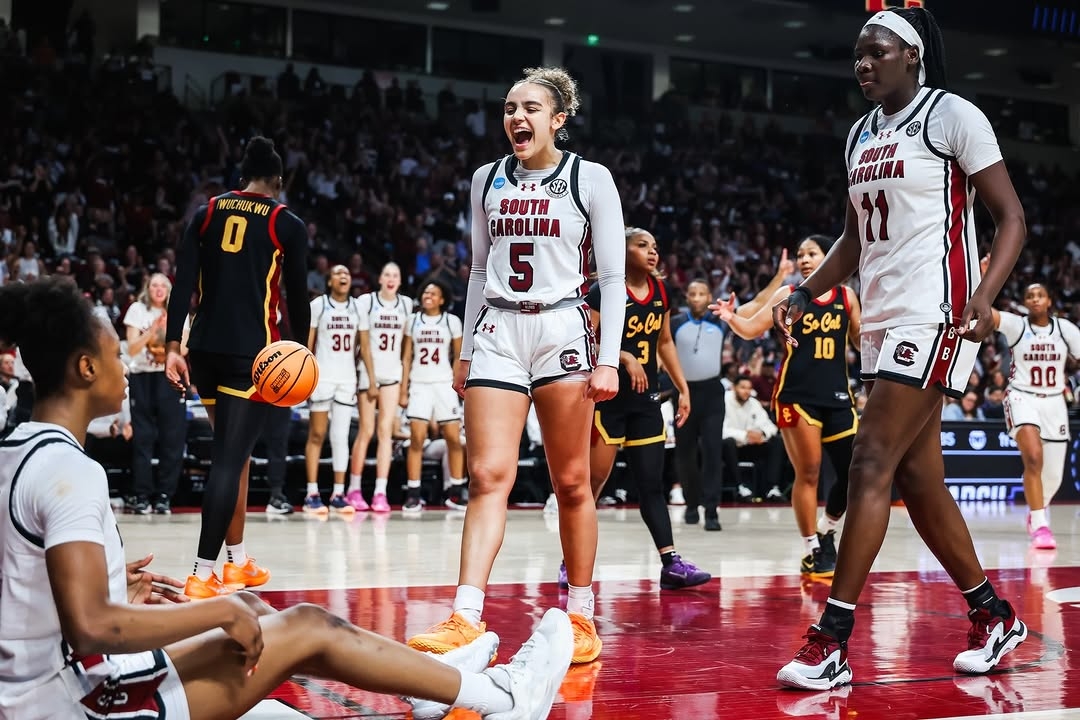
Numbers tell the story with brutal efficiency. Across their first two tournament games — against No. 16 seed Southern and No. 9 seed Southern California — South Carolina outscored opponents 30-4 over the combined opening six minutes. Against Southern, the Gamecocks opened with a 15-0 run. Against Southern Cal, they went up 13-0 before the Trojans could catch their breath.
This was not coincidence. This was a team that had spent two weeks sitting with the memory of a 14-0 deficit and deciding, collectively, that it would never let that happen again.
Senior guard Ta’Niya Latson put it in terms that needed no additional analysis.
“It’s like animals released from a cage,” she said. “I feel like we’re just ready to play … We don’t like getting punched in the face first, so we have to set the first punch. That’s something we learned from the SEC Tournament loss.”
There it is — explicit, unambiguous, and revealing. The SEC Tournament loss wasn’t just processed and filed away. It was converted into a competitive principle. South Carolina didn’t just decide to play harder at the start of games. They decided, as a unit, that getting hit first was no longer acceptable.
Defense as the Engine
The mechanism behind the fast starts is worth examining closely, because it wasn’t simply a matter of offensive aggression. Head coach Dawn Staley identified the root cause clearly: the defense is generating the offense.
South Carolina recorded three steals in the opening quarter against both Southern and Southern Cal — a consistency that signals scheme and preparation, not luck. The Gamecocks held opponents to 25 percent shooting from the field in opening quarters across both games, and did not surrender a single three-pointer in the first quarter of either contest. That is a suffocating defensive posture that forces opponents into rushed decisions, low-percentage looks, and — critically — turnovers that become transition opportunities.
“I think we are creating some offense from our defense,” Staley said. “When you’re able to see the ball go in and shoot a high percentage shot, it really is a momentum builder.”
This is the flywheel Dawn Staley has been constructing in Columbia for years: defense generates turnovers, turnovers generate easy baskets, easy baskets generate confidence, and confidence compounds into dominance. When it is operating at full speed, as it has been in the tournament’s first two rounds, it is extraordinarily difficult to slow down.
Latson reinforced the point directly, describing the fast start against Southern as simply “South Carolina basketball” — not an adjustment, not a new approach, but the program’s identity expressed at its fullest.
The Cracks Worth Watching
Staley is too experienced and too honest a coach to let the dominant starts obscure the areas that still need correction. Against Southern Cal, the Gamecocks committed four turnovers in the opening quarter — a byproduct of playing at a pace that occasionally outran their own decision-making. Staley acknowledged it plainly: in their urgency to dominate early, they sometimes played too fast and gave possessions away.
From Southern Cal’s perspective, guard Jazzy Davidson pointed to South Carolina’s eight offensive rebounds in the first quarter as a significant early factor — suggesting that even when the Gamecocks’ half-court offense broke down, their physicality and relentlessness on the glass created second-chance opportunities that sustained the early momentum.
The balance Staley is seeking — playing with urgency without sacrificing control — is the difference between a team that jumps out to leads and a team that finishes games. The former has been on full display. The latter will be tested in the Sweet 16.
“I think we’re starting to connect,” Staley said. “I do think the excitement of playing in the NCAA Tournament has lifted them to play connected basketball.”
The Oklahoma Question
The rematch is coming. When South Carolina tips off in the Sweet 16, they will face Oklahoma — the same Sooners who handed them a 94-82 overtime loss earlier this season, just as SEC play was beginning to ramp up. It was a significant result at the time, and the only question now is how much it still matters.
Raven Johnson offered the clearest possible answer.
“Yeah, we lost to them, but that was four games [into SEC play]. That was the beginning of SEC [play]. I think we’re ready for the challenge,” she said.
The framing is deliberate and important. Oklahoma beat a South Carolina team that was four games into its toughest stretch of the schedule, still calibrating chemistry and finding its identity. The team that went up 13-0 on Southern Cal, that absorbed the SEC Tournament loss and turned it into a competitive doctrine, that has been described by its own players as animals released from a cage — that is not the same team Oklahoma beat in overtime.
Whether the Sooners can exploit the same vulnerabilities remains to be seen. But South Carolina has made one thing abundantly clear: they will not be waiting to find out. The first punch belongs to them now.
About The Author