Ahead of The Sweet 16 Gameday, Ta’Niya Latson Opens up about An Additional Hidden Truth She Choose Dawn Staley’s South Carolina

The Decision Nobody Understood
When the news broke, the reaction was almost universal confusion.
Ta’Niya Latson — the nation’s leading scorer at 25.2 points per game, a player who had just dropped 30 points with seven rebounds, four assists, and two steals in a tournament loss with Florida State — was entering the transfer portal. That alone wasn’t shocking. What came next was.
She chose South Carolina. Dawn Staley’s program. A system built on collective excellence, shared sacrifice, and the deliberate suppression of individual statistical glory in service of something larger. For a player who had averaged 21 or more points per game in each of her seasons at Florida State, taking 15.9 or more field goal attempts a night, it looked on paper like a step backward.
Latson knew exactly what people would say. She said it before they could.
“I know a lot of people don’t understand my why,” she said. “I know a lot of people are like, ‘She was just the leading scorer in the nation. Why the hell would she go to South Carolina to give the ball up?’ But I want to win. The purpose is bigger than scoring points. I want to be a complete player when I get to the league.”
That last sentence is the entire story. Latson didn’t transfer to South Carolina despite her WNBA ambitions — she transferred because of them.
The Education She Needed
The WNBA is unforgiving to players with one dominant skill and visible gaps everywhere else. Latson was intelligent enough to recognize that what worked in the ACC — carrying a program on her back, demanding the ball on nearly every possession, outscoring her limitations — would not translate to the professional level without significant refinement.
She needed to improve her passing. Her defense. Her ability to operate without the ball in her hands. She needed to learn how to be great within a system rather than in spite of the absence of one. And she needed to do it against the highest level of competition available in women’s college basketball.
Dawn Staley’s track record made the choice logical, even if it looked irrational from the outside. Three national championships. Ten SEC regular-season titles. Seven Final Four appearances. Eighteen WNBA draft picks. The numbers represent not just a winning program but a proven pipeline — a place where elite players are refined into professional-level talents year after year.
“I’m playing around a lot of other talented players and this is what I came to South Carolina to do,” Latson said. “A lot of people don’t understand that and that’s fine, because I do.”
The Proof Is in the Numbers
The skeptics had a simple argument: her scoring average dropped from 25.2 to 14.3 points per game. In isolation, that looks like regression. In context, it tells a completely different story.
Heading into the Sweet 16 rematch with Oklahoma, Latson is posting career highs in field goal percentage (49.5%), effective field goal percentage (55.9%), points per play (1.01), and points per scoring attempt (1.15). She is scoring more efficiently than she ever has — she is simply doing it on fewer attempts, because she no longer needs to force volume to justify her presence on the floor.
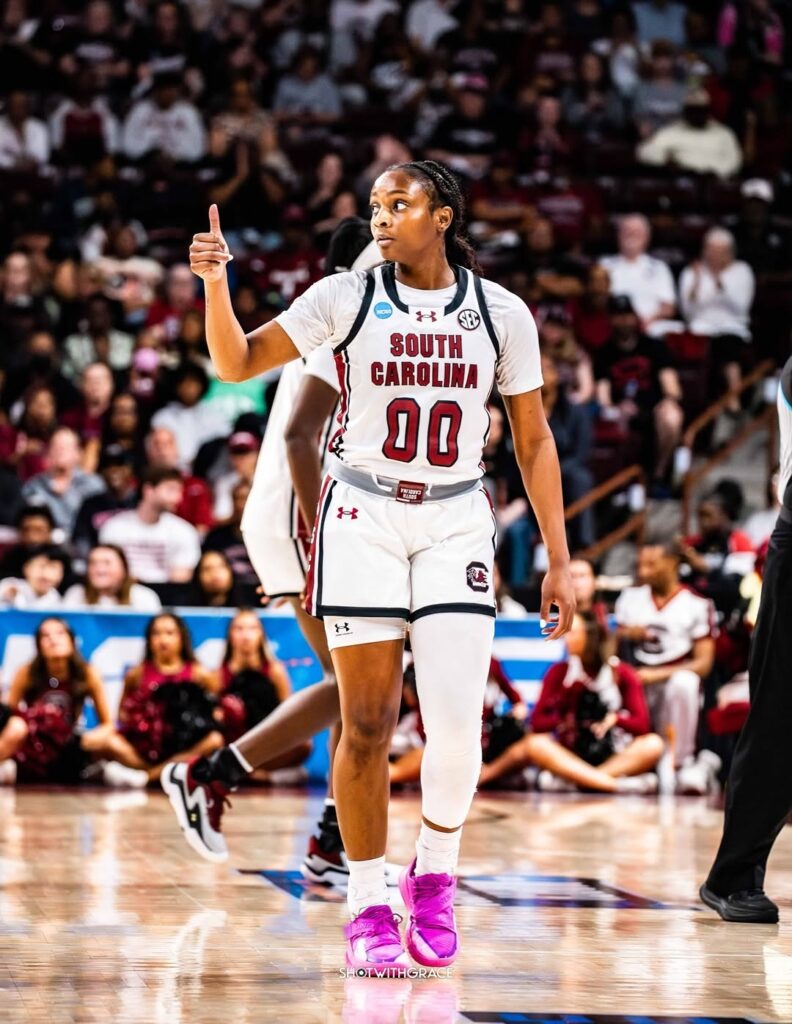
That is not a lesser player. That is a more complete one. The scoring average is lower because the need for it is lower, not because the ability has diminished. Surrounded by Raven Johnson, Tessa Johnson, and a roster of legitimate threats on every possession, Latson no longer has to manufacture 25 points out of thin air every night. She has to make the right play — and increasingly, she is.
When It Got Hard
The transition was not seamless, and Latson has never pretended otherwise. The early months were a genuine battle — a daily exercise in extending herself grace while dismantling habits that had been built over three years of being the unquestioned first option.
She averaged 17.4 points across her first 13 games, shooting 51% from the floor — a promising start that suggested the adjustment was coming faster than expected. Then a sprained ankle against Providence on December 28 disrupted everything. She returned January 11, only to hurt her knee on January 29, missing two more games and losing the rhythm she had worked so hard to establish in an unfamiliar system.
Injuries, inconsistency, and the unforgiving lens of social media created a difficult environment. Every off night became ammunition for the critics who had questioned the transfer from the start — voices insisting she had made the wrong choice, that she had wasted her final college season, that South Carolina had diminished her.
Her response was direct and without defensiveness.
“Nobody ruined me,” Latson said. “I made a decision and I would 100% do it again. Injuries, probably pressure has gotten to me a little bit, not the coaching. I feel like Dawn has always given me the freedom to be myself.”
That distinction — pressure versus coaching — matters enormously. The hardest parts of this year were not imposed on Latson by the system or the staff. They were the natural friction of growth, of a player demanding more of herself in areas where she had previously been comfortable being average.
What Staley Gave Her
Beyond the tactical development, something quieter and equally important was happening between Latson and her head coach. Staley, who has navigated the psychology of elite players for decades, understood what Latson needed — not just on the floor, but in her head.
Before South Carolina’s first tournament game, Latson’s phone lit up with a text from Staley. It wasn’t a scouting report or a set of instructions. It was simpler than that.
“She texted me before the tournament, just told me she believed in me and that just went a long way for me,” Latson said. “Having my coach text me that, means a lot.”
“She can turn on a light bulb in just a few words.”
That image — a light bulb, switched on in a moment of uncertainty — captures something essential about what effective coaching looks like at this level. Staley didn’t need to rebuild Latson’s confidence with a lengthy conversation. She knew exactly what to say and exactly when to say it.
March Madness, Finally
On March 28, Ta’Niya Latson will play in her first career Sweet 16 — not as the nation’s leading scorer, not as the undisputed star, but as a crucial piece of the best team in women’s college basketball.
In her first two tournament games as a Gamecock, she scored 29 points on shooting splits of 54% and 50% — the best she has ever shot in NCAA Tournament games. She added seven rebounds, 11 assists, and eight steals across the two contests. The full box score of a complete player, not a scorer.
This is what she left Florida State for. This is what the critics couldn’t see past the statistics to understand. Latson gave up the leading scorer title, the volume, and the individual recognition to gain something the numbers don’t capture cleanly — the experience of winning at the highest level, the credentials of a complete player, and a legitimate path to the professional career she has been building toward all along.
She knew her why when no one else did. Three months into March, the why is becoming impossible to argue with.
About The Author