Not Revenge. Not Emotion. Just Basketball — How South Carolina Is Approaching the Oklahoma Rematch
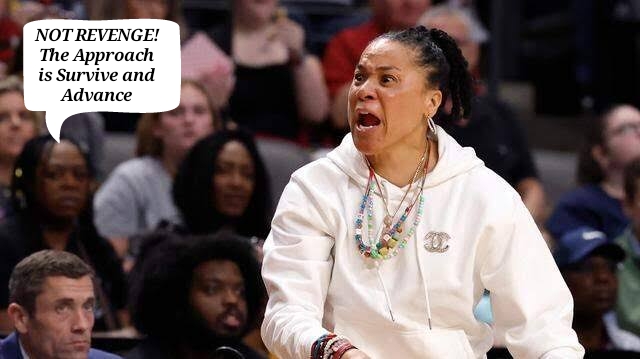
Dawn Staley has won three national championships by controlling what her team thinks about. Against Oklahoma, that discipline may matter as much as any X or O.
The Right Kind of Energy
When the bracket revealed a potential Sweet 16 collision with Oklahoma — the team that handed South Carolina its only conference loss of the season — the narrative wrote itself. Revenge game. Redemption arc. Circle the date.
Staley spent the next several weeks erasing that narrative from her program’s consciousness.
“We’re not motivated by we’re avenging a loss,” Staley said. “We’re motivated by advancing. It’s not like, oh, they beat us last time, let us do this or that. It’s survive and advance.”
That message wasn’t reserved for media availabilities. It was delivered in practice, reinforced in film sessions, and internalized by a roster that had every emotional reason to approach Saturday differently. Veteran point guard Raven Johnson confirmed the internal consistency of Staley’s framing.
“Honestly, she told us in practice what she said here. I think, you know, it’s not really about getting a lick back,” Johnson said. “We’ve just gotta come here and do what we do, play to a standard that we know we can play and bring our practice habits to the game. So I think it’s all about advancing and beating the team that’s in front of you.”
Freshman Agot Makeer articulated why that framing matters tactically — offering a window into the coaching staff’s deeper reasoning.
“Coach talked about the amount of energy (revenge) takes. It’s the wrong kind of energy going into that game,” Makeer said. “Obviously, we are going to be motivated because we lost to them before, and we shouldn’t have. Going forward, we’re going to be ready to go.”
The callback to the SEC Tournament is instructive. South Carolina played LSU at a fever pitch — emotionally charged, competitive, fully engaged — then came out flat against Texas in the following game. That sequence taught Staley’s program something specific about the cost of emotional expenditure. Revenge energy burns fast and burns hot. It is also exhaustible. Advancement energy is sustainable across 40 minutes and, if necessary, beyond.
What January Actually Revealed
The January loss in Norman was not simply a bad night. It was a diagnostic — an exposure of specific vulnerabilities that South Carolina has spent two months addressing.
The Gamecocks surrendered a season-high 94 points — in overtime, but still. Oklahoma shot 48% from the floor, the second-highest shooting percentage South Carolina allowed all season. The Sooners out-rebounded the Gamecocks by 15, a margin that is almost structurally impossible against a Staley-coached team. Season-highs in rebounds, assists and field goals made and attempted allowed — in a single game.
The individual performances were equally revealing. Ta’Niya Latson shot 1-for-10 for six points. Joyce Edwards managed 12 points on 3-for-12 shooting. Madina Okot contributed six points on 3-for-9. As a collective, South Carolina shot just 37%.
Latson identified the root cause with the kind of honesty that suggests genuine self-examination.
“They played with a lot of physicality, and I feel like we weren’t necessarily mentally prepared for that, and that also played a part in the way we shot the ball,” Latson said. “We’re looking forward to tomorrow and playing better and attacking them with just as much. We can’t be the first one that gets hit. We’ve got to hit first.”
Makeer’s assessment was equally direct: “What she remembers most about the first game was that the Gamecocks didn’t play like themselves.” That framing matters. This wasn’t Oklahoma executing a scheme that South Carolina fundamentally cannot handle. It was South Carolina failing to meet its own standard — which means the corrective is internal, not external.
Despite the shooting struggles, 82 points would ordinarily be sufficient to win. The deeper concern was defensive — and two players in particular embodied Oklahoma’s ability to hurt the Gamecocks in ways that 82 points couldn’t overcome.
Raegan Beers shot 8-for-9 for 18 points and 14 rebounds, including the putback on Oklahoma’s final possession that sent the game into overtime. Payton Verhulst added 19 points. And freshman Aaliyah Chavez — the player South Carolina will most need to contain on Saturday — finished with 26 points, scoring 15 in overtime alone, repeatedly finding open looks in transition that the Gamecocks failed to prevent.
“Really, all I remember is how my team made sure I got wide-open shots,” Chavez said. “That’s all it is. Obviously, they put the trust in me to make those shots. They passed it to me to make those shots.”
That humility is tactically revealing. Chavez isn’t describing individual creation. She is describing a system — Oklahoma’s pace, its ball movement, its ability to find open shooters off transition and secondary actions — that generated clean looks for a freshman who was composed enough to convert them at the highest-pressure moments of the game.
The Chavez Problem — and the Makeer Solution
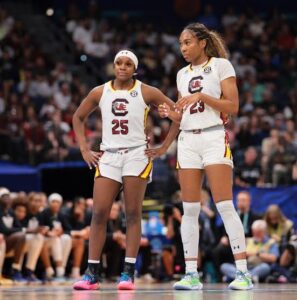
Containing Chavez on Saturday falls primarily to Raven Johnson, the SEC Defensive Player of the Year, with support from Latson and Makeer. But the most analytically compelling dimension of this defensive assignment belongs to Makeer specifically.
The two freshmen have history. In the Nike Hoop Summit last April, Makeer was deployed as the primary defensive stopper against Chavez for the World team. The unofficial accounting: Chavez scored three points against Makeer before recovering elsewhere. Makeer answered at the other end with a spot-up three.
That prior experience — competing against Chavez at the international level, in a high-pressure game environment, before either player stepped onto a college floor — gives Makeer a scouting file that no amount of film study can fully replicate. She knows how Chavez moves. She knows how she receives the ball. She knows what she prefers and where she is most dangerous.
Makeer comes into this game having just outperformed Jazzy Davidson — the Pac-12 Freshman of the Year — in the second-round victory over Southern Cal. Her response to that performance reflects a player who understands that individual matchup victories are built on preparation, not reputation.
“She’s going to get her shots up regardless,” Makeer said of Chavez. “Make sure you contest. Making sure she’s taking the toughest possible shot is a big emphasis. She’s a good player, and she’s going to get the ball.”
That is a textbook defensive assignment — not denial, but difficulty. Force bad shots. Contest everything. Accept that a player of Chavez’s caliber will score, but dictate the circumstances under which she does.
The X-Factor Nobody Can Predict
If Saturday follows the pattern South Carolina has established against Oklahoma, the decisive contribution may come from the most unexpected source on the roster.
In the 2025 SEC Tournament, Maryam Dauda came off the bench and outplayed Beers. In the January regular-season game — playing just her third college game — Alicia Tournebize produced nine points and three rebounds in 14 minutes. South Carolina’s bench has a specific history of stepping up precisely when this opponent is involved.
Makeer, despite being labeled the team’s X-factor by her teammates, redirected that designation toward the collective.
“I feel like anybody can be the difference-maker,” Makeer said. “Whether it’s me, whether it’s Ali, Ayla (McDowell), Maryam, someone stepping up off the bench.”
That is the competitive reality of what Dawn Staley has constructed. On a roster built for March, the threat doesn’t concentrate in one place. It distributes — to the bench, to the freshman, to the player Oklahoma hasn’t specifically prepared for.
Survive and advance. The philosophy is simple. The execution, against a team that has already proven it can beat these Gamecocks, is anything but.
Saturday in Sacramento, South Carolina finds out if two months of the right kind of preparation beats one night of the wrong kind of result.
About The Author