Azzi Fudd Gets Emotional with Tearful Farewell: A Five-Year Journey at UConn Ends in Phoenix
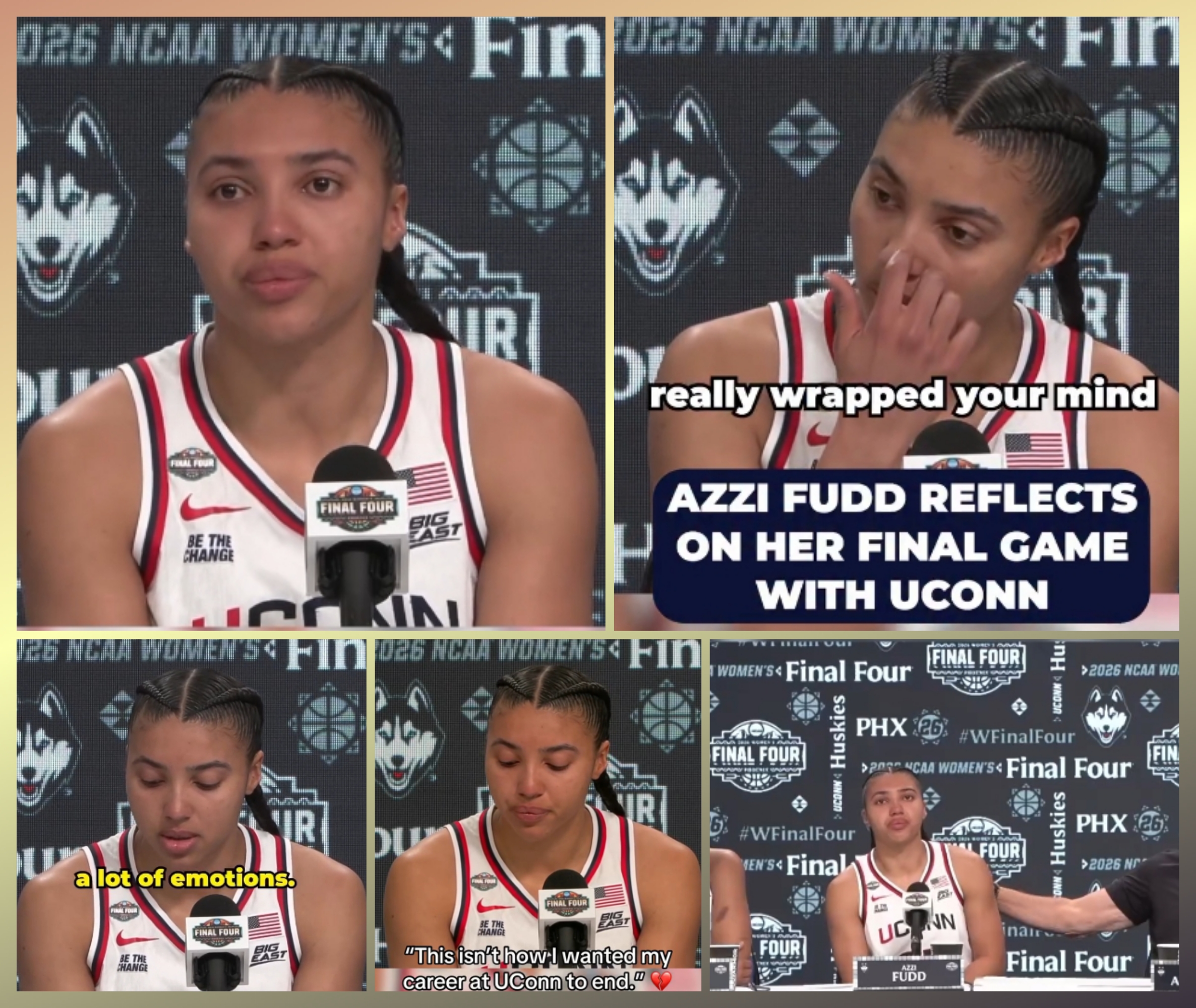
PHOENIX — The scoreboard read 62-48. The confetti would fall for South Carolina. And Azzi Fudd, one of the most decorated players in UConn women’s basketball history, stood before the cameras with tears in her eyes and tried to find words for something that may be beyond them.
She could not quite get there. But what she managed to say was enough.
The Words She Could Find
“This isn’t how I wanted my career at UConn to end,” Fudd said, her voice carrying the weight of everything the moment contained. “But this five years, I have so much to be grateful for. I couldn’t have asked for better teammates, better coaches, better experience.”
Then came the part that revealed the character at the center of her story.
“I feel guilty. I feel like I let the team down today.”
She paused before continuing. “But a lot of gratitude, a lot of love — a lot that I won’t be able to verbalize. I want to thank the coaching staff, my teammates, and everyone in this program that supported and touched me. I won’t be able to verbalize how much they meant to me.”
A Career That Defied the Odds
To fully appreciate the emotion of Fudd’s farewell, you have to understand the road she traveled to get to this moment. Her five years at UConn were not the linear ascent her recruiting profile promised. She arrived as one of the most celebrated prospects in the history of the sport, and then spent significant stretches of her college career on the sideline — knee injuries that required medical redshirts, long rehabilitations, and the particular psychological weight of watching teammates compete while you are unable to join them.
She knows what that feels like more intimately than almost anyone. So does Raven Johnson, the South Carolina point guard who beat her Friday night and who traveled a similarly painful road through injury. The parallel between them — two elite guards, both five-year players, both carrying medical redshirts, meeting in a Final Four — was one of the quiet human stories running beneath the surface of a game that generated enormous heat.
Fudd returned from each setback and produced. This season she averaged 17.5 points on 48.9% shooting with one of the quickest releases in the college game. She scored 28 points against South Carolina in the regular season last year. She scored 24 in last year’s national championship. Friday night, South Carolina’s defensive scheme disrupted her rhythm in ways that clearly frustrated her — and now her college career ends without the championship she returned for.
The Guilt That Says Everything
The most revealing moment of Fudd’s postgame interview was not the tears. It was the guilt.
A player who gave everything she had to a program — who came back from multiple serious injuries, who played through five years of physical and emotional difficulty, who poured herself into a team that finished 38-1 — sat in front of cameras after a loss and said she felt like she let her teammates down.
That is not a rational assessment. It is a deeply human one. And it speaks to the kind of competitor Fudd has always been — someone for whom the standard is not effort or individual production, but winning. Anything short of a championship registers as personal failure, even when it is not.
Geno Auriemma, who has watched her grow from a celebrated recruit into a five-year program cornerstone, addressed her future with characteristic directness in his own postgame session: he is not worried about her. She will be fine. The WNBA awaits a player of her caliber.
But Friday night in Phoenix was not about the WNBA. It was about the end of something that mattered enormously to her, and the difficulty of accepting that it ended before she was ready.
What She Leaves Behind
Fudd’s legacy at UConn is not diminished by Friday’s loss. She is one of the most talented players to wear a Husky uniform in the modern era — a shooting guard whose combination of technical skill, competitive fire, and personal resilience made her one of the defining players of her generation. She leaves with a national championship from last season, memories that will outlast any score, and the knowledge that the people in that program — coaches and teammates alike — will carry pieces of her with them long after she is gone.
“A lot that I won’t be able to verbalize,” she said, searching for the right words in the wrong moment.
Sometimes the most important things resist language. Azzi Fudd’s five years at UConn were exactly that kind of thing — too full, too complicated, too meaningful to compress into a postgame interview.
The tears said what the words could not.
About The Author