
UCLA Wins the 2026 National Championship: How the Bruins Dismantled South Carolina 79-51
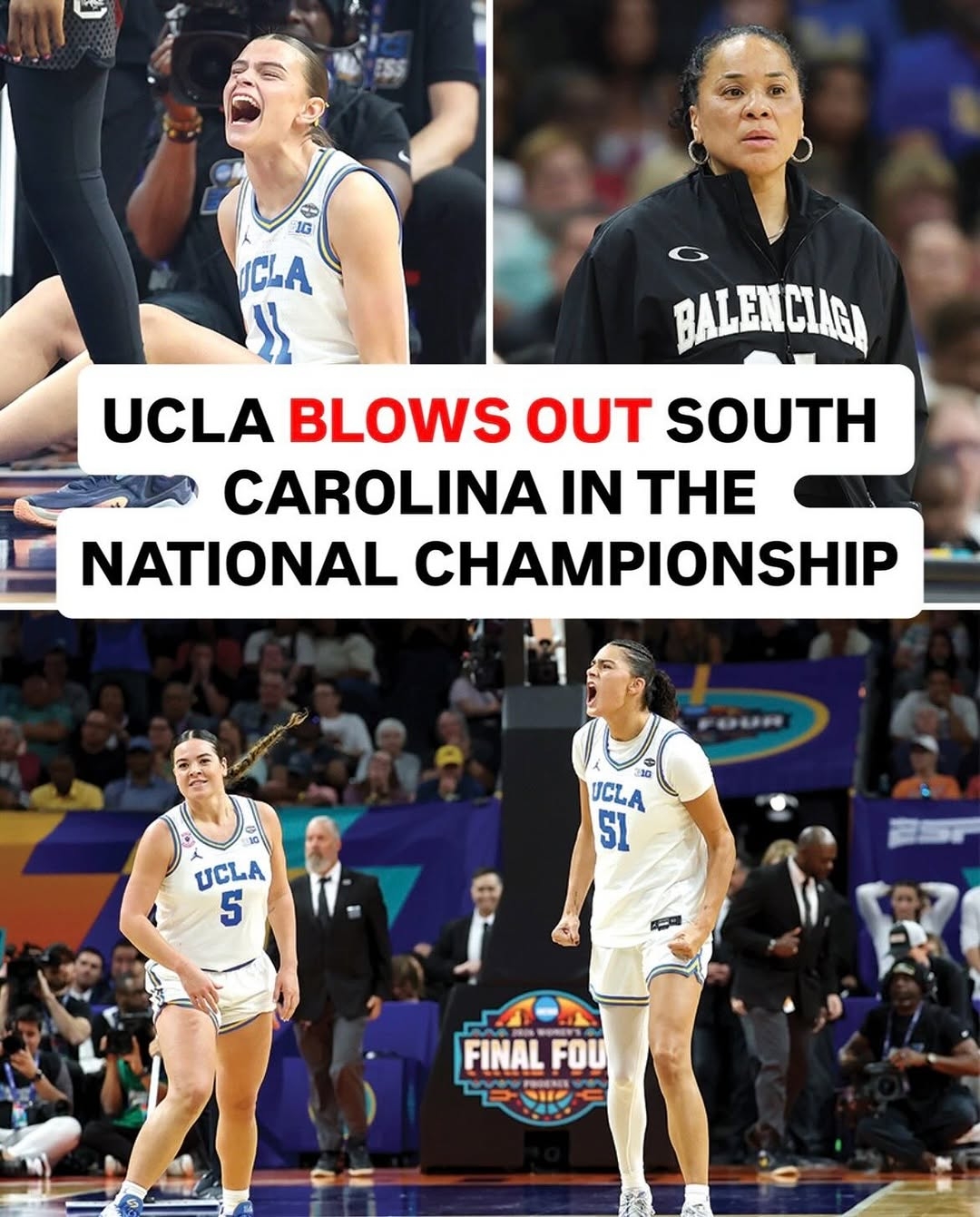
PHOENIX — It was not supposed to end like this.
South Carolina came to Phoenix having ended UConn’s perfect season, having avenged last year’s championship loss, having built a roster specifically designed to handle everything UCLA could throw at them. Dawn Staley was chasing her fourth national title. The signs, the history, the momentum — all of it pointed toward the Gamecocks.
Then the ball went up. And Lauren Betts and the Bruins delivered the most lopsided national championship game result in recent memory, beating South Carolina 79-51 to claim UCLA’s first national championship in the modern era.
The final score was not a fluke. The quarter-by-quarter breakdown tells the story of a team that was overwhelmed from the opening tip and never found a way back.
Quarter by Quarter: How the Game Slipped Away
First Quarter: UCLA 21, South Carolina 10
The damage was done before South Carolina could establish anything. UCLA opened the game with an 11-point advantage after the first ten minutes — a margin that reflected both the Bruins’ aggressive execution and the Gamecocks’ inability to match their intensity from the opening possession.
South Carolina scored only 10 points in the first quarter. For a team averaging 87 points per game this season, that number is catastrophic. The defense that had been so disciplined and connected against UConn looked disconnected against UCLA’s ball movement. Lauren Betts commanded the interior immediately, and the shooters around her — Gabriela Jaquez, Gianna Kneepkens — found rhythm before South Carolina’s rotations could adjust.
The 11-point hole after one quarter was not insurmountable. But it set a tone that the Gamecocks spent the rest of the night trying — and failing — to reverse.
Second Quarter: UCLA 15, South Carolina 13
South Carolina’s best quarter of the night. The Gamecocks outscored UCLA 13-15 — nearly evening the quarter — and showed flashes of the competitive identity that had carried them through five tournament wins. The deficit narrowed slightly, and there was a brief sense that South Carolina might be finding its footing.
But “nearly evening a quarter” is a different thing from closing a double-digit gap. At halftime, UCLA led 36-23. South Carolina needed to be dramatically better in the second half. What happened instead was the opposite.
Third Quarter: UCLA 25, South Carolina 9
This is where the game ended. UCLA outscored South Carolina 25-9 in the third quarter — a run of basketball so dominant it effectively removed all doubt about the outcome with ten minutes still to play.
Nine points in a quarter. Against a team that had averaged 87 per game all season. The Gamecocks could not generate clean looks, could not convert when they did, and could not slow a UCLA offense that was operating at an entirely different level. Jaquez took over this stretch, and the Bruins’ ball movement through Betts — exactly the inside-out attack Staley had warned about — became unstoppable.
The deficit ballooned to 40 points at various stages of the period. South Carolina’s season — its redemption arc, its Final Four brilliance, its identity as a team built for exactly this kind of game — was being erased in real time.
Fourth Quarter: UCLA 18, South Carolina 19
The final quarter was essentially garbage time, with both teams’ reserves playing significant minutes. South Carolina actually outscored UCLA 19-18 in the fourth — a meaningless moral victory in a game that had already been decided. The final score of 79-51 reflected a 28-point loss that stood as one of the most decisive championship game outcomes in recent women’s basketball history.
The UCLA Performance That Won It
The Bruins’ box score tells the story of a complete team performance built around their best players delivering their best games.
Gabriela Jaquez — 21 points | 8-14 FG | 2-4 3PT | 3-3 FT | 10 rebounds
The most complete performance of the night. Jaquez was the difference-maker South Carolina could not account for — she went 8-for-14 from the field with 10 rebounds and scored 21 points in the biggest game of her career. Her ability to operate as both a scorer and a rebounder created problems that South Carolina’s defensive scheme was not equipped to solve.
Gianna Kneepkens — 15 points | 5-15 FG | 3-7 3PT | 2-2 FT | 1 rebound
The three-point threat that Staley had specifically identified as dangerous before the game. Kneepkens went 3-for-7 from deep — not a perfect night, but enough to demand defensive attention that opened lanes for everyone else. Her 15 points came in the context of a team that was generating clean looks at every level.
Lauren Betts — 14 points | 6-10 FG | 0-0 3PT | 2-2 FT | 12 rebounds
Betts did not need to have a statistically dominant offensive night because the game was won around her. She went 6-for-10 from the field, grabbed 12 rebounds, and controlled the interior in a way that validated everything Staley had said about her ability to read defenses and make the right decision. Madina Okot could not neutralize her, and the Bruins’ inside-out attack operated exactly as designed.
Kiki Rice — 10 points | 3-7 FG | 1-1 3PT | 3-4 FT | 5 rebounds
Rice did not need to carry the offensive load — UCLA had enough weapons operating simultaneously. Her 10 points and five rebounds were efficient contributions in a game the Bruins controlled throughout.
Charlisse Leger-Walker — 10 points | 4-12 FG | 2-5 3PT | 0-0 FT | 4 rebounds
The ball-handler who freed Rice to become a scorer all season long. Leger-Walker’s 4-for-12 shooting was the one soft spot in UCLA’s performance — but in a 28-point win, it did not matter.
What Went Wrong for South Carolina
The numbers from South Carolina’s side of the ledger are not available in full from the box score, but the quarter-by-quarter scoring tells the essential story: 10, 13, 9, 19. A team that had been one of the most efficient offenses in the country all season could not generate the basketball it needed on the sport’s biggest stage.
Several factors combined to produce the result:
The Betts problem was not solved. Madina Okot — the piece South Carolina did not have in previous years, the reason Staley believed this roster was specifically built for this matchup — could not contain Betts at the level required. Betts’s 6-for-10 shooting and 12 rebounds reflected a player who was not dominant but was consistently effective, and that was enough.
The UCLA perimeter was too hot. Jaquez’s 21-point, 10-rebound performance was the variable South Carolina had not fully accounted for. The defensive attention devoted to Betts and the perimeter shooters created a gap that Jaquez exploited relentlessly. Her combination of scoring and rebounding gave UCLA second-chance opportunities that extended possessions and extended leads.
The third quarter collapse was decisive. Nine points in a quarter is a number that cannot be recovered from against a team of UCLA’s caliber. Whatever adjustments Staley made at halftime — with the Gamecocks already trailing by 13 — were not enough to counter what the Bruins brought out in the second half.
The offensive identity that had carried South Carolina all tournament vanished. Against UConn, the Gamecocks had found their pace, pushed transition opportunities, and made quick decisions. Against UCLA, the half-court game that Cori Close’s defense imposed was one South Carolina could not consistently solve.
What This Means
UCLA wins its first national championship in the modern era of women’s basketball. Cori Close, who has been building this program since 2011-12, reaches the summit she has been climbing toward for fifteen years. The veteran roster — all five starters playing their final college game — delivered the performance of their careers when the moment demanded it.
For South Carolina, the season ends at 36-4. The Final Four run was historic. The UConn victory was one of the great performances in program history. The championship game loss — the second in consecutive years — is a result that will sting through the offseason and fuel the 2026-27 rebuild.
For Raven Johnson, Ta’Niya Latson, and Maryam Dauda, it is the final game of their South Carolina careers. They leave having won more games, appeared in more Final Fours, and meant more to this program than any box score can capture.
For Dawn Staley, it is her second consecutive championship game loss — a result that will only sharpen the hunger to return. She has done it before. She will build again.
But tonight belongs to Lauren Betts, Gabriela Jaquez, Cori Close, and the UCLA Bruins.
The Gamecocks gave everything they had. The Bruins had more.
About The Author