“Zia Cooke Opens Up About Her Four Favorite Gamecock Memories of What That Era Actually Was”
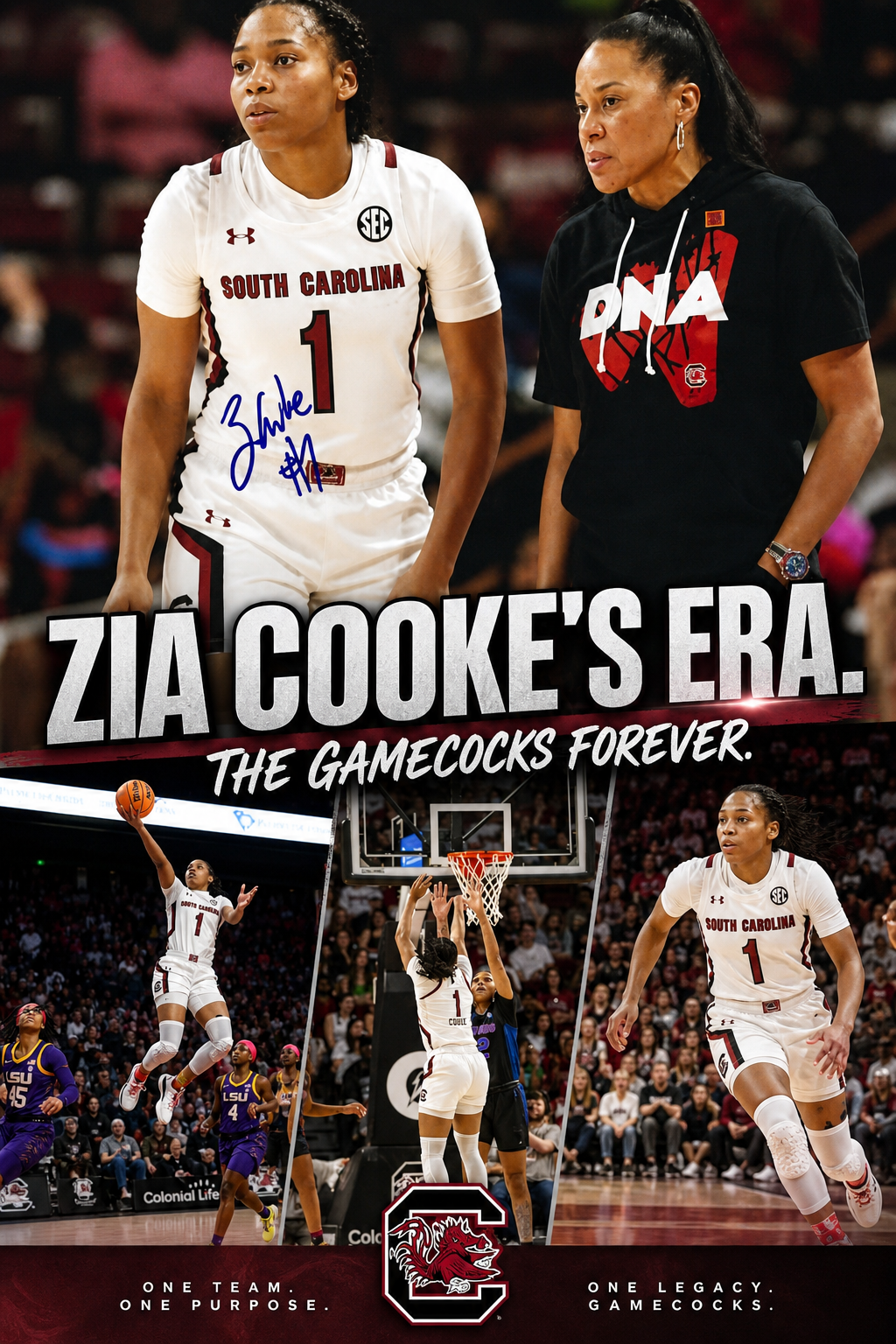
One hundred and twenty-nine wins. Four Final Fours. A national championship. A career-high scoring performance that stopped an entire arena. A steal that decided a game. A comeback that nobody outside of Columbia fully remembers but everybody inside it will never forget.
Zia Cooke has more South Carolina women’s basketball memories than a single interview can contain — and when Matt Dowell of South Carolina Sideline sat down with her for the Cookin’ Up a Storm podcast and asked her to identify a favorite game, she didn’t hesitate to clarify that one was never going to be enough.
“I’ll say our first time beating UConn was one of my — I got three favorites. Four.”
Four favorites. From a player who played in 129 wins. The fact that she immediately had to expand the number tells you everything about the density of meaningful moments packed into Zia Cooke’s time in garnet and black — and the four she chose tell you something even more specific about what she valued, what she remembers with her body as much as her mind, and what the South Carolina era she helped build actually meant.
The Four Games: A Window Into Who Zia Cooke Really Was
Beating UConn for the first time. The selection is analytically revealing in the most important way. Of everything Cooke accomplished — and the list is extraordinary — the memory she reaches for first is a team victory against the program that had historically defined the ceiling of women’s college basketball. Beating UConn wasn’t just a win. It was a statement of arrival, a declaration that South Carolina had crossed the threshold from great program to rival of the sport’s most dominant dynasty. That Cooke names it first, ahead of individual performances and even the national championship itself, reveals a player whose competitive identity was fundamentally team-oriented.
The Mississippi State steal. “When we played Mississippi State and I had got the steal in transition and we won that game.” This one is personal in the most visceral sense — a moment where her individual instincts changed a game’s outcome in real time, where basketball IQ and athletic execution merged into a single decisive act. Transition steals don’t happen by accident. They happen because a player studies tendencies, anticipates passing lanes, and commits her body to a risk that most players calculate away from. Cooke trusted herself in that moment, and it produced a memory she still carries.
Winning the national championship. The 2022 title belongs on any list she constructs — the culmination of everything the program chased from the moment she arrived. But analytically notable is where it sits: third, not first. Not because it meant less, but because Cooke’s memory catalog is so rich that the championship coexists with other moments rather than eclipsing them entirely. That is the profile of a player who was fully present for all of it, not just the final destination.
The 30-plus point game against Georgia. The career-high scoring performance earns its spot precisely because it represents something different from the other three — an individual expression of ability at its absolute peak. “I had scored like 30 plus points, that was like my career high.” For a player who spent much of her Gamecock career operating within a selfless, collective system, a night where her own scoring erupted to that level carries a specific and irreplaceable electricity.
And still, she acknowledged the list was incomplete: “Man, I could — I can go down a list of more, but I’ll just say that.”
The Origin: A Vision Declared Before Anyone Believed It
To fully understand what makes Cooke’s reflections so analytically significant, you have to return to the beginning — to a moment she described with the kind of vivid specificity that only genuinely formative memories produce.
“Man, I just remember — I’ll never forget we were in the CLA and we were doing like a group video session and I remember I said to our group like we wanted a national championship. And I think that’s something that we all wanted from the moment we stepped in the CLA — having the Gamecocks across our jersey.”
A video session. A group of freshmen. A declaration of championship intent before they had played a single college game together. That moment, described by Cooke with almost architectural clarity, is the origin story of the most successful era in South Carolina women’s basketball history — and its significance is impossible to overstate.
They were not reacting to success. They were demanding it before it existed. The 2019 recruiting class didn’t arrive in Columbia hoping to be good. They arrived in Columbia announcing, to each other, in a film room, that they would be champions. And then they spent four years making it true.
“I feel like that’s something that we all agreed on early and we didn’t stop till we got it, you know, especially making it to the final four every year. Like that’s major. The amount of games that we won versus the ones we lost was just legendary.”
129 wins. The numbers validate the memory. But the memory preceded the numbers — which is the most important detail of all.
The Championship: Making Mom Proud
Cooke’s reflection on the 2022 national championship carries an emotional dimension that transcends the competitive and reaches into something more intimate and more durable.
“We were so dedicated and disciplined to just what Coach Staley wanted from us. And we wanted to make her proud too. Like genuinely, that was like our mom. So like we wanted to make her proud and all the things that she’s taught us.”
The use of the word mom is not casual or performative. It is the distilled truth of what the South Carolina program under Dawn Staley actually is at its core — not a transactional athletic relationship built on scholarships and playing time, but a familial bond built on genuine investment in the whole person. Cooke and her teammates were not executing a basketball strategy when they won that championship. They were honoring a relationship that mattered to them on a level that had nothing to do with a trophy.
“When you work as hard as we work, like you just want to be able to make it to the end and then just have your hands up, ’cause you got a victory.”
There is no more honest summary of championship mentality than that sentence. All of the tactical sophistication, the recruiting excellence, the film study and conditioning and sacrifice — it reduces, in the moment of completion, to hands in the air and the knowledge that the work was worth it.
And yet even beyond the championship, the relationship she describes with her teammates is perhaps her most treasured legacy of all.
“We still talk to this day, which is crazy and that’s very unusual, but those are my girls for sure. And I’m happy for all of us and what we’ve been able to accomplish.”
Unusual. She used the word unusual because she understands, having now seen the world beyond Columbia, that what that group built and maintained is genuinely rare. Teams win championships and disperse. These women remained. That bond — outlasting the games, the stats, and the trophies — is the true measure of what the South Carolina era Zia Cooke helped build actually produced.
The Forgotten Masterpiece: The Stanford Comeback
Woven into the broader interview, Cooke also pointed to a moment that the national narrative has consistently undervalued — a comeback against Stanford, down 18 points, rescued in the second half with dominant play from Destanni Henderson. The game that should have been lost but wasn’t. The game that required a kind of collective refusal to accept defeat that only the most resilient teams possess.
It belongs in the conversation of her best memories precisely because it didn’t end with a championship or a career high. It ended with survival — with proof that this group of Gamecocks had something inside them that scoreboards alone could not extinguish.
What Zia Cooke Actually Left Behind
Reframe the entire interview through an analytical lens and what emerges is the portrait of a player who understood, with rare clarity, that the games were always about something larger than the games. The UConn victory was about arrival. The Mississippi State steal was about instinct and trust. The championship was about honoring people who invested in her. The Georgia career-high was about individual expression within a collective system.
And underneath all of it — the video session declaration, the Final Fours, the 129 wins, the bond that still holds years later — was a group of young women who decided together, before anyone gave them permission to believe it, that they were going to be champions.
They were right. And Zia Cooke remembers every moment of how they got there. 🐓
About The Author