The Birthplace of Women’s Basketball Is Honoring the Woman Who Defines It
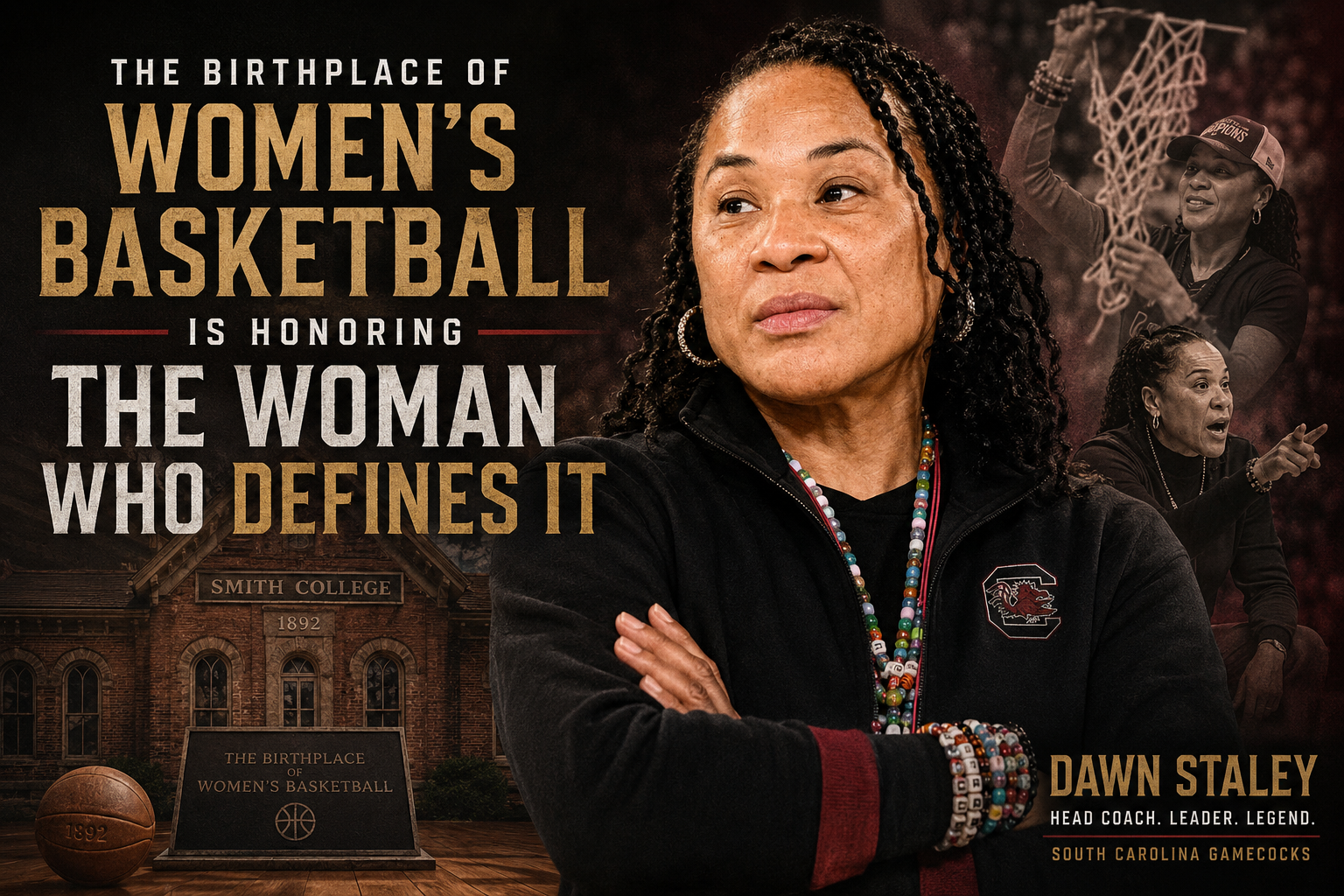
Dawn Staley’s honorary degree from Smith College isn’t just a ceremony — it’s a full-circle moment 133 years in the making
There are honors that are well-deserved. And then there are honors that feel almost cosmically inevitable — as if the universe spent decades lining up the pieces before finally delivering the moment the game always deserved.
Dawn Staley receiving an honorary degree from Smith College on May 17 belongs firmly in the second category.
Smith College, the historic women’s institution tucked into Northampton, Massachusetts, is not just another prestigious school handing out another prestigious credential. It is the birthplace of women’s basketball. On March 22, 1893, physical education director Senda Berenson Abbott adapted James Naismith’s newly invented men’s game for women and organized the first women’s college basketball game on Smith’s own campus — 133 years before the name Dawn Staley would echo through an auditorium on that same grounds to a roar of applause.
“We are unapologetically proud of being the birthplace of women’s basketball,” said Smith College athletic director Kristin Hughes.
And now the woman who has done more than anyone alive to advance that birthright will stand on that campus and receive its highest honor.
The Moment the Name Was Announced
Smith College’s Rally Day — one of the institution’s oldest and most cherished traditions — is the moment when the school reveals its honorary degree recipients ahead of commencement. This year, Hughes knew something significant was coming. The message she received was sparse but telling: “You might want to get your teams there.”
“We knew some good name was coming,” Hughes said.
What she couldn’t have fully anticipated was the reaction when it arrived. When the audience heard “Dawn Staley,” the auditorium didn’t politely applaud — it erupted.
“We all collectively freaked out because she’s such an icon, it was really cool to see her name on the screen,” said Maeve Huit, a defender on the Smith field hockey team. “Her message has carried all over the world… genuinely everybody is so excited to hear what she’s going to say.”
That reaction — from a field hockey player at a Division III school in Massachusetts — tells you everything about where Staley’s influence has traveled. This is no longer a basketball story. This is a cultural one.
A Career That Earned This Moment Long Ago
To understand why Smith College’s selection of Staley is so resonant, you have to appreciate the fullness of what she has built and what she has represented across four decades in the game.
Before she was South Carolina’s head coach, she was one of the greatest point guards of her generation at the University of Virginia. Before she was a three-time national champion, she was a three-time Olympic gold medalist who represented the United States on the sport’s biggest international stage. Before she became the highest-paid women’s college basketball coach in history, she was grinding through years of program building in Columbia, establishing a culture that would eventually produce a dynasty.
The numbers are stunning in their consistency: three national championships, 10 SEC regular-season titles — the most recent of which was clinched less than 24 hours before Smith announced this honor — and a pipeline of professional players that has reshaped the WNBA landscape. But Hughes made clear that the basketball achievements, remarkable as they are, represent only part of why Staley’s name belongs in the conversation at Smith.
“She’s an unbelievable competitor… she wins on the biggest of stages, shows up in the biggest of moments. I could stop the conversation right there and say, ‘That’s enough,'” Hughes said. “She now has the kind of reach that crosses genders. She has the respect, the admiration, the fandom from men and women. It’s not just about basketball anymore.”
That last line is the most important one. When a women’s basketball coach generates a fandom that transcends gender, transcends sport, and travels to a small women’s college in western Massachusetts where a field hockey player collectively loses her mind at the mere announcement of the name — you are no longer talking about a coach. You are talking about an icon.
What Smith Represents — and Why Staley’s Recognition Matters There Specifically
Smith College has always been more than an institution of higher learning. With just under 3,000 students, it punches well above its enrollment weight in terms of cultural and intellectual influence — and its connection to women’s basketball is both historical and ongoing.
In February, Smith became the first basketball program to win six straight NEWMAC Championships. The Pioneers went back-to-back in the Division III NCAA Tournament in 2024 and 2025, building a dynasty of their own at a different level of the sport. There is no detachment between the school’s historical claim on women’s basketball and its present-day commitment to the game.
“Anyone who has been in the game long enough and has the level of respect for the game that we really all should have, understands the gift it is to be giving back to the game that’s given you so much,” Hughes said. “I think Dawn does that all the time.”
That reciprocal relationship — between a player and coach who has taken everything the game offered and poured it back in — is precisely what makes this honor land differently than a typical commencement degree. Staley has spent her career “growing the game,” as she describes her mission, whether through her famous acts of generosity toward opponents during March Madness or her tireless advocacy off the court.
Staley’s response to the recognition was characteristically grounded: “It’s cool. It’s an all-female school that represents higher education. If any young people see it and feel like they’re impacted by that and want to go to a higher education institution, so be it. But I think it’s really cool.”
The Reach That Extends Beyond Basketball
Perhaps the most moving dimension of this story isn’t captured in any trophy case or coaching record. It lives in the lives of people Staley has touched in ways she may never know.
Sharon Deal is a middle school special education teacher in Northampton who has never set foot in South Carolina. She discovered Staley’s coaching philosophy from a distance and found in it a framework applicable to her own classroom — the belief in meeting each person where they are, identifying strengths, and building people rather than just performers.
“She meets each player where they are, draws on their strengths, and guides them to be better players and more importantly, better human beings,” Deal said.
But it is Staley’s advocacy for cancer research — a cause she has championed with consistent public commitment — that has reached Deal most profoundly. As a cancer survivor currently recovering from her second surgery for a necrotic femur, Deal described what Staley’s work in that space has meant to her: “As a cancer survivor currently recovering from my second surgery to repair a necrotic femur, Staley’s advocacy for research and young people struggling with the disease means the world to me. Her commitment to the cause is truly uplifting as I navigate my own ‘new normal’ and focus on my recovery.”
That is what an icon looks like when the lights go off and the cameras stop rolling. Not a coaching record. Not a trophy. A middle school teacher in Massachusetts, fighting through her own battle, drawing strength from the example of a woman she has never met.
On May 17, Dawn Staley will stand on the same campus where women’s basketball was born and accept an honor she has earned many times over — not just through wins and championships, but through decades of showing up, growing the game, and building a life worth honoring. Smith College couldn’t have chosen better. And women’s basketball couldn’t ask for a more fitting full-circle moment.
About The Author