Lisa Leslie to Receive Statue at Crypto.com Arena, Becoming WNBA’s Second Franchise Icon So Honored
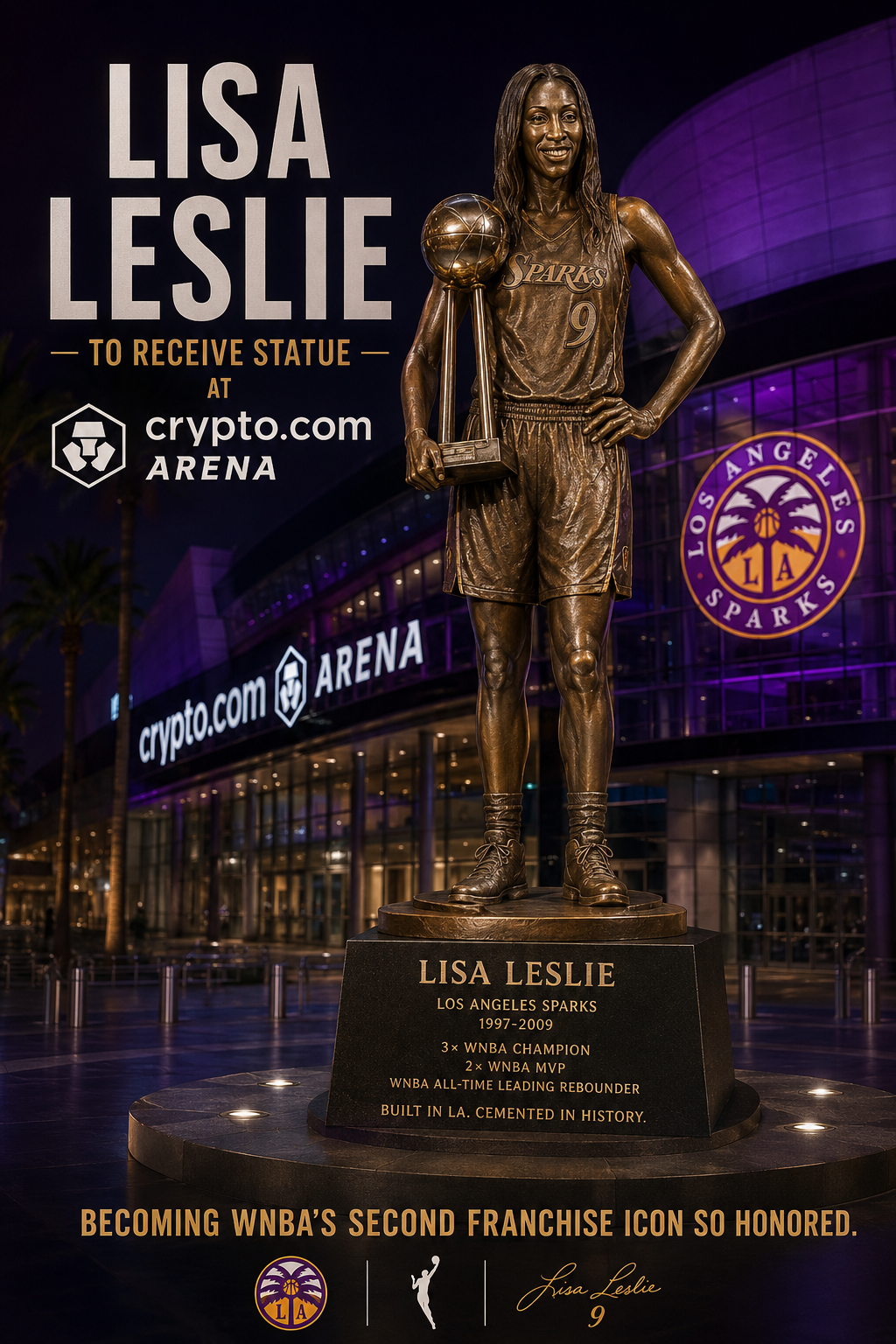
The Los Angeles Sparks will unveil a statue of Hall of Famer Lisa Leslie in the Star Plaza at Crypto.com Arena on Sunday, September 20, ahead of the team’s home game against the Portland Fire. The honor places Leslie in rare company — she becomes just the second player in WNBA history to be immortalized in statue form by her franchise — and stands as perhaps the most fitting tribute the organization could offer a player who gave it everything for 12 uninterrupted seasons.
Why This Moment Matters
Statues in the Star Plaza are not handed out lightly. The iconic courtyard outside Crypto.com Arena is home to fifteen sculptures of some of the most celebrated figures in Los Angeles sports history — Wayne Gretzky, Kobe Bryant, Magic Johnson, Jerry West, Kareem Abdul-Jabbar, Shaquille O’Neal and others among them. Leslie’s addition to that company is not merely a WNBA milestone; it is a statement that her legacy belongs in the same civic conversation as the giants of Los Angeles basketball.
That argument is difficult to dispute on the numbers alone. Leslie remains the Sparks’ all-time leader in points, rebounds, blocks, field goals, free throws, offensive and defensive rebounds, Defensive Win Shares, minutes, and games played. She ranks second on the franchise in assists, steals, and Win Shares. Leaguewide, she sits in the top 15 in multiple categories — third all-time in both blocks and double-doubles, sixth in rebounds and defensive rebounds, ninth in offensive rebounds, 13th in scoring, and 14th in field goals. Her eight First Team All-WNBA selections rank second in league history. Three WNBA MVP awards, four Olympic gold medals, and back-to-back championships in 2001 and 2002 round out a résumé that, by any honest measure, represents the high watermark of the franchise’s existence.
Leslie herself framed the honor with characteristic grace:
“To be cemented in Los Angeles, the city that raised me, I couldn’t be more proud to be a role model forever! God has blessed me and I have truly given my all to this sport and our community. I am thankful to my coaches, teammates, incredible fans, and, most importantly, my family and friends. As the saying goes, ‘The wolf is only as strong as the pack,’ and I’ve been fortunate to have an amazing pack supporting me every step of the way.”
The quote reveals something important about how Leslie understands her own story — not as an individual achievement but as a collective one. That perspective tracks with the kind of player and leader she was throughout her career.
Magic Johnson Puts Her Legacy in Perspective
Few people are better positioned to contextualize this honor than Earvin “Magic” Johnson, who has watched Leslie’s entire journey up close. His statement was notably expansive, going beyond statistics and championships to address what Leslie actually changed about the game:
“I’ve known Lisa for nearly three decades and believe that she is beyond deserving of this incredible honor. She was the driving force behind bringing back-to-back championships to the Los Angeles Sparks franchise in 2000 and 2001, and Lisa’s hard work and commitment has made her one of the best to ever play the game. Lisa’s legacy isn’t just measured by championships and accolades, though; it’s defined by the doors she opened and the standard she set for generations to come. More than an athlete, she is a pioneer, a cultural icon and a force who elevated women’s basketball to new heights. This statue celebrates her excellence, her leadership and the future she helped create, and it ensures her impact will forever be part of the fabric of this city.”
Johnson’s emphasis on the doors Leslie opened is the crux of the matter. The most cited example — and rightly so — is the first dunk in WNBA history, which Leslie converted in 2002. It was a watershed moment not because of the basket itself, but because of what it signaled: that the ceiling of women’s basketball was higher than most had imagined, and that it was Leslie who was raising it. More broadly, she played her entire career at the intersection of elite athleticism and mainstream cultural visibility, becoming one of the first women’s basketball players to build a recognizable public identity beyond the court through broadcasting, media, and fashion.
The Sculpture and the Ceremony
The statue was created by Julie Rotblatt Amrany and Omri Amrany, the same sculptors responsible for several of the existing Star Plaza figures. Their work brings institutional credibility to the commission — these are artists with a proven record of capturing athletic legacy in bronze.
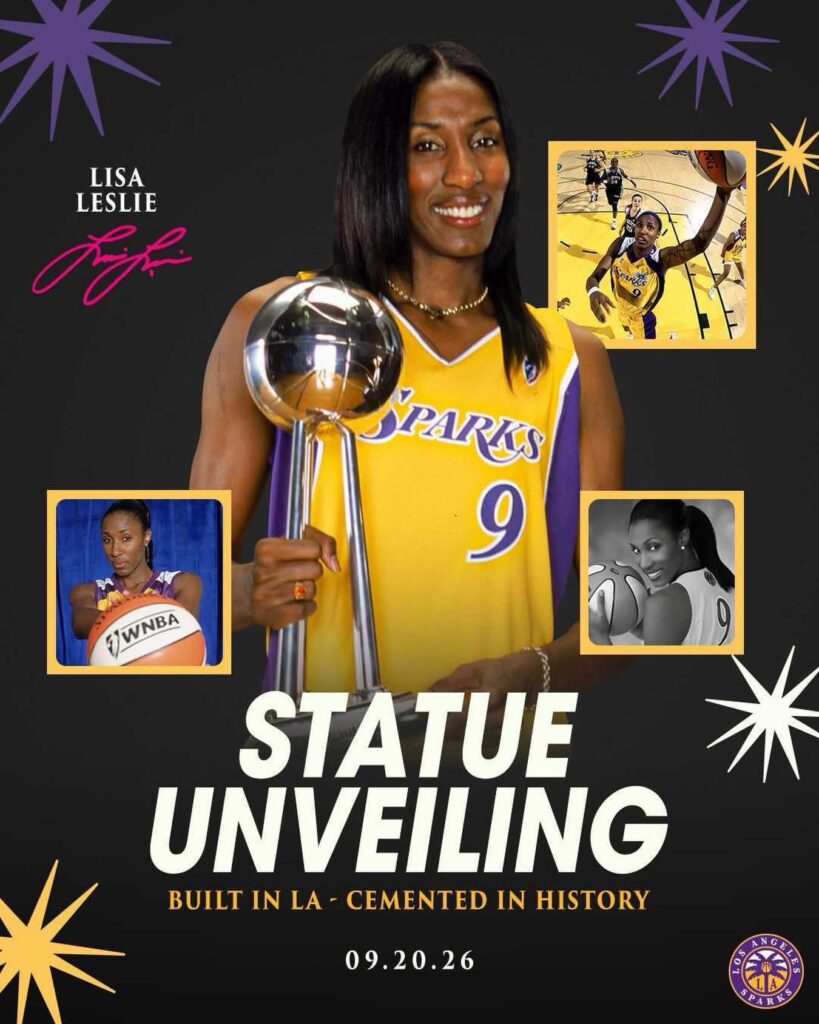
The unveiling ceremony on September 20 precedes the Sparks’ home game against the Portland Fire. Additional details regarding timing, programming, and fan participation are expected to be announced in the coming months.
The Broader Significance
Leslie’s statue arrives at a moment when the WNBA’s cultural profile is arguably higher than it has ever been. In that context, honoring the woman who helped lay the foundation for that growth is not just an act of nostalgia — it is an acknowledgment of cause and effect. Her No. 9 jersey was retired by the Sparks back in 2010, but a retired number lives inside an arena. A statue in the Star Plaza lives in the city itself, visible and permanent, accessible to anyone who walks past. For a player whose influence extended far beyond the hardwood, that distinction matters.
Leslie spent 12 seasons building something in Los Angeles. On September 20, the city will build something back.
About The Author