“Oliviyah Edwards High school Coach Melanie Jones Breaks Silence On Why South Carolina is The Perfect Fit For Edwards”
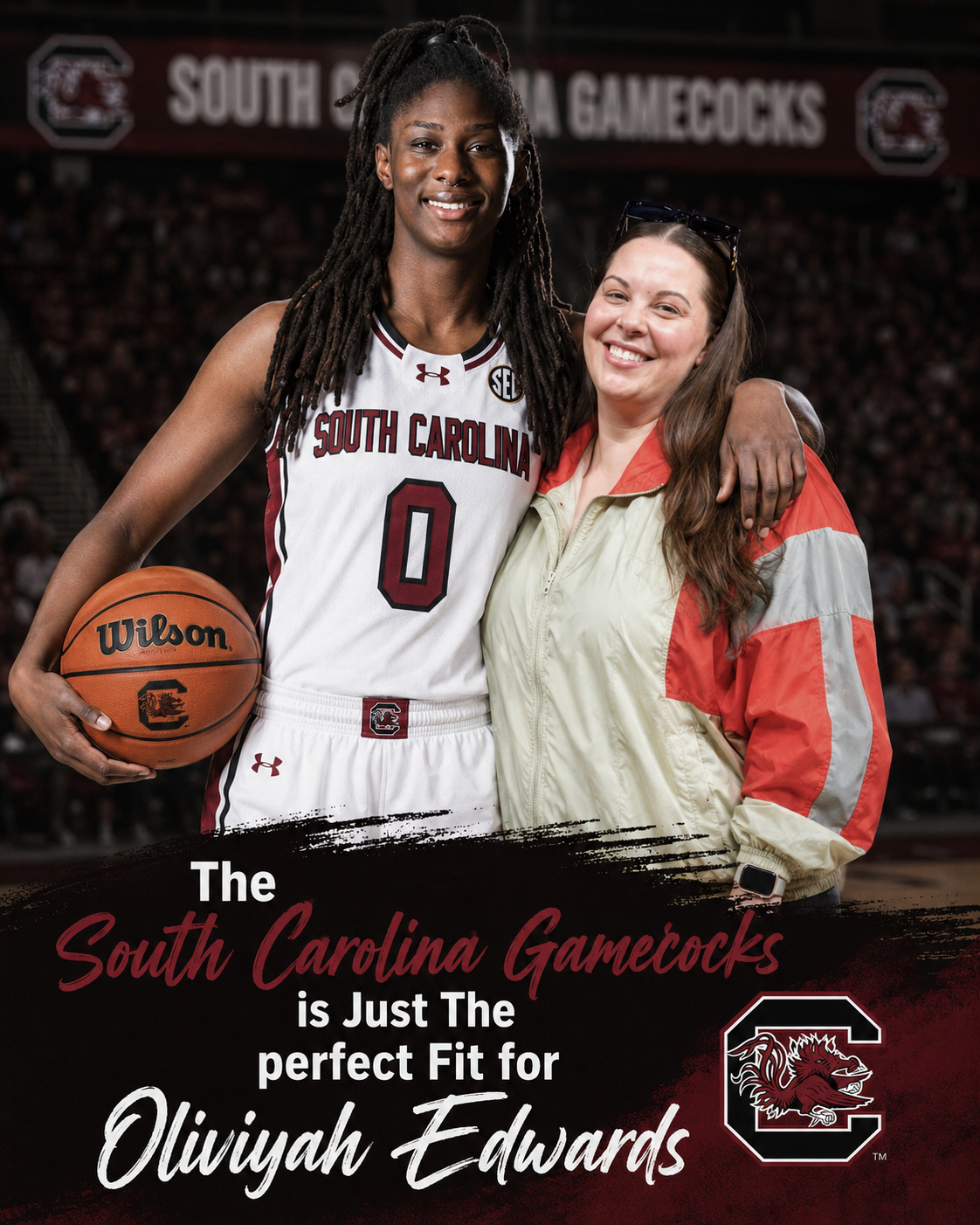
There is a particular kind of talent that announces itself quietly before the world catches up to what it is witnessing. Oliviyah Edwards was a shy, reserved fifth grader when she first walked into Melanie Jones’ life at Lincoln High School in Tacoma, Washington. She didn’t speak much. She didn’t demand attention. She didn’t need to. The ability was already there, waiting for the moment the body and the game caught up to what was clearly an extraordinary foundation.
That moment has arrived — emphatically, historically, and with a McDonald’s All-American selection to formalize what anyone watching already knew.
“I always knew she was gonna be successful,” Jones, who coached Edwards throughout her high school career at Lincoln, told The State.
Edwards enters South Carolina as the crown jewel of Dawn Staley’s 2026 recruiting class — a five-star forward ranked No. 3 nationally in her class by ESPN, arriving with a senior season that defies reasonable description and a journey to Columbia that took one of the more dramatic turns in recent women’s basketball recruiting memory.
The Senior Season That Settled Every Debate
Before examining how Edwards ended up in Columbia, the production demands acknowledgment on its own terms. In her senior season at Lincoln High School, Edwards averaged 30 points, 22 rebounds, and five blocks per game. Those are not typos. Thirty points. Twenty-two rebounds. Five blocks. Per game. Over the course of a full season.
The recognition that followed was entirely proportional. McDonald’s All-American. Naismith All-American. Naismith Trophy semifinalist. Each honor representing a different constituency of evaluators — coaches, media, basketball executives — arriving at the same unanimous conclusion: Edwards is generational.
What makes those numbers more meaningful, rather than less, is the physical and developmental profile Jones described when contextualizing how Edwards arrived at this point. Raw athleticism alone does not produce 22 rebounds a game at any level. What produces that kind of rebounding consistency is positioning, anticipation, and the physical capacity to execute when the ball leaves the rim. All three require work that happens away from games, away from highlights, and away from rankings.
“I would say one of those intangibles is her length,” Jones said, “when she goes full speed down court, how fast she can get down court and make blocks. She’s gotten a lot better with her agility, so being able to have balance and control in her body, her core strength. Those are big intangibles. You have other players that you know have great speed but are not strong. Oliviyah has really built up her strength and her agility.”
That combination — elite length operating through a body that has developed genuine functional strength and agility — is what separates prospects who produce highlight moments from prospects who change programs. Staley, who has recruited and developed elite forwards throughout her coaching tenure, recognized it immediately. She praised Edwards’ “deep toolbox” and “elite intangibles” when discussing what the incoming freshman brings to South Carolina. The fact that Edwards has been dunking since seventh grade is almost a footnote at this point — a data point that contextualizes just how early her physical development began tracking toward something extraordinary.
The Tennessee Chapter And What It Reveals About Her Character
Edwards’ path to South Carolina is not a straightforward story, and the detour through Tennessee reveals something important about who she is as a person beyond what she is as a player.
She committed to Tennessee in November and signed with the Lady Vols — a genuine commitment made in good faith to a program she genuinely loved. What followed was not a player looking for an exit. It was a player watching the program she had committed to undergo significant upheaval, centered largely on the departure of Tennessee assistant Gabe Lazo, with whom Edwards had built a particularly close relationship during the recruiting process.
Jones was careful and precise in explaining the sequence of events, and her account paints a portrait of a young woman who takes her word seriously.
“She truly loved Tennessee,” Jones said. “Was trying to hold out and see what happened with some players. But she had formed a very, very strong relationship with Coach Gabe and I think that that was pivotal. I know that she loved Tennessee, and she is about keeping commitments and her word. It wasn’t like the first day when people started leaving or reports started coming out that she was like, ‘I’m out of here.’ Definitely wasn’t that.”
That detail matters beyond its narrative interest. In an era of college athletics defined by the transfer portal and rapid, sometimes transactional commitment decisions, a prospect who holds her commitment under pressure until the specific circumstances that justified it are fundamentally altered is demonstrating a character trait that coaching staffs value as much as any on-court skill. Edwards didn’t bolt at the first sign of turbulence. She waited, evaluated, and acted when the situation genuinely changed.
Once she was granted a release from her letter of intent, she moved quickly and deliberately. A flurry of official visits followed — South Carolina among them in mid-April, overlapping with Texas transfer Jordan Lee’s visit to campus. Less than a week after her South Carolina visit, Edwards committed to the Gamecocks. She signed on April 27.
The speed of that decision, following the deliberateness of her departure from Tennessee, suggests a player who knew what she was looking for and recognized it the moment she found it.
Why South Carolina Makes Sense — And Why Jones Believes It’s The Perfect Fit
The analytical case for Edwards at South Carolina runs in multiple directions simultaneously, and Jones articulated several of the most important dimensions with the clarity of someone who has watched Edwards develop for years.
The system alignment is immediately apparent. Staley’s program runs in transition, presses defensively, and rewards athletic forwards who can cover ground quickly, protect the rim, and execute at both ends without requiring the offense to be designed around them. Edwards’ combination of speed, length, and defensive instincts checks every box that Staley’s system demands.
“I know Dawn will push the ball,” Jones said. “Oliviyah likes to get up and down the court. I know that Dawn is defensive-minded with their team. They play strong defense. They want to trap here and there. Oliviyah plays well doing those things.”
Perhaps equally important is the positional flexibility Edwards brings to a frontcourt that is already loaded with post talent. Jones believes Edwards’ vertical ability and perimeter shooting give her a profile that doesn’t require her to compete directly with the program’s established interior presences — she can operate as a wing-forward, spacing the floor and attacking from the perimeter, while Joyce Edwards, Chloe Kitts, and others anchor the post.
“I think she’ll be in an area where she won’t have to be four or the five,” Jones said. “She’ll be able to be like a three, where she can shoot more and not play directly at the basket. She will if she has to, if they’re sets that are drawn up that she needs to do that. But I think it’s going to be a good system for her.”
That assessment is analytically significant. A 6-foot-3 forward who can legitimately play the three position — defending on the perimeter, shooting off the face-up, attacking off the dribble — while retaining the physical capacity to play four or five when the matchup demands it is, quite simply, a nightmare alignment problem for opposing defenses. Staley can deploy Edwards in multiple configurations without the offense losing coherence, which gives the Gamecocks a versatility that most rosters, even elite ones, do not possess.
Managing Expectations In A Loaded Room
Honesty demands acknowledging what history tells us about five-star freshmen arriving at South Carolina. They play within the system. They earn their minutes. They develop behind veterans who have already proven themselves at the highest level of college basketball. The frontcourt Edwards is entering — anchored by Joyce Edwards, Chloe Kitts, and others — is not a group that will simply step aside because a highly ranked freshman has arrived.
That reality, however, appears to be something Oliviyah Edwards is not only aware of but genuinely prepared to embrace — and Jones’ read on her mentality in this regard is one of the most reassuring parts of the entire profile.
“The thing about Oliviyah, she’s going in ready to absorb and soak up all the information and learn right away,” Jones said. “She’s going to learn a lot, but I don’t think she’ll have a problem with that at all. For her to be where she’s ranked and stuff is very unique, her kind of attitude and mindset toward everything.”
The phrase “for her to be where she’s ranked” is worth pausing on. Jones is pointing to something that experienced coaches and scouts understand well — the higher a prospect’s recruiting ranking, the more common it is to encounter an ego that has been inflated by years of being the best player everywhere they’ve played. The humility to arrive at a program like South Carolina, sit behind veterans, absorb information, and trust the process is genuinely rare among top-five national prospects.
If Edwards’ mindset is as Jones describes — and there is every reason to believe it is, given how Jones characterized her response to the Tennessee situation — then South Carolina is not simply getting a physically gifted five-star forward. It is getting a five-star forward with a fifth-year senior’s approach to the developmental process.
Jones summarized the overall picture with a completeness that is difficult to improve upon.
“I think South Carolina is a place where she’s going to grow as a young lady, as a person, first academically, and then all the intangibles of playing with Dawn Staley,” Jones said. “She’s going to grow, she’s going to learn. I think she’s going to form some relationships, some strong bonds with people there in South Carolina.”
From a shy fifth grader in Tacoma to the No. 3 player in the country arriving in Columbia — the journey of Oliviyah Edwards is only beginning. And if the people who know her best are right, the best of it is still ahead.
About The Author