
The 22-Year-Old From Kenya Just Gave A’ja Wilson Everything She Could Handle — And The WNBA Is Starting To Pay Attention
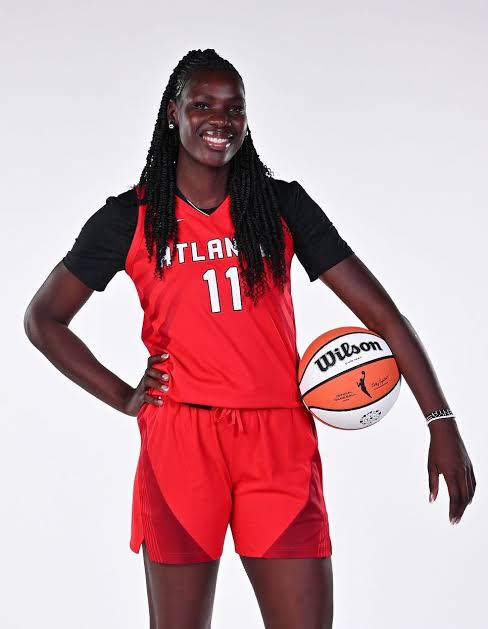
There is a particular kind of audition that separates professional athletes from prospects — the moment where the lights are brightest, the opponent is the best in the world, and everything you are as a player is exposed without the protective scaffolding of a college system around you. For Atlanta Dream rookie Madina Okot, that moment arrived in just her third career WNBA game, and she passed it in a way that has the league’s most informed observers revising their timelines for her development.
On May 17, in 16 minutes of court time against the Las Vegas Aces, the 6-foot-6 center out of South Carolina posted a career-high 14 points and 11 rebounds, adding a block and an assist while competing directly against A’ja Wilson — the WNBA’s only four-time MVP and the most dominant player the league has produced in a generation. The Aces won 85-84 on a Chelsea Gray jumper with 3.6 seconds remaining, but the final score was almost beside the point for what Okot demonstrated. Atlanta named her player of the game. The WNBA took notice. And the conversation around what the Dream have in their 13th overall pick shifted meaningfully in a single afternoon.
Putting The Performance In Context
Before unpacking what Okot did against the Aces, it is worth establishing the degree of difficulty involved. A’ja Wilson is not simply a good player having a good season. She is a historically dominant force who is currently rewriting the record books in real time, shooting nearly 60% from the field and averaging 25 points through the early weeks of the 2026 season. Rookies do not typically compete with her on even terms. They survive, they learn, and they come back next year better equipped for the experience.
Okot did not survive. She competed.
“We’re talking about the A’ja Wilson’s of the world, who will go down as one of the greatest players of all time, and she still had a double-double,” said Wilton Jackson II, who covers the Dream and the SEC for The IX. “As she continues to get more playing time, she’s going to be a force.”
The double-double — 14 points, 11 rebounds in 16 minutes — is remarkable in its own right. The efficiency and composure with which it was achieved amplifies that remarkability considerably. This was not a stat-padding performance against a weak opponent in garbage time. This was a rookie center, in her third professional game, producing at a high level against the gold standard of her position.
Meghan L. Hall, senior WNBA reporter for USA TODAY Sports, was unambiguous in her assessment of what transpired.
“She completely bodied A’ja Wilson with no problem,” Hall said. “She looked really calm, really poised in what was very much a high-pressure environment. It’s a good preview of what’s to come for her.”
Why Atlanta Needed Her Specifically
Understanding Okot’s fit with the Dream requires understanding the organizational problem she was brought in to solve. Atlanta has struggled for multiple seasons to establish a genuine interior presence — the kind of physical, skilled big who can anchor a post defense, clean the glass consistently, and give the team a credible scoring option inside without being a liability in space.
The Dream attempted to address this through Brittney Griner and Brionna Jones, but Hall noted the organization still lacked the depth and reliability the position demanded heading into this season. Then Karl Smesko, in his second year as head coach, got the prospect that fit his system almost perfectly.
“Atlanta has been in dire need of a big for a couple of seasons now, really just an interior presence in the post,” Hall said. “Madina fit Smesko’s system almost like a hand in glove.”
The reason for that fit is specific and worth examining. Smesko’s system prioritizes footwork, rebounding discipline, and — critically for a modern WNBA offense — perimeter shooting from his big players. The Dream led the league in rebounding in his first season, and he has been explicit about wanting bigs who can stretch the floor with a legitimate three-point threat alongside their interior production. Okot checked every box. She shot 44.8% from behind the arc during her college career, a number that is genuinely exceptional for a 6-6 center and one that makes her simultaneously dangerous at the rim and credible as a floor-spacer.
The addition of former LSU star Angel Reese via trade just before the draft added another dimension to Atlanta’s frontcourt. With Reese — the best rebounder in the WNBA — absorbing much of the interior pressure, Okot is not being asked to carry the frontcourt in her first professional year. That distribution of responsibility is a gift for a rookie still acclimating to the speed and physicality of the professional game.
Dream head coach Karl Smesko has made no effort to temper his enthusiasm for what he believes Okot can become.
“I think everybody can see what Madina is capable of becoming,” Smesko said. “I really do think that she’s going to end up being one of the best players in this league. She has that type of ability. She’s still learning but to see what she can do at this point is pretty impressive.”
The South Carolina Foundation — And Its Complications
Okot’s path to Atlanta is not without its nuances, and understanding her college trajectory provides important context for evaluating where she is now and what she still needs to develop.
She arrived from Kenya and spent two seasons at US colleges before landing at South Carolina, where she averaged 13.8 points and an SEC-best 10.6 rebounds in 2025-26. Those numbers — particularly the rebounding average, which led the entire conference — established her as one of the most productive big men in women’s college basketball. She attempted to secure an additional year of NCAA eligibility given her limited time in the American college system, and when that was denied, she pivoted to the WNBA with a fundamentally shorter runway of college development than most of her peers in the draft class.
That context matters because it explains both her ceiling and her current inconsistencies. Dawn Staley, recognizing the pressure Okot was carrying, removed her from the starting lineup midway through the South Carolina season to recalibrate her confidence and reduce the weight of expectation. The move worked in certain respects — her footwork and rim production improved — but the national championship loss against UCLA exposed real limitations. She shot 3-of-9 for six points with three rebounds in the program’s most important game of the year, a performance that left legitimate questions about what version of Okot would translate to the professional level.
The answer, at least through three games, appears to be the better version.
The Sustainability Question
One important variable shaping Okot’s current production is Brionna Jones’ absence. The 6-3 forward had knee surgery in April, and her return timeline remains unclear. With Jones unavailable, Okot’s minutes and role have been expanded beyond what her draft position might otherwise have projected in the early weeks of her rookie season.
The honest question is what happens when Jones returns to full health and reclaims her place in Atlanta’s rotation. How does Okot continue to carve out meaningful minutes from the bench in a more crowded frontcourt? The answer likely lies in the thing she already does better than almost anyone on the roster.
“There’s still a need for centers to be centers,” ESPN women’s basketball writer Michael Voepel said. “Rebounding is a big part of the Dream’s game, so you got Angel Reese, who’s the best rebounder in the WNBA, but I think Madina — that’s a big thing that she can bring.”
Voepel’s point is analytically sound. Even when Jones returns and the frontcourt becomes more crowded, a 6-6 center who rebounds at Okot’s rate, shoots 44% from three, and moves with the footwork Smesko prizes does not become redundant. She becomes a rotation piece with a clearly defined and valuable role. The ceiling for that role will be determined by how quickly she continues to develop, how her body holds up under professional physical demands, and how effectively she absorbs the adjustments opposing coaches will inevitably make as she becomes a known quantity.
Right now, she is still an unknown quantity — and that is working in her favor.
The Bottom Line
Three games into a professional career that almost didn’t happen on this timeline, Madina Okot has done more than survive her introduction to the WNBA. She has posted a double-double against A’ja Wilson, earned her team’s player of the game honor in a near-upset of the defending champions, and drawn the kind of unqualified praise from credentialed observers that rookies typically have to wait months to generate.
She is still learning. She is still developing. There will be difficult nights ahead — games where the reads don’t come quickly enough, the footwork breaks down, or an experienced opponent figures out how to neutralize her before she figures out how to counter. That is the nature of rookie development at any level, and the WNBA does not offer accommodations.
But the foundation is real, the fit is genuine, and the performance against the best player in the world — calm, poised, and utterly unbothered — suggests that Madina Okot is operating on a timeline that is ahead of where most expected her to be.
Dawn Staley built the base. Atlanta is already building something on top of it.
About The Author