No Days Off: How Joyce Edwards Is Using the Offseason to Sharpen Her Game on the World Stage
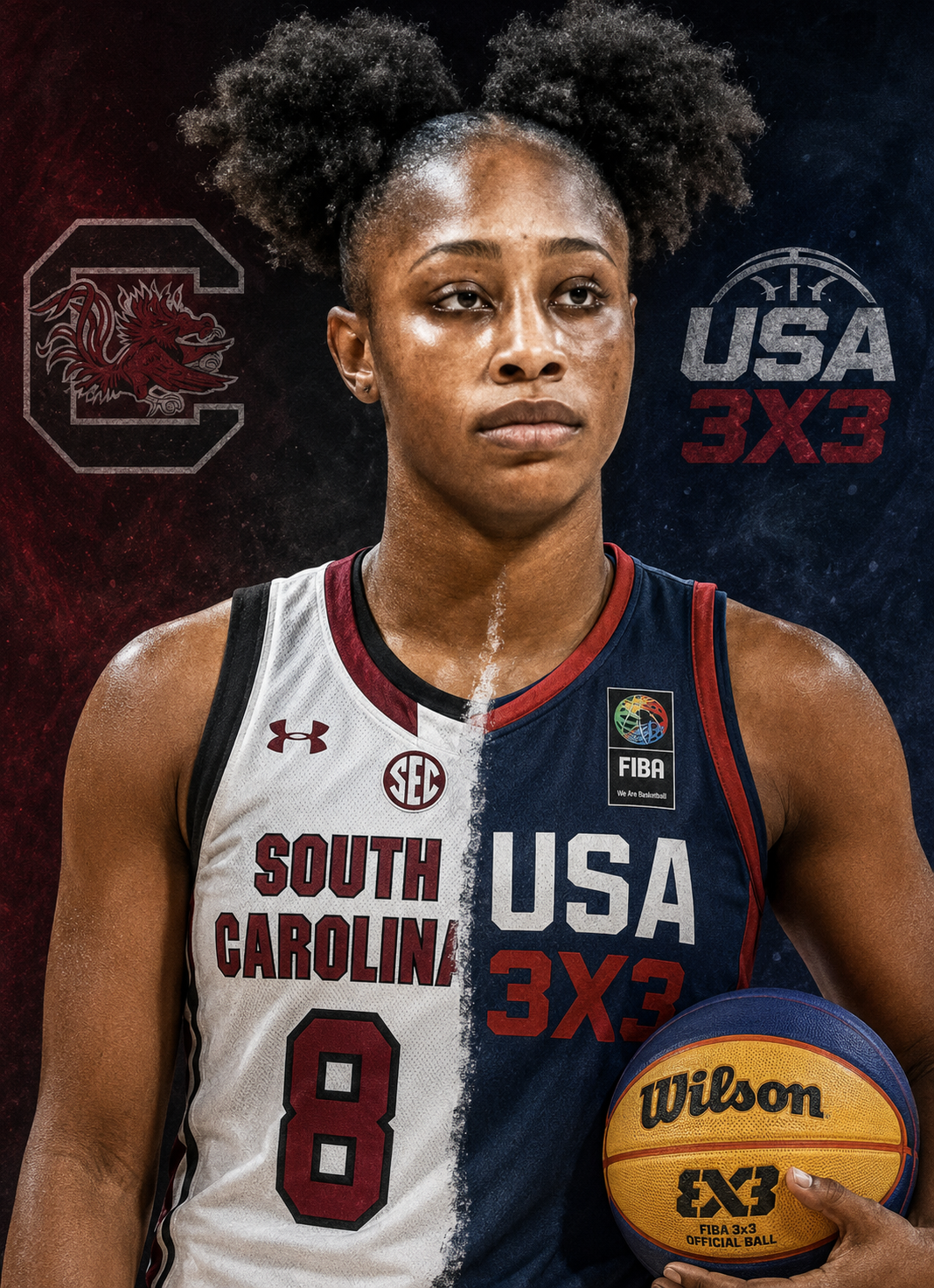
For most college basketball players, the weeks following a long season are reserved for rest, recovery, and stepping away from the gym. For South Carolina’s Joyce Edwards, the offseason looks considerably different — it looks like airport terminals, international competition, and a basketball in her hands on the other side of the world.
A Break That Isn’t Really a Break
Every year, after what Dawn Staley hopes is a deep postseason run, South Carolina’s players are given roughly two months off before returning in mid-to-late June for summer workouts. The intent is genuine rest — a concept Staley adopted partly from the philosophy of A’ja Wilson — and players are actively encouraged to step away from the game and recharge mentally.
But there is a catch. When those players walk back through the doors in June, sports performance coach Molly Binetti expects them to be in basketball shape. No exceptions, no excuses. The players know it. So while the break is real, the idea that any of them are truly ignoring basketball is largely a fiction. Most are working out privately or with personal trainers to stay sharp. Edwards, however, is operating at an entirely different level — spending her break competing in 3×3 basketball tournaments across Asia and Europe as a member of Team USA.
Why Staley Champions International Competition
To understand why Staley not only allows but actively supports this kind of summer involvement, you have to understand what international basketball means to her personally. Staley’s playing career was defined by the Olympic stage — she won three gold medals as a player and carried the American flag at the opening ceremonies in Athens in 2004. As a coach, she added two more Olympic golds, first as an assistant in Rio and then as head coach in Tokyo. International competition is not an inconvenience in Staley’s world — it is a privilege and a priority.
That conviction has shaped how she manages her roster throughout the calendar year, even during the season itself. She has previously allowed players like Laeticia Amihere and Kamilla Cardoso to leave the team temporarily to represent their respective national teams — a decision that requires real trust and flexibility. During the offseason, however, the calculus is straightforward.
“Anytime your players can play outside the season and play in a competitive event, it’s a good thing,” Staley said.
The results have backed her up. In October 2024, Sania Feagin left the program for a week to compete in the 3×3 U23 World Cup in Mongolia, returned with a gold medal, and both she and Staley credited that experience as a meaningful factor in her productive senior season. International competition, it turns out, does not detract from a player’s development — it accelerates it.
A Program Built on Global Reps
Edwards is not blazing a new trail within the Gamecock program — she is continuing a well-established tradition. Last offseason, Edwards, Chloe Kitts, Tessa Johnson, and Maddy McDaniel traveled to Arizona for the 3×3 Nationals in April. In June, Edwards and Ayla McDowell competed in the AmeriCup Tournament in Chile, representing the United States and Brazil, respectively. McDowell immediately followed that tournament with a trip to Czechia for the U19 World Cup, where she was joined by teammate Agot Makeer, who played for Canada. Edwards capped the summer by returning to Chile for the 3×3 Nations League in late July.
The depth and consistency of that international involvement is a reflection of the program’s identity. South Carolina is not simply developing players for the college game — it is producing athletes who are competitive at the highest levels of international basketball. That culture has a compounding effect on the entire roster.
What 3×3 Basketball Actually Demands
For those unfamiliar with the format, 3×3 basketball is played on a half court with a 12-second shot clock. The game ends when one team reaches 21 points or when the 10-minute clock expires, whichever comes first. On the surface, it sounds simpler than the five-on-five game. In practice, players almost universally describe it as more physically and mentally demanding.
The format is relentless. Play is continuous, the pace rarely lets up, and there is no opportunity to coast through possessions. There are also no on-court coaches, which means players must make real-time decisions without the safety net of a timeout or a drawn-up play. For young guards and forwards still developing their basketball IQ, that kind of pressure is an accelerant.
Coaches value 3×3 specifically for what it demands — conditioning, versatility, and the ability to function as a complete player rather than a specialist. It also, as Staley would be the first to note, does not transfer perfectly to the five-on-five game. She made that point with characteristic humor when reflecting on a 3×3 tournament her players competed in last fall.
“Chloe came back, during the tournament, saying, ‘Joyce and I need to be playing more pick and rolls,'” Staley said with a laugh. “Okay. What about the four other people that are going to be on the court when it’s not 3X3?”
The Bigger Picture
With 2026 being a World Cup year — which eliminates the typical slate of international five-on-five summer tournaments — 3×3 competitions have become the primary avenue for players like Edwards to stay sharp, competitive, and connected to the game during the break. And while the format has its quirks and its limitations, the core benefits are undeniable: Edwards returns to South Carolina in June having played high-stakes basketball against elite competition, with her conditioning maintained and her instincts sharpened.
In a program that sets the standard for year-round development, Joyce Edwards is not resting on last season’s accomplishments. She is somewhere over the Pacific, getting better.
About The Author