Beyond the Basketball: How South Carolina’s Newest Gamecocks Are Building Life Skills Through SPURS
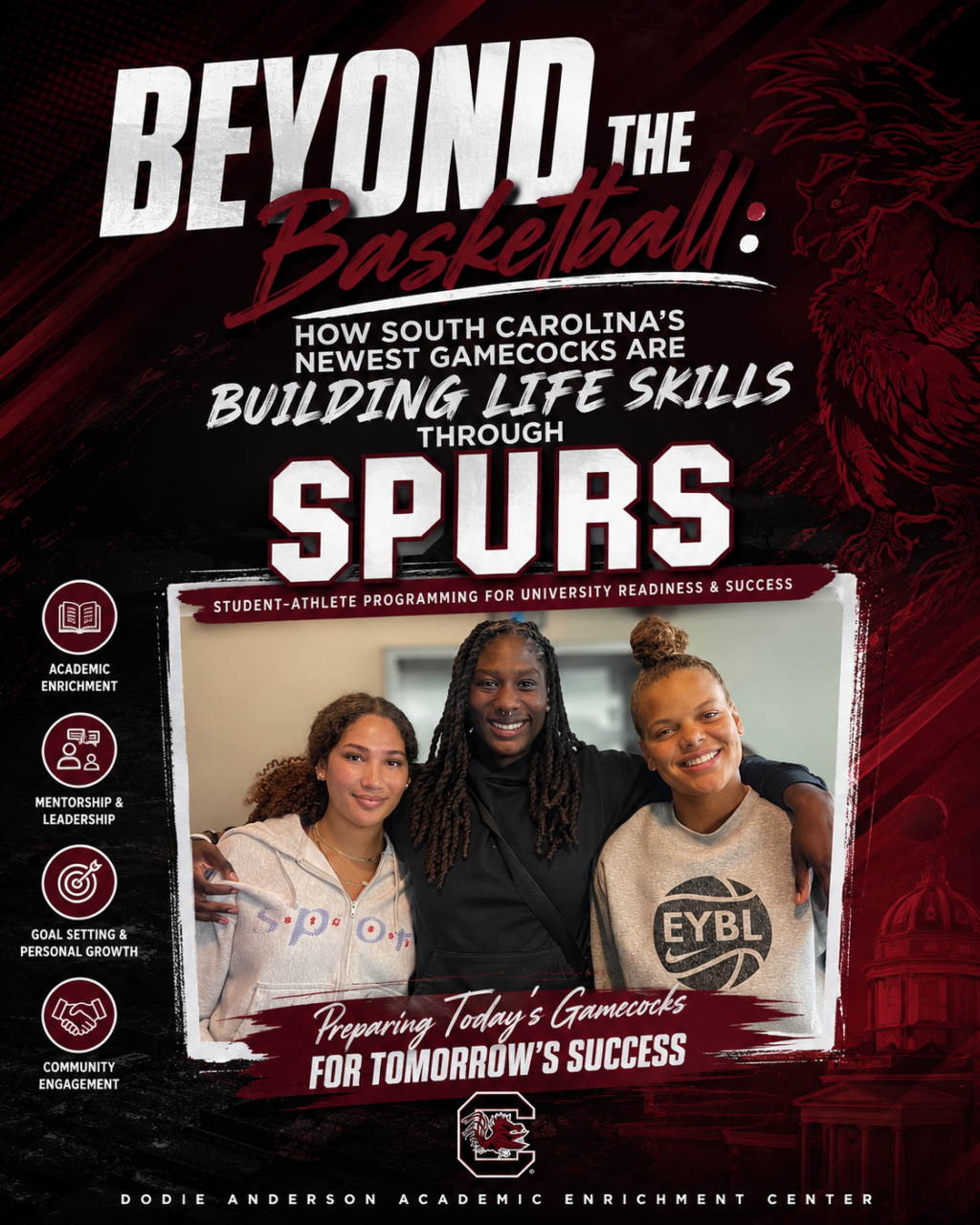
While South Carolina’s incoming freshmen prepare for their first season on the court, a different kind of development is already underway off it. This week’s SPURS Spotlight highlighted a program focused squarely on personal and professional growth — proof that South Carolina’s investment in its newest Gamecocks extends well beyond X’s and O’s.
What SPURS actually is
SPURS stands for Student-Athlete Programming for University Readiness & Success, run through the Dodie Anderson Academic Enrichment Center. The program exists specifically to prepare incoming student-athletes for the realities of university life — not just the athletic demands, but the academic, professional and administrative structures that come with being a Division I athlete. This week’s focus, as the program’s own materials put it, centered on “The Carolina Experience” and resume building, giving the newest members of the women’s basketball program tools they’ll be able to draw on throughout their time in Columbia.
What the players themselves are taking away
The most telling part of this week’s spotlight comes directly from the players, whose reflections cover a wide range of practical, real-world skills rather than anything basketball-specific.
Kaeli Wynn pointed to time management as her biggest takeaway: “During SPURS, I learned how to manage my time.” For any incoming freshman balancing coursework, practice schedules, film sessions and a new social environment simultaneously, that skill is arguably the single most important adjustment to make early — and having a structured program actively teach it, rather than leaving players to figure it out through trial and error, gives South Carolina’s newcomers a real head start.
Oliviyah Edwards, the five-star forward and No. 3 overall recruit in her class, highlighted something less obvious but just as practical: “I learned the importance of a compliance office.” That’s a notably mature takeaway for an incoming freshman — understanding NCAA compliance isn’t a glamorous topic, but it’s an increasingly critical piece of navigating college athletics in the NIL era, where rules around endorsements, transfers and eligibility carry real consequences if misunderstood.
Jerzy Robinson, another incoming freshman, focused on career-building fundamentals: “I learned the basics of a résumé.” That’s a skill most college freshmen don’t think about until much later in their academic careers, if at all — and having South Carolina’s athletic program proactively teach it early reflects an institutional understanding that not every player’s path leads directly to a professional basketball career, making early exposure to standard job-market tools a genuinely valuable investment.
Why this matters beyond this season
Taken together, these three reflections paint a picture of a program that’s thinking beyond wins and losses for its newest signees. Time management addresses the immediate transition into college life; compliance knowledge protects players from costly, avoidable mistakes as NIL and the transfer portal continue reshaping college athletics; and resume-building lays groundwork for life after basketball, whenever that eventually arrives. For a program that just landed one of the most talented incoming classes in the country — highlighted by Edwards, Wynn, Robinson and fellow signees — ensuring those players are equipped with practical life skills alongside their on-court development is a meaningful piece of how South Carolina continues building sustained success both during and after a player’s time in garnet and black.
About The Author